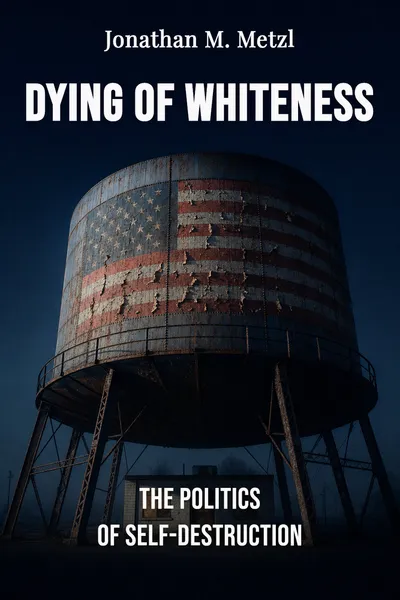
Dying of Whiteness
The politics of self-destruction
Description
Somewhere in Tennessee, a man named Trevor sits in a hospital bed, dying of a liver condition that a course of treatment might have slowed. He is out of work, out of money, and would qualify for the coverage that could have caught his illness earlier — except that his state declined to expand Medicaid. Talking to the physician and sociologist Jonathan Metzl, Trevor does not ask for the coverage. He says he would rather die than see his tax dollars go to Mexicans or welfare recipients. He would rather die. He means it, and within weeks he does.
Metzl spent years in the American heartland — Missouri, Tennessee, Kansas — collecting conversations like that one and setting them against something colder: state health data, mortality tables, suicide rates, dropout figures. What he found is that a cluster of policies sold as restoring greatness to white America did measurable damage to the white Americans who backed them hardest. Gun laws loosened, and white male suicides climbed. Coverage was refused, and lives shortened. Schools were gutted, and children left them. The numbers do not moralize; they simply record.
Dying of Whiteness is Metzl's attempt to explain why people vote, again and again, for arrangements that shorten their own lives — and to name the currency they think they are gaining in exchange. His argument is neither a sneer nor a lament. It is a diagnosis, built from bedside interviews and epidemiology, of a bargain that was never written down but that millions have signed anyway.
The question we’re asking : Why would people back policies that measurably shorten their own lives, and what do they believe they gain in return?What we’ll see : Three states, three policies, and a physician reading resentment the way he'd read a chart.
Table of contents
01 Chapter 1 — The bargain nobody wrote down
Metzl comes to this as a doctor first. He treats symptoms, orders labs, watches how a body under stress starts to fail. So when he turns to politics, he brings the same habit: he looks for what a decision does to the people who make it, not what it promises them. The promise, across the states he studied, was some version of the same sentence — life will be great again for people like you. The people like you were, overwhelmingly, working- and middle-class white Americans who felt the ground shifting and wanted it to stop.
The rise of the Tea Party and then the election of Donald Trump gave that feeling a political home. Metzl is careful not to reduce it to bigotry, though bigotry is part of it. What he keeps hearing, in kitchens and clinics and parking lots, is a story about status: the sense that the country used to place people like the speaker near the top, and no longer does. Guns, taxes, immigrants, welfare — these become the vocabulary for a deeper anxiety about slipping down a ladder that whiteness was supposed to keep you high on. The anxiety is real even when the reasoning built on it is not.

02 Chapter 2 — Missouri, where the guns turned inward
Missouri gave Metzl his starkest case, because the story people tell about guns and the story the data tells point in opposite directions. Over the 2000s and 2010s the state dismantled much of its firearm regulation — permit requirements, background-check provisions, restrictions on carrying. The argument was protection: a good guy with a gun, a home defended, a family safe from the threat that racial and economic anxiety had made vivid. The imagined danger almost always had a face that wasn't white.
The killing that followed was real, but it did not match the imagined script. The great majority of gun deaths in Missouri were not home invasions repelled. They were suicides, and they were disproportionately white men — the very demographic most invested in gun rights as an emblem of freedom and self-reliance. A firearm in the house, easily bought and easily reached, turned moments of despair into deaths that other means would not have completed. Metzl watched the suicide rate climb as the laws loosened, and traced the difference not to more sadness but to more lethal access to the means of ending it.
03 Chapter 3 — Tennessee and the coverage that never came
Tennessee is where Metzl met Trevor, and where the abstract becomes a hospital bed. When the Affordable Care Act offered federal money to expand Medicaid, Tennessee, like several Southern states, declined. The refusal was framed as principle — no handouts, no big government, no subsidizing people who hadn't worked for it. Behind that principle, in Metzl's interviews, sat a persistent worry about who else would be covered, and whether coverage meant sharing something with people who weren't supposed to share in it.
The people who lost most from the refusal were low-income white Southerners, the base that had cheered it. They fell into the coverage gap: too poor for subsidized private plans, shut out of the Medicaid that would have caught them. Cancers went undiagnosed, chronic conditions went unmanaged, treatable illnesses became terminal ones. Metzl estimates the cost in concrete terms — a measurable stretch of life expectancy surrendered, thousands of dollars per person in care never received, deaths that a yes would have prevented. The refusal did not save the state money so much as move the bill onto the bodies of the uninsured.
04 Chapter 4 — When resentment becomes a health condition
Step back from the three states and Metzl's real move comes into focus. He is asking us to treat racial resentment not as an attitude but as a variable — something that shows up in mortality tables the way smoking or income does. Kansas rounds this out: under sweeping tax cuts sold as prosperity, the state hollowed out its schools and services, and dropout rates rose, futures narrowed, the machinery that lifts children stalled. Missouri's guns, Tennessee's refused coverage, Kansas's gutted schools — three policies, one grammar. Each promised restoration to white voters. Each drew down their health, their safety, or their children's prospects.
The insight that ties them together is that a politics organized around whiteness has to spend something to sustain the feeling it sells. It cannot deliver actual gains fast enough, so it delivers the sensation of standing — of being above someone, of keeping a line intact. And the sensation, Metzl's data suggests, is paid for in years of life. The resentment is not free. It has a price expressed in suicides, in coverage gaps, in classrooms shut. The people paying it are frequently the ones who feel they are winning, which is why the bill is so rarely contested: you don't audit a victory.
05 Conclusion
Trevor died within weeks of talking to Metzl, still holding the position that his tax dollars should not reach people he'd been taught to resent. His body kept the appointment his politics had made for it. Multiply that across Missouri's suicide figures, Tennessee's coverage gap, and Kansas's emptied classrooms, and the pattern stops looking like a series of unrelated bad calls and starts looking like a single arrangement operating everywhere at once.
Related books