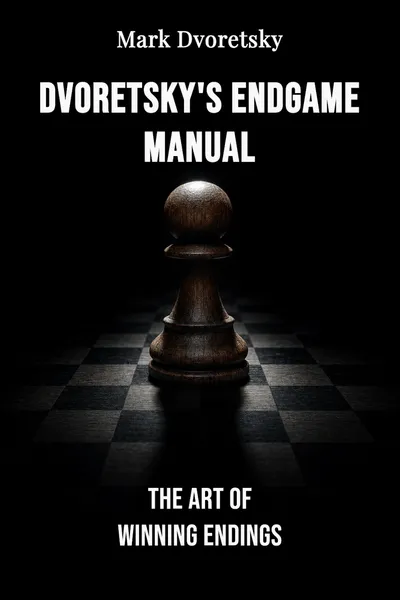
Dvoretsky's Endgame Manual
The art of winning endings
Description
Somewhere in the late stages of most amateur games, the board empties out and something strange happens: the players who fought hard for thirty moves suddenly stop thinking. A king and a couple of pawns remain, maybe a rook, and both sides shuffle pieces around hoping the position resolves itself. Mark Dvoretsky, one of the most respected chess trainers of the last half-century, spent his career arguing that this is exactly where games are won and lost — and where most players, including strong ones, never learned to look. His "Endgame Manual," first published in English in 2003, was built to fix that.
Dvoretsky was not a world champion. He was something rarer and, for the ambitious student, more useful: a coach who took promising players and turned several of them into grandmasters. His method was demanding to the point of severity. He believed the endgame was the phase of chess most governed by exact truth — a position is either won, drawn, or lost, and no amount of bluffing changes that. The manual is his attempt to hand a serious player the body of knowledge and the working technique needed to face that truth without flinching.
The book has a reputation. Players call it hard, sometimes brutal, and almost everyone who works through it says the same thing afterward — that they finally understood what they had been guessing at for years. It is not a casual read, and it was never meant to be. It is a training tool with a point of view about how a difficult skill gets built, one exact position at a time.
The question we’re asking : How does one master the phase of chess where there is nowhere to hide, and what makes Dvoretsky's method work where lighter approaches fail?What we’ll see : What the manual actually teaches, how it teaches it, and what its exacting method says about the making of real skill.
Table of contents
01Chapter 1 — The positions you have to know cold
Dvoretsky opens with a distinction that organizes the whole book. Some endgame knowledge is theoretical — a finite set of positions whose outcome has been worked out exactly, which a strong player is simply expected to know. Other knowledge is practical — the methods, ideas, and rules of thumb that help you navigate the many positions no one has memorized. The manual marks the essential theoretical positions in blue text, and Dvoretsky is blunt about it: these you must know cold, the way a musician knows scales. There is no reasoning your way to them at the board.
The book is arranged by material, which is how endgames actually behave. Pawn endings come first, because everything else eventually reduces to them and because their logic — opposition, the rule of the square, key squares, breakthrough — underpins the rest. Then come knight endings, bishop endings, the notoriously subtle bishop-versus-knight battles, rook endings, and finally queen endings and more complex material. Rook endgames get the most space, and deservedly: they are the most common in practice and among the hardest to play well.

02Chapter 2 — Precise analysis over memorized moves
It would be easy to mistake the manual for a catalogue of positions to memorize. It is the opposite. Dvoretsky's real subject is how to think when memory runs out — which, in the endgame, it always does. The theoretical positions are anchors, but most of what happens over the board is the work of getting to them, or avoiding them, and that work is analysis.
His model is calculation done honestly. He shows lines to their conclusion rather than waving at a plausible idea, and he is merciless about the difference between a move that looks right and a move that is right. Endgames punish the gap between the two more than any other phase, because there are fewer pieces to create confusion and fewer chances to recover from an error. A single tempo, a king one square off, a pawn pushed too early — any of these can flip a result. The manual trains the reader to see at that resolution.
03Chapter 3 — The exercises that build a player
The manual is not written to be read so much as worked. Threaded through every chapter are exercises — positions where the reader is asked to find the win, hold the draw, or determine the truth before turning the page. Dvoretsky the trainer is fully present here. He understood that a player learns an idea not by being told it but by needing it, failing to find it, and then seeing what they missed.
The exercises are graded and often hard, and this is deliberate. Dvoretsky believed that difficulty is where growth happens, and that positions which yield too easily teach nothing. Many of the exercises are drawn from real games, including the mistakes of strong players, because seeing a grandmaster go wrong in a technically won ending is one of the most instructive things a student can witness. It removes the illusion that this knowledge is optional above a certain level.
04Chapter 4 — What mastery of the ending really asks
Step back from the specific positions and the manual reveals a philosophy about how a hard skill is genuinely acquired. Dvoretsky's endgame is a domain where the truth is knowable and unforgiving, and his method takes that seriously in a way most instruction does not. He never lets the student mistake familiarity for understanding, or a good-looking move for a correct one. The whole book is organized around the difference between seeming to know and actually knowing.
That distinction is why the endgame makes such a demanding teacher, and why Dvoretsky chose it. In the opening, memorized preparation can carry a player a long way. In the middlegame, complications hide errors and a strong opponent can be out-fought through sheer creativity. The endgame strips those refuges away. What remains is exact calculation, patience, and the willingness to work through positions that offer no shortcut. The manual is, in effect, a school for a kind of intellectual honesty that happens to be conducted on sixty-four squares.
05Conclusion
The image the manual keeps returning to is the one it opens with: a nearly empty board, a game that most players believe is winding down, and a moment where everything is still to play for. Dvoretsky spent a career convincing serious students that this moment deserves their sharpest attention, not their least. The blue-marked theoretical positions, the exhaustive analysis, the exercises that refuse to yield — all of it serves the single conviction that the endgame is where knowledge and discipline convert directly into results.
Related books