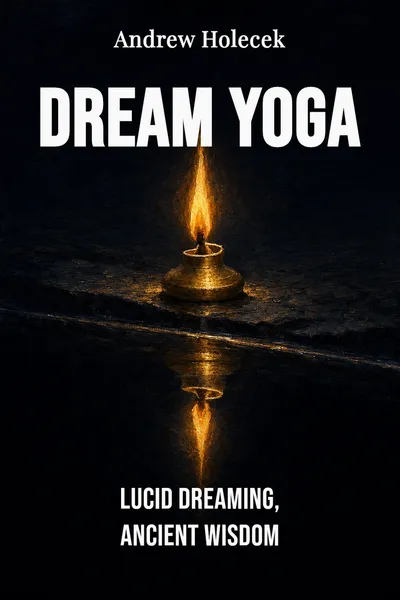
Dream Yoga
Lucid dreaming, ancient wisdom
Description
Roughly a third of a human life is spent asleep, and a good slice of that is spent dreaming — vivid, absurd, sometimes frightening scenes we mostly forget within minutes of opening our eyes. We treat that stretch as downtime, the dark filler between the parts of life that count. Andrew Holecek, a Buddhist teacher trained in the Tibetan tradition, opens his book Dream Yoga by refusing that assumption. What if those hours were not dead time at all, but a hidden classroom — one that ancient practitioners in Tibet were mapping in detail while the West was still calling dreams meaningless noise?
Holecek's wager is that the dreaming mind can be woken up. Not woken out of the dream, but woken inside it: the sleeper realizes, mid-scene, that none of this is real, and stays. That moment has a modern name, lucid dreaming, and a growing pile of sleep-lab research behind it. But Holecek is after something older and stranger than a party trick or a creativity hack. He treats lucidity as the doorway to a full contemplative practice the Tibetans called dream yoga, refined over roughly a thousand years and passed down as a serious path, not a novelty.
The book sits at an unusual crossroads — one foot in the electrode readings of Western sleep science, the other in the monastery. Holecek writes as someone who has done the practice for decades and read the studies, and he wants both to hold. The claim underneath everything is that becoming conscious in dreams changes what you can do while awake, and eventually what you can do while dying.
The question we’re asking : Can the hours we spend asleep be turned into conscious, trainable experience — and what did the Tibetans think was at stake if we managed it?What we’ll see : How a discipline built for the dark treats the dream not as escape but as rehearsal, and follows it all the way to its most demanding claim.
Table of contents
01 Chapter 1 — The third of your life nobody accounts for
Holecek starts with an accounting problem. We plan our waking hours obsessively and write off the sleeping ones as a blank. Yet the mind does not go dark when the eyes close; it keeps generating experience, night after night, with a richness we rarely examine. His first move is simply to argue that this territory is real estate worth surveying — that the dismissal of dreams as random static is a cultural habit, not a settled fact. Cultures across history read dreams as messages, warnings, rehearsals. The modern West is the outlier for treating them as nothing.
Sleep science gives him a foothold here. Dreams cluster in REM sleep, the phase marked by rapid eye movement and a brain nearly as active as when awake, discovered in the early 1950s by Aserinsky and Kleitman at the University of Chicago. Holecek uses this not to reduce dreaming to biology but to establish that something structured and repeatable is happening. If the phenomenon is regular, it can be studied. If it can be studied, it can be entered.

02 Chapter 2 — Waking up while still asleep
Lucid dreaming is the hinge of the whole book: the moment you know you are dreaming without leaving the dream. It sounds like a paradox, but it has been documented in the lab. In the late 1970s and early 1980s, researchers including Keith Hearne in England and Stephen LaBerge at Stanford showed that lucid dreamers could send prearranged eye signals from inside REM sleep, proving they were genuinely asleep and genuinely aware at the same time. Holecek leans on this to answer the first objection anyone raises — that it is just a vivid ordinary dream. It is not; it is a distinct, verifiable state.
How do you get there? Holecek lays out a toolkit, most of it disarmingly simple. Reality checks are the workhorse: through the day you pause and genuinely ask whether you are dreaming — try to push a finger through your palm, reread a line of text, check a clock twice. In waking life the answer is obviously no, but the habit carries into sleep, where the same test suddenly comes back yes. The dream betrays itself, and lucidity dawns.
03 Chapter 3 — The Tibetan map behind the technique
Behind the reality checks and dream journals sits a lineage Holecek treats with real seriousness: the Tibetan Buddhist practice of dream yoga, one of the so-called Six Yogas associated with the eleventh-century figure Naropa and carried down through the centuries in monastic transmission. In that setting, becoming lucid was never the goal. It was step one. The goal was to use the dream as a laboratory for the mind's deepest habits.
Once lucid, the Tibetan practitioner is instructed to do things that sound outlandish and are, in fact, the point. Change the dream deliberately — turn fire into water, multiply one object into a hundred, fly. The exercises are not entertainment. They are meant to prove, in direct experience rather than as an idea, that the dream is made of mind and bends to it. Holecek's argument is that this lesson, once felt from the inside, does not stay locked in the dream. It loosens the grip of the assumption that our experience is solid and fixed.
04 Chapter 4 — The rehearsal for the one night that matters
Step back and Holecek's real subject comes into view, and it is not better sleep. In the Tibetan framework, dream yoga is a rehearsal for death. The reasoning follows a chain the tradition takes literally: falling asleep, the dissolution of the waking world into the dream, is treated as a small-scale model of dying, the dissolution of this life into whatever comes after. If you can stay conscious as waking gives way to dreaming, the argument runs, you are training the exact capacity you will need to stay conscious as life gives way to death.
This is the claim that separates dream yoga from lucid dreaming as a hobby. The lucid dreamer wants to fly or meet a lost friend. The dream yogi is practicing to keep awareness intact through the most disorienting transition a person faces. Holecek connects this to the bardo teachings of Tibetan Buddhism — the accounts of the states between death and rebirth — and presents nightly practice as the only rehearsal available for a performance that comes exactly once.
05 Conclusion
Dream Yoga ends where it began, with the third of life we normally forfeit — but the ledger looks different now. What started as unaccounted downtime has become, in Holecek's hands, the most demanding classroom he knows: a place to build recall, then lucidity, then the deliberate bending of the dream, and finally a rehearsal for the transitions no one gets to practice twice. The unglamorous notebook by the bed and the eye-signal experiments in a Stanford lab turn out to sit on the same continuum as a thousand-year-old monastic path.
Related books