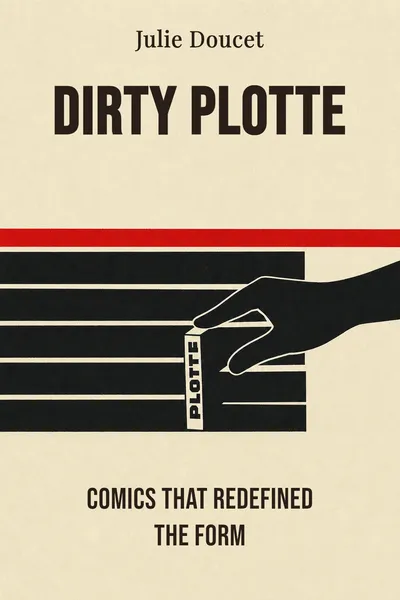
Dirty Plotte
Comics that redefined the form
Description
In the late 1980s, in a small apartment in Montréal, a young art-school graduate named Julie Doucet was drawing comics on cheap paper and running them off on a photocopier. She stapled the pages into a little self-published zine and called it Dirty Plotte — plotte being Québécois slang for a woman's genitals, a word crude enough that stores would sometimes shelve the thing spine-in. The print runs were tiny, sold or traded through the mail and the underground network of the era. Then the Toronto publisher Drawn & Quarterly picked it up, and between 1991 and 1998 Dirty Plotte ran for twelve issues as a proper comic book that reached readers well beyond Québec.
What arrived on those pages was not what the comics world of the time was set up to receive. The alternative scene had its confessional men and its underground provocateurs, but here was a woman drawing her own life in dense, ink-black panels crawling with detail — her periods, her dreams, her boyfriends, her body doing things bodies do and comics did not depict. It was funny and grotesque and tender in the same breath. It did not ask to be liked, and it did not soften itself for anyone's comfort.
Decades later, the whole run sits in a single fat hardback, and Doucet is talked about as one of the cartoonists who changed what the medium could hold. That kind of retrospective consensus tends to smooth over how strange the work felt when it landed, and how deliberately it refused the poses available to a young woman making autobiography in public.
The question we’re asking : How did a photocopied Montréal zine full of blood and dreams end up reshaping what comics were allowed to be?What we’ll see : We follow Dirty Plotte from the copier to the canon, and watch a first-person voice pull the form open behind it.
Table of contents
01Chapter 1 — A Montréal apartment and a photocopier
Doucet came out of the graphic-design program at the Université du Québec à Montréal in the mid-1980s, and the first Dirty Plotte was a zine in the most literal sense: drawn at home, photocopied, folded, stapled, and passed hand to hand. The mini-comix world of that moment ran on exactly this economy — small editions, trades through the post, ads in the backs of other people's zines. It was a circuit built for people who had something to say and no institution willing to print it.
The self-published run got Doucet noticed, and Drawn & Quarterly launched the comic-book series in 1991. That shift mattered more than it might sound. A stapled zine is a private object shared among a few dozen people; a distributed comic book lands on shop shelves next to superheroes and the established alternative titles, in front of readers who did not go looking for it. The crudeness of the name and the density of the drawing were suddenly public in a way they had not been.

02Chapter 2 — Blood, dreams, and a body that won't behave
The subject matter of Dirty Plotte is Doucet's own life, but the emphasis is on the parts most autobiography quietly edits out. Menstruation is everywhere — not as a symbol, just as a monthly event that stains and inconveniences and occasionally goes spectacularly, comically wrong. She draws herself bleeding, cleaning up, running out of supplies, improvising. The body in these comics is not a well-behaved vessel for a personality; it leaks, aches, wants things, and embarrasses its owner.
Alongside the daily material runs a strong vein of the fantastical. Doucet drew her dreams, and the dream strips are some of the most startling pages in the run — she cuts off her own limbs, changes sex, grows extra body parts, murders and is murdered, all rendered with the same matter-of-fact density as a scene of doing the dishes. The violence is cheerful and surreal rather than dark, closer to the logic of a nightmare recounted over coffee than to horror. It gives the collection a texture where the ordinary and the impossible sit flush against each other.
03Chapter 3 — What autobiography looks like without the flattering angle
Autobiographical comics existed before Dirty Plotte — the underground had made a whole mode out of the cartoonist's own life. What Doucet added was a female first person that declined every softening move available to it. She did not make herself sympathetic, did not stage her experiences as lessons, did not tidy the mess into a narrative arc. The strips are episodic and unresolved, closer to a diary than a memoir, and that refusal of shape is itself the argument.
The frankness about the body is the part most often cited, and rightly, but it works because of the drawing rather than in spite of it. The dense, cluttered panels give even the most explicit material a kind of domestic ordinariness; a page about blood looks like a page about a messy apartment, because to Doucet it is one. The register never tips into shock for its own sake. It is too busy being specific.
04Chapter 4 — The form after Doucet let it loosen
Step back from the specific pages and Dirty Plotte reads as one of the works that changed what the comics form was understood to be capable of. The medium had spent decades proving it could do adventure, satire, and the male underground confessional. Doucet's contribution was to show that it could hold the female interior — the body, the dream, the unglamorous daily self — without translating any of it into the shapes those other modes preferred. She widened the range of what a comic could be about, and just as importantly, who it could be by.
Part of that widening is technical. The zine aesthetic she carried into print — the handmade density, the refusal of clean composition — helped legitimize a whole way of making comics that did not look like professional cartooning and did not want to. The page could be crowded, nervous, personal. It could feel like an object someone made in an apartment, because it was, and that texture turned out to be a resource rather than a limitation.
05Conclusion
The whole of Dirty Plotte now fits in one hardback, a long way from the stapled folds that went out through the mail from a Montréal apartment. Reading it in a single block, the surprise is how little of it needs the archaeology — the blood, the dreams, the wandering days still land with the immediacy of something made yesterday, because Doucet never dressed them up in the fashions of their moment. The work aged well precisely because it refused to flatter itself in the first place.
Related books