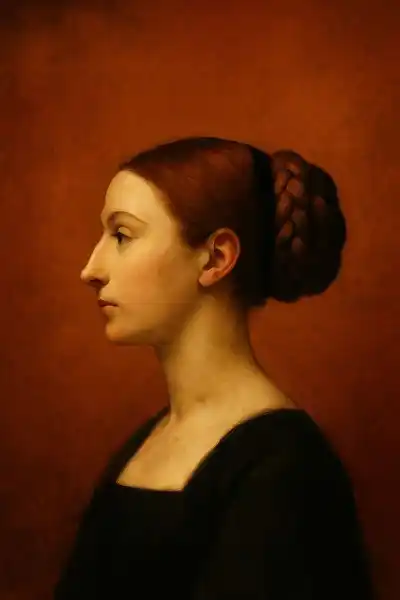

Diane de Poitiers
A royal favourite and real power
Description
In 1547, when Henri II was crowned king of France, one of the most watched people in the kingdom was a widow of forty-seven who held no throne, commanded no army, and owed her name to a dead husband. Diane de Poitiers had been born around 1500 into the minor nobility, married young to Louis de Brézé, and widowed in 1531. By the time Henri took the crown she had been close to him for years, and she now became the fixed point of his reign. The king signed some documents with a monogram that entwined his initial with a D. She wore black and white, the colours of mourning, for the rest of her life, and the court read them as her signature.
For four centuries the story told about her has been remarkably stable, and remarkably narrow. Diane the seductress. Diane who kept her beauty by bathing in cold water and drinking gold. Diane who bewitched a king twenty years her junior and ruled France from his bed while the legitimate queen, Catherine de' Medici, waited in the shadows. It is a good story. It has furnished novels, paintings, and a chateau at Chenonceau. Almost none of it survives contact with the documents, and the parts that do survive have usually been read backwards, through the outcome, as if a woman close to power could only ever have been there for one reason.
The historian Didier Le Fur went back to what Diane actually left behind — account books, land deeds, letters, the paper trail of a great fortune managed over decades — and found a figure the legend had almost entirely covered over. What emerges is less scandalous and far more interesting: a woman doing recognisable political and administrative work, in a system that had a place for exactly that, whose competence was later rewritten as enchantment.
The question we’re asking : If we set aside the seductress and read the archive instead, what did Diane de Poitiers actually do at the court of Henri II?What we’ll see : A widow's careful climb, the real levers she held, the everyday machinery of a royal favourite, and how a competent life got turned into a legend of sorcery.
Table of contents
01Chapter 1 — The mistress who was never quite a mistress
The word we reach for first is the word that fits worst. "Mistress" suggests a private arrangement, a bedroom affair carried on beside the real business of the reign. Diane's position was nothing so marginal. She occupied a recognised, semi-public role at the French court, the role of the king's favourite, and that role came with expectations, functions, and a kind of legitimacy that had nothing to do with concealment. She was not hidden. She was, for years, the most visible person around Henri after the king himself.
Her relationship with him began long before he was king, when he was a boy shaped by trauma. After his father François I lost the battle of Pavia in 1525, Henri and his elder brother were handed to Spain as hostages and held there for several years. He came back withdrawn and unhappy, and Diane, older, steady, already a widow of standing, became something the sources are genuinely uncertain about — protector, guide, the adult who paid attention. The romance was constructed later. What the early record shows is a bond between a damaged young prince and an experienced woman of the court, of a kind that period society understood and did not particularly scandalise.

02Chapter 2 — What the widow actually held
Strip away the romance and a plainer question appears: what did Diane control? The answer is written in property. She accumulated one of the largest private fortunes in the kingdom — lands, seigneuries, revenues, the chateau of Anet rebuilt for her on a grand scale, and for a time the royal chateau of Chenonceau, which the king gave her and which Catherine would reclaim after his death. This was not jewellery given by a besotted lover. It was a durable economic base, and Diane managed it herself, with attention to detail that the surviving accounts make unmistakable.
She had learned this work early. Widowed in 1531, she had spent years administering the Brézé estates, defending her interests in court cases, running the affairs of a great house as its head. By the time she stood beside a king she was already an experienced manager of land, money, and litigation. What looks, from a distance, like a favourite showered with gifts was up close a landowner consolidating, exchanging, and defending holdings with real skill.
03Chapter 3 — The machinery of a favourite
To see the role clearly, it helps to watch it working day to day. Diane was a node in a network of patronage. Nobles, clergy, office-seekers, and family members routed requests through her because she had the king's ear and, more importantly, his trust. She wrote letters on behalf of clients. She promoted her relatives and allies into positions. She helped arrange marriages that knit families to the crown and to herself. This is the ordinary substance of court politics in the sixteenth century, and Diane did it fluently.
Her alliance with the powerful Guise family was central to how the reign functioned. The Guises rose spectacularly under Henri II, and Diane's connection to them — cemented by the marriage of her daughter into the family — placed her at the heart of the dominant faction. To be Diane's friend was to be near the levers; to have her against you was a serious problem. Contemporaries knew this, and their letters and memoirs treat her as a political fact to be reckoned with, not merely a romantic curiosity.
04Chapter 4 — How the legend swallowed the woman
The moment Henri died — killed in 1559 by a lance splinter in a tournament — Diane's power evaporated almost overnight. Catherine de' Medici, now the power behind her sons, dismissed her from court, reclaimed Chenonceau, and left her to live out her years at Anet, where she died in 1566. The speed of the fall exposes the true nature of what she had held: influence entirely dependent on one man's favour, which is real power in a personal monarchy and no power at all once the person is gone.
What is striking is what happened to her memory afterwards. The competent administrator and skilled political operator was steadily painted over by the seductress and the sorceress. The cold baths, the drink of liquid gold, the ageless beauty that supposedly bewitched a younger king — these are the stories that survived, and they survived because they explained an uncomfortable fact in an acceptable way. A woman near the top of power for a dozen years could not, the tradition seemed to insist, have been there because she was good at the work. There had to be a spell.
05Conclusion
Diane de Poitiers spent her last years at Anet, the chateau she had built and shaped, still wealthy, still formidable, but permanently outside the room where things happened. She had risen with a king and fallen with him, and the paper she left behind — deeds, accounts, letters — records a life of management far more than a life of romance. The woman who reappears when the legend is peeled away is neither innocent nor bewitching. She is capable, calculating, and thoroughly at home in the mechanics of power.
Related books