
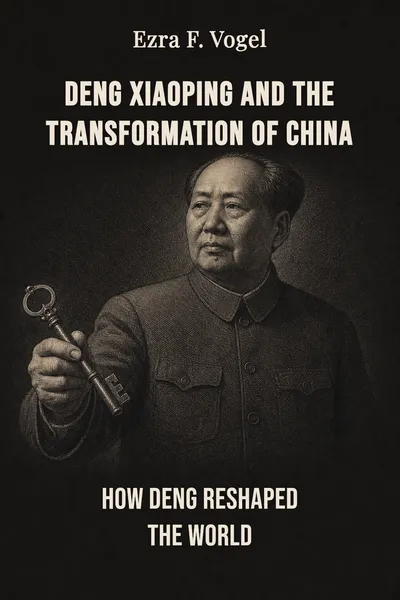
Deng Xiaoping and the Transformation of China
How Deng reshaped the world
Description
In the winter of 1978, a seventy-four-year-old man who had been purged three times, sent to labor in a tractor-repair plant, and whose eldest son had been left paralyzed after a fall during the Cultural Revolution, walked into a Communist Party meeting in Beijing and quietly took control of the largest country on earth. Deng Xiaoping held no formal title as head of state or head of party. He never would. And yet, over the next fifteen years, he would pull roughly a billion people out of the world Mao Zedong had built and set them on a road that made China the second-largest economy on the planet.
Ezra Vogel, who spent a decade researching the life of this small, chain-smoking Sichuanese revolutionary, argues that few individuals in the twentieth century shaped the long arc of world history as decisively as Deng. Not because he authored a grand theory — Deng distrusted theory — but because he made a series of concrete, stubborn, sometimes ruthless choices about how a poor and closed nation could grow rich without, in his mind, coming apart. The China we deal with today, as trading partner and rival, is largely the one he designed.
Vogel's portrait refuses the easy verdicts. Deng is neither the benevolent reformer of Western hope nor the mere tyrant of Western condemnation. He is a man of contradictions, holding modernization in one hand and one-party control in the other, and never quite letting go of either. The book asks us to sit with that tension rather than resolve it too quickly.
The question we’re asking : How did a man purged three times remake China — and, through it, reorder the world — without ever holding its top job?What we’ll see : A revolutionary's long climb, the pragmatism that unlocked an economy, the calculated opening to the West, and the moment the whole project ran into its own limits.
Table of contents
01Chapter 1 — The man who came back three times
Deng Xiaoping was born in 1904 in Sichuan, the son of a modest landowning family, and left for France at sixteen on a work-study program. It was in the factories and cafés of 1920s Paris, not in a Chinese classroom, that he became a communist, sharing cheap lodgings with a young Zhou Enlai who would remain his ally and shield for the next half-century. He moved on to Moscow, returned home, and spent the following decades as a soldier and Party organizer through the Long March, the war against Japan, and the civil war that brought Mao to power in 1949.
What Vogel emphasizes is not Deng's ideology but his durability. Three times he was cast out. In the 1930s he was demoted for backing Mao's line before it prevailed. In 1966, as the Cultural Revolution erupted, he was denounced as the country's second-largest "capitalist roader," stripped of his posts, and sent south to labor. Rehabilitated by Mao and Zhou in 1973 for his administrative gifts, he was purged again in early 1976 after Zhou's death, when the radicals around Mao's wife moved to finish him off.

02Chapter 2 — The pragmatist's gamble
Deng's famous line — that it does not matter whether a cat is black or white, so long as it catches mice — captures the whole method. He inherited an economy wrecked by the Great Leap Forward and the Cultural Revolution, a country where hundreds of millions lived on the edge of hunger and where ideology had for two decades trumped results. His answer was not a blueprint but a permission: try things, keep what works, drop what doesn't, and don't argue about whether it's truly socialist.
The experiments began, in Vogel's telling, more from below than from above. In poor Anhui province, desperate peasants had quietly begun dividing collective land among households and keeping what they grew. Output surged. Rather than crush this as a betrayal of collective farming, Deng and his allies let it spread, then blessed it. Within a few years the communes were effectively dismantled and rural incomes were climbing faster than anyone had dared hope. It was reform by ratification — letting reality lead, then giving it a name.
03Chapter 3 — Opening the door without losing the key
The second half of Deng's project pointed outward. A country that had spent Mao's final years hostile to both superpowers and technologically frozen could not modernize alone. Deng understood that catching up meant importing foreign capital, foreign technology, and foreign management — and that this required a settlement with the very West that Maoist rhetoric had spent decades denouncing.
His January 1979 visit to the United States was, in Vogel's account, a piece of theater with a serious purpose. Deng in a cowboy hat at a Texas rodeo, Deng touring factories and space facilities, was a message beamed home and abroad: China was opening for business. Normalization with Washington gave him the stable external footing he needed, and he shrewdly used the American relationship to balance against the Soviet Union to the north. The border war he launched against Vietnam that same year was, in part, a demonstration of resolve staged for both Moscow and Washington.
04Chapter 4 — The paradox of Tiananmen
In the spring of 1989, students filled Tiananmen Square, mourning the reformist Hu Yaobang and calling for less corruption and more freedom. For weeks Deng hesitated while his lieutenants split — Zhao Ziyang urging conciliation, hardliners demanding order. Then Deng chose. On the night of June 3 and into June 4, the army cleared the square by force, killing many hundreds and perhaps more. Zhao was placed under house arrest for the rest of his life. Vogel does not soften this; it was Deng's decision, and it is inseparable from everything else he built.
This is the contradiction at the center of the man, and Vogel refuses to let it dissolve. The same leader who freed hundreds of millions from grinding poverty also ordered soldiers against unarmed citizens to preserve one-party rule. The two acts flow from a single logic: that China's overriding need was stability and growth, and that political pluralism was a luxury a poor, fragile country could not afford without risking the chaos Deng had lived through. Order first, prosperity second, everything else deferred.
05Conclusion
Deng Xiaoping died in 1997, months before Hong Kong returned to Chinese sovereignty in the peaceful handover he had negotiated with Margaret Thatcher. He left no towering monument, no personality cult, no book of collected wisdom to rival Mao's little red one. He had asked to be judged by results, and the results were a country unrecognizable from the one he had inherited: hundreds of millions lifted from poverty, cities risen where fishing villages had stood, a nation restored to the center of the world's economy.