De Re Militari
Rome's forgotten war manual
Description
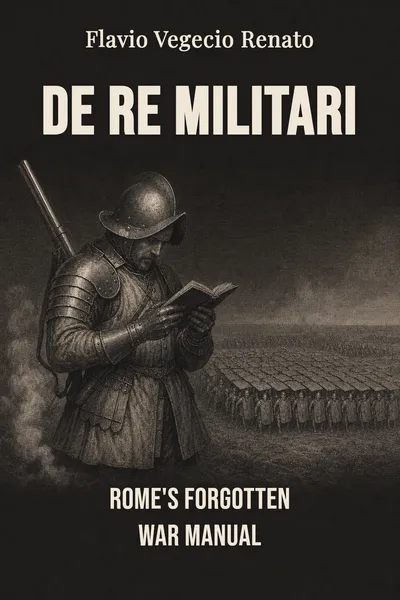
Sometime near the end of the fourth century, a Roman civil servant named Flavius Vegetius Renatus sat down to write a book he was not, strictly speaking, qualified to write. He had never commanded a legion. He was an administrator, a man of the archives, and by his own admission he had gathered his material from older authorities — the regulations of Augustus, the writings of Cato, the drill manuals of a Rome that had long since stopped drilling that way. What he produced, De Re Militari, was not a memoir of battles won. It was a reconstruction, assembled from paper, of how the Roman army used to work when it worked.
The timing matters. Vegetius was writing as the western empire came apart at the seams, its frontiers leaking, its legions increasingly filled with reluctant recruits and foreign auxiliaries who did not train the way the old army had trained. His book reads less like a celebration than an alarm. He kept returning to a single uncomfortable idea: Rome had not been beaten by braver enemies, it had forgotten its own methods. The discipline, the ceaseless drill, the engineering, the logistics — the boring parts — were what had built the empire, and they were the parts being quietly abandoned.
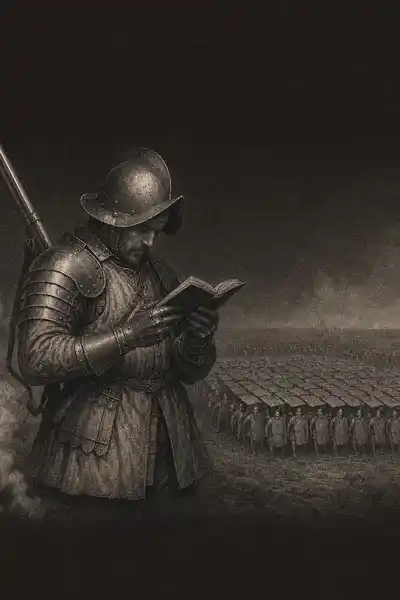
That is the strange thing about this book. It was written by a man watching his world decline, and it became one of the most consulted military texts in European history — copied by hand through the Middle Ages, printed early, carried into the age of muskets and cannon. Soldiers who had never seen a legion still read it as a working guide.
The question we’re asking : How did a fifth-century treatise assembled by a non-soldier become the field manual of choice for a thousand years of European warfare?What we’ll see : We follow Vegetius from the crisis that drove him to write, through his account of how Rome actually forged an army, to why his answers kept mattering long after Rome was gone.
Table of contents
01Chapter 1 — A late empire looks backward for answers
Vegetius dedicated his work to a reigning emperor — most likely Theodosius, though scholars have argued over which one — and the dedication is not decoration. The book is a plea dressed as a treatise. The empire, Vegetius argued, was losing wars it should have won, and it was losing them because the army had let its standards rot. He wanted the emperor to read him and act.
His central diagnosis was almost heretical for a Roman writer: Rome had never really beaten its enemies through numbers or natural ferocity. The Gauls were bigger, the Germans fiercer, the Spaniards richer, the Greeks cleverer. What Rome had was training and organization. "Victory," he wrote in one of the lines that would echo for centuries, comes not from raw courage but from skill and discipline — from knowing your trade better than the man trying to kill you.

02Chapter 2 — The making of a soldier, from body to drill
Vegetius began where he thought everything began: with who becomes a soldier in the first place. He devoted careful attention to recruitment, arguing that the raw material mattered enormously. He preferred country people to city dwellers, reasoning that farmers and laborers were used to hardship, sun, and heavy work, while urban recruits arrived soft. He weighed the trades a man had practiced, favoring those hardened by physical labor over those who had spent their lives indoors.
But selection was only the start. The heart of the book — and the part later readers marked and remembered — was training. Vegetius described a regime of relentless, repetitive drill. Recruits practiced with weighted wooden swords against wooden posts, learning to thrust rather than slash, because a thrust of a couple of inches killed while a wild cut often did not. They marched under load at fixed paces, learned to swim, to vault onto horses, to build fortifications. They repeated it until it stopped being effort and became reflex.
03Chapter 3 — Logistics, leadership, and the arithmetic of survival
Having built his soldier, Vegetius widened the lens to the things that decide campaigns before the fighting starts. He wrote at length about supply, and the phrasing was blunt: an army is destroyed more often by hunger than by the enemy. Grain, fodder, water, the timing of harvests, the safety of the routes that carried them — these were not background details, they were the campaign. A general who neglected them was already losing.
This is where his book stops being a drill manual and becomes something closer to a theory of war built on caution. Vegetius distrusted the pitched battle. A general, he argued, should prefer to win by maneuver, by cutting supply lines, by outlasting and outpositioning the enemy — because open battle put everything on a single roll of chance, and chance did not respect preparation. Only fight when the odds are clearly in your favor, or when you have no choice. It is advice that sounds obvious and that armies have ignored, at enormous cost, ever since.
04Chapter 4 — A manual that outlived the army it described
What Vegetius could not have known is that his rescue plan for a dying army would fail in the short term and succeed spectacularly in the long one. The western empire fell anyway. But the book survived, and it survived because it had accidentally isolated something that outlives any particular army: the claim that wars are won by preparation, and lost by its absence. That idea does not date.
Through the medieval centuries De Re Militari was copied more than almost any other secular Latin text. Kings and commanders owned it. Later it was among the earliest works to reach print, and it kept being read even as pikes gave way to muskets and muskets to artillery — technologies Vegetius had never imagined. Readers did not consult him for the specifics of Roman equipment; they consulted him for the posture. Train relentlessly. Feed the army first. Fortify by habit. Avoid the battle you do not need. Never march blind.
05Conclusion
The man who wrote the most durable military manual in European history had, as far as we know, never fought. Vegetius was a compiler, an anxious administrator borrowing from dead authorities, trying to hand his emperor a way out of a decline he could see coming. The army he described was already half a memory when he described it, and the empire he hoped to save did not last the century.
Related books