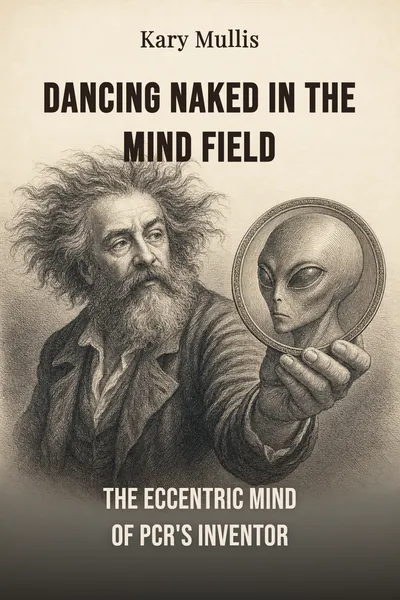
Dancing Naked in the Mind Field
The eccentric mind of PCR's inventor
Description
One night in 1983, driving north on California's Highway 128 toward his cabin in Mendocino, a Cetus Corporation biochemist named Kary Mullis worked out a way to copy a single fragment of DNA over and over until there were billions of it. He pulled the car over. He did the math in his head, doubling and doubling, and could hardly believe the number he got. The technique would come to be called the polymerase chain reaction — PCR — and it would rebuild molecular biology, genetics, and forensics from the ground up. A decade later it won him the Nobel Prize in Chemistry.
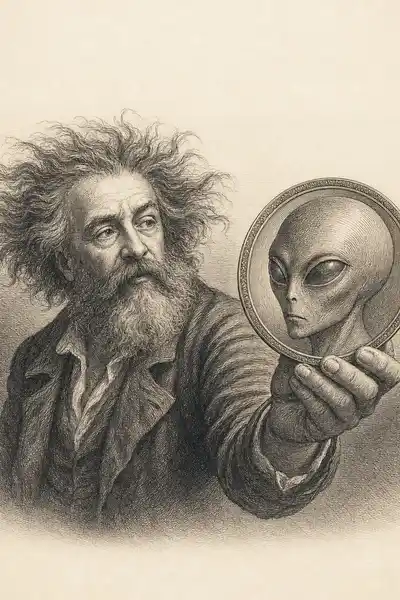
That is the part the textbooks keep. The book Mullis wrote, Dancing Naked in the Mind Field, keeps the rest. This is a Nobel laureate who surfed, who dropped acid at Berkeley in the sixties, who describes a glowing raccoon that spoke to him one night and a possible abduction he can neither explain nor dismiss. He picks fights with the scientific establishment over HIV and the ozone layer, distrusts anyone who argues from authority, and follows the money whenever an official announcement lands. It is not the memoir of a careful man.
And yet the same intelligence that produced PCR runs through every strange chapter. Mullis applies one instrument to everything — his own experience, weighed against the evidence, with nobody's reputation allowed to stand in for proof. The book is less a scientist's life story than a demonstration of how one particular mind refuses to take anything on faith.
The question we’re asking : What kind of thinking produces both a Nobel-winning invention and a man who says he met aliens?What we’ll see : How the mind behind PCR turned the same restless, evidence-first curiosity loose on everything it touched.
Table of contents
01Chapter 1 — The night on Highway 128
Mullis tells the origin of PCR the way you'd tell a story about a good night out. He was driving to Mendocino with a chemist he was seeing, the manzanita blooming along the road, his mind idling over a problem in DNA sequencing. He wanted a way to read a specific stretch of genetic code without the surrounding noise. Somewhere around mile marker 46, the pieces snapped together: use two short primers to bracket the target, let an enzyme copy the strand, then heat it, cool it, and do it again. Each cycle doubles what you have. Twenty cycles gives you a million copies. Thirty gives you a billion.
What strikes him, retelling it, is how obvious it was and how nobody had seen it. The individual reactions were all known chemistry. Nothing in the idea required a new tool or a new discovery. It required only the willingness to arrange familiar steps in a loop and trust the arithmetic of doubling. He woke up his companion to tell her. She went back to sleep. For weeks afterward he asked colleagues why the method wouldn't work, half-expecting someone to point out the fatal flaw. Nobody could.

02Chapter 2 — The rule: show me the data, not the consensus
If there is a single principle running under everything Mullis writes, it is this: he will not accept a claim because important people repeat it. He wants to see the original evidence himself, and if he can't, he treats the claim as unproven no matter how many experts stand behind it. Secondhand knowledge, in his view, is not knowledge. It is a rumor with a lab coat on.
He applies this most bluntly to two of the era's biggest scientific consensus stories. On HIV and AIDS, Mullis says he went looking for the single paper that established the virus as the cause of the syndrome — and reports he could not find a reference that satisfied him. This position is genuinely wrong; the causal link between HIV and AIDS is one of the best-supported findings in modern medicine, and Mullis's skepticism did real harm by lending a Nobel name to denialists. The book renders his reasoning faithfully all the same, because his reasoning is the point: he refused to take the conclusion on authority, even when authority happened to be right.
03Chapter 3 — Aliens, astrology, and other things a Nobel laureate admits to
The most talked-about pages of the book are the ones a respectable scientist is supposed to leave out. One night at his cabin, Mullis walked out toward the outhouse with a flashlight and encountered a glowing raccoon that, he says, greeted him with a friendly "good evening." The next thing he can recall it is morning, and hours are missing. He does not know what happened. He raises the possibility of alien contact, notes that his daughter later reported a similar lost-time experience at the same cabin, and then — crucially — declines to resolve it.
That refusal is the whole trick. Mullis does not claim he was abducted. He claims something happened that he cannot account for, and that his training obliges him to say so rather than force the memory into a story that makes him comfortable. A lesser writer would either play it for belief or explain it away. Mullis does neither, because either move would betray the same rule he applies everywhere: don't pretend to know what you don't know. He extends the same open-mindedness to astrology, which he says he investigated seriously enough to be unsettled by, and to other phenomena he can't file neatly.
04Chapter 4 — The scientist who refused to be respectable
Step back from the raccoons and the feuds, and Mullis is making one large argument, mostly without stating it outright: scientific authority and scientific method are two different things, and confusing them is dangerous. A credential tells you someone was trained. A consensus tells you many trained people currently agree. Neither is evidence. Evidence is what you can check yourself, and the moment a field starts treating agreement as proof, it has stopped doing science and started doing something closer to religion — with heretics, orthodoxies, and money to protect.
This is why the book keeps his triumph and his errors in the same frame. PCR came from a man who trusted his own reasoning over the received wisdom that the method was too simple to work. His AIDS denialism came from the identical impulse, aimed at a conclusion that happened to be true. Mullis would say the impulse was correct both times and only the second application was flawed. Readers can decide whether that defense holds. But it does clarify what he thinks a scientist actually is: not a member of a guild, but a person who insists on seeing for themselves.
05Conclusion
The book ends where the man lived — somewhere between the Nobel podium and the surfboard, unwilling to be tidied into either. Mullis died in 2019, still defending positions most of his colleagues had long since abandoned, still describing his cabin's glowing raccoon to anyone who asked. Dancing Naked in the Mind Field is his case for himself: not a defense of any single claim, but of a way of holding all claims at arm's length until the evidence arrives.
Related books