D-C-T
NYC in Steig's playful style
Description
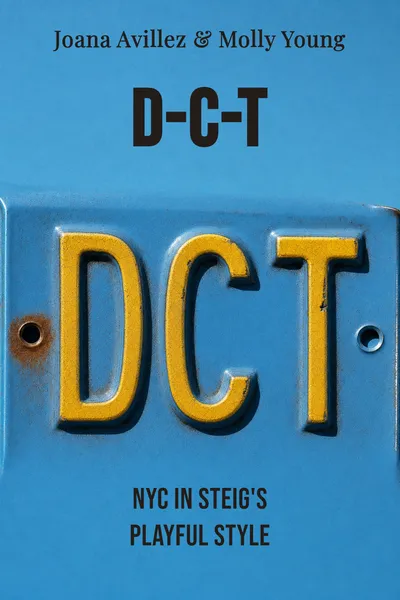
Say the letters D-C-T out loud, slowly, and something happens. The sounds run together and a word surfaces: deceit. That small click — from three flat consonants to a whole idea — is the entire engine of a slim illustrated book that Joana Avillez and Molly Young published in 2018. The cover gives you almost nothing: a title that looks like a license plate, or an acronym for a government office nobody wants to visit. Inside, page after page, letters and numbers sit under Avillez's ink drawings, and the reader's job is to sound them out until they crack open into New York.
The conceit is borrowed on purpose. In 1968, the cartoonist William Steig — the man who would later invent Shrek — published a children's book called CDB!, built entirely on the same idea: letters that, spoken aloud, become sentences. C-D-B reads as "see the bee." Steig's world was rural, gentle, a little vaudeville. Avillez and Young took his device downtown, pointed it at Manhattan, and let it loose on bodega cats, co-op boards, group texts and the particular exhaustion of a city that never fully explains itself.
A book like this could have been a one-note gag, clever for four pages and tiresome by the tenth. It isn't. It holds because the puzzle and the subject turn out to be made for each other — because reading a coded city is, in a quieter way, what living in one already feels like. The pleasure is real, and it's worth asking where it comes from.
The question we’re asking : How does a book made of scrambled letters manage to feel like an honest portrait of New York?What we’ll see : A children's-book trick from 1968, redirected at a grown-up city, and what the guessing does to the reader along the way.
Table of contents
01Chapter 1 — A code you read out loud
The rule of D-C-T is simple enough to grasp in a single page and hard to put down once you do. Each spread pairs a drawing with a string of letters and numbers. You read them not as words but as sounds, letting your mouth do the decoding your eyes can't. "N-E-1" is not a serial number; it's "anyone." The satisfaction is physical — the answer arrives in the ear before the brain catches up, and there's a small jolt when the nonsense resolves into meaning.
What makes it work is that the puzzles are never merely mechanical. A lazy version of this book would just spell out ordinary words and call it a day. Avillez and Young instead aim the device at things that are already funny or true about the city, so that the solving delivers a double payoff: you crack the code, and then you recognize the thing it points to. The drawing does half the work, nudging you toward the answer without handing it over, so you feel clever rather than instructed.

02Chapter 2 — Steig's trick, borrowed and updated
To understand what Avillez and Young are doing, it helps to sit with what William Steig did first. CDB! came out in 1968, when Steig was already in his sixties and decades into a career of drawing for the New Yorker. He'd go on to write picture books that became household objects — Sylvester and the Magic Pebble, Doctor De Soto, and eventually the Shrek book that Hollywood turned into an empire. But CDB! was a stranger, purer thing: a book with almost no conventional words in it, built on the bet that a child could be taught to hear language hiding inside letters.
Steig's puzzles had a specific flavor — plainspoken, faintly old-fashioned, populated by animals and country scenes. The device felt like a game a clever grandfather might invent on a long drive. What Avillez and Young inherited was the mechanism, not the mood. They kept the exact grammar of the thing — letters and numbers, read phonetically, paired with a picture — and swapped out the entire world it described.
03Chapter 3 — New York, spelled in fragments
The genius of pointing the device at New York is that the city is already written in code. Anyone who has lived there reads it constantly without noticing — the difference between a good block and a bad one, the meaning of a certain awning, the social information packed into where someone says they live. Avillez and Young simply make that background decoding literal, forcing the reader to do out loud what a resident does silently all day long.
The drawings are the other half of this. Avillez works in a loose, confident ink line that owes something to Steig but has its own downtown looseness, and her New York is specific rather than postcard. It's less the skyline than the street: the corner deli, the crowded stoop, the small human comedies that play out on a sidewalk. The pictures don't illustrate the puzzles so much as flirt with them, giving you a foothold while keeping the answer just out of reach. You look, you read, you sound it out, and the city assembles itself in your mouth.
04Chapter 4 — What a puzzle knows about a city
Step back from the individual jokes and D-C-T is quietly making a point about how we read anything at all. The book only works because the mind is a compulsive gap-filler. Show a person three unrelated letters and they cannot help reaching for a word; the reaching is automatic, older than reading itself. We are built to hear pattern in noise, to complete the shape, to turn fragments into sense. The book doesn't teach that skill — it just puts a frame around one we already run constantly.
That habit is what makes cities legible in the first place. Nobody experiences a place whole. We catch pieces — a snatch of conversation, a storefront, a stranger's outfit, a smell — and stitch them into an impression that feels like knowledge. Most of the time the stitching is invisible to us; we mistake the finished impression for something we simply saw. D-C-T slows the process down to the point where you can feel yourself doing it, letter by letter, and that slowing is oddly clarifying. You catch your own mind in the act of manufacturing meaning.
05Conclusion
D-C-T ends the way it began: with three letters that mean nothing until a reader gives them breath. Between the covers, Avillez and Young take Steig's fifty-year-old classroom trick and prove it was never only for children — that the delight of hearing a word climb out of its own spelling belongs to anyone, and lands especially hard when the words add up to a place they know. The drawings hold the whole thing together, loose and specific and warm, giving the puzzles somewhere to live.
Related books