Craft in the Real World
Rethinking how we teach writing
Description
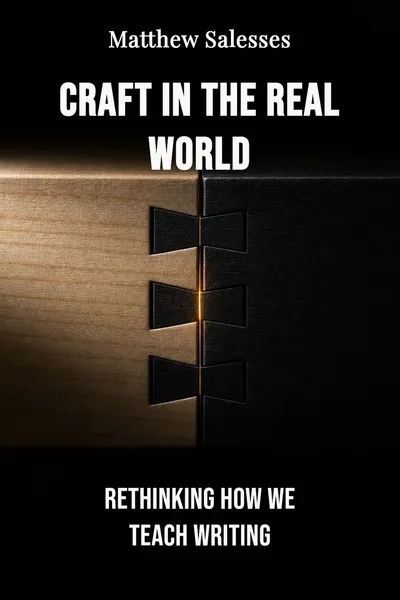
Anyone who has taken a fiction workshop knows the word craft. It hangs over the seminar table like a settled agreement: show don't tell, cut the backstory, keep the protagonist active and wanting something, resolve the arc. These are the moves a good writer supposedly learns, the difference between a story that works and one that doesn't. The word carries a reassuring air of neutrality — craft is technique, and technique is just technique, the way a carpenter's joinery is a fact about wood and not a statement about anything. That is the assumption Matthew Salesses, a novelist and teacher, sets out to take apart.
His argument in Craft in the Real World, published in 2021, is that craft is never neutral. Every rule about how a story should behave is also a claim about what readers expect, what feels natural, what counts as a satisfying ending — and those expectations were shaped by particular people, in particular places, telling particular kinds of stories. When a workshop treats one tradition's conventions as simply "good writing," it quietly turns everything else into error. Salesses knows the stakes from the inside: adopted from Korea as an infant, raised in a white American family, he spent years being told his stories didn't quite work in ways he came to suspect had nothing to do with technique.
So the book does two things at once. It's a craft book — it teaches structure, tension, character, revision. And it's a critique of the very frame that craft books usually leave unexamined, including the American workshop model that has trained generations of writers. Salesses wants to keep the tools while refusing the pretense that the tools came from nowhere.
The question we’re asking : If craft is supposed to be neutral technique, whose expectations are actually built into it — and what happens to the writers it wasn't built for?What we’ll see : How a set of rules that looks like pure technique turns out to be a cultural argument about readers, endings, and who gets to feel at home in a story.
Table of contents
01Chapter 1 — The word we treat as neutral
Salesses starts by pulling apart the word itself. Craft, he argues, is a set of expectations about how a story communicates meaning — and expectations are learned, not given. What feels like an obvious rule to one reader is an unfamiliar convention to another. The insistence that a protagonist must want something clear and pursue it against obstacles, for instance, isn't a law of narrative. It's a particular idea about the individual as a self-directed agent, more at home in some cultures and periods than others. Plenty of celebrated storytelling traditions organize meaning around family, community, cyclical time, or the acceptance of fate rather than the triumph of a single striving hero.
Once you see craft as a set of choices rather than facts, the vocabulary of the workshop starts to look different. Words like universal, relatable, and earned do a lot of quiet work. They sound like descriptions of quality, but they're really descriptions of a fit — how closely a story matches the conventions a given reader already carries. A story can be called unearned not because anything is wrong with it, but because it resolves in a way that reader wasn't taught to anticipate. The judgment gets dressed up as craft, and its cultural origin disappears.

02Chapter 2 — The room where the writer stays silent
Nowhere are these hidden assumptions more concentrated than in the workshop itself — the method most American writers pass through, in which a student's story is discussed by the group while the author sits quietly, forbidden to explain or defend it. The format is so standard that it feels like the natural way to critique fiction. Salesses points out that it is nothing of the kind. It is a specific procedure with a specific history, refined at the Iowa Writers' Workshop in the mid-twentieth century, and it encodes assumptions that most participants never examine.
The silence of the author is the heart of it. The idea is that a story should stand on its own, that if the writer has to explain, the writing has failed. But this quietly assumes that the room and the writer share the same context — the same sense of what needs explaining and what can be taken for granted. When they don't, the writer whose references or rhythms fall outside the room's defaults is placed in an impossible position: told the work is confusing, and forbidden from saying that the confusion might live in the readers, not the page. The gag rule turns a mismatch of expectations into the writer's personal failure.
03Chapter 3 — Reading is not universal
Behind every craft rule sits an imagined reader — the person the story is supposedly for, whose expectations the writer is trying to meet or subvert. Salesses argues that the workshop's great sleight of hand is refusing to name this reader while acting as if everyone shares the same one. That phantom reader tends to be assumed rather than described: someone who values individual agency, forward momentum, tidy resolution, and a certain plain-spoken realism. Treat that reader as universal, and every convention built around them hardens into common sense.
But readers are made, not born. A person raised on Russian novels expects a different pace than one raised on manga; a reader steeped in oral tradition hears repetition as music where another hears redundancy; someone whose stories have always centered the collective may find a lone hero's arc oddly thin. None of these is more advanced or more primitive. They are different literacies. When a teacher calls one of them the standard, the others don't just lose a competition — they get reclassified as mistakes, and the writers who serve them learn to distrust their own ear.
04Chapter 4 — What craft has been protecting
Step back and the book's real subject comes into view. Salesses is writing about craft, but craft turns out to be a way of deciding who belongs — who the culture has quietly agreed to imagine when it pictures a reader, a writer, a story that works. Every rule that presents itself as pure technique is also a small act of admission or exclusion, drawing a line around the expectations that count. His achievement is to make that line visible without pretending it can simply be erased.
This matters beyond the seminar table because craft standards travel. They shape what agents acquire, what editors buy, what prizes reward, what gets taught to the next cohort, which then internalizes the standard and enforces it in turn. A norm that began as one group's preference becomes, through this loop, the shape of a national literature — and the writers it wasn't built for spend their careers being told, in the vocabulary of quality, that they are almost there. Salesses names the loop so it can be interrupted, not so it can be blamed.
05Conclusion
The image the book keeps returning to is the writer sitting silent while a room decides what their story means. Salesses lived that scene, and it taught him something the room didn't intend: that the standards being applied to him were never the neutral technique they claimed to be. They were expectations with an address, a history, a default reader who was rarely him. Craft in the Real World is his attempt to hand that recognition to everyone still sitting in that chair, and to the teachers running the room.
Related books