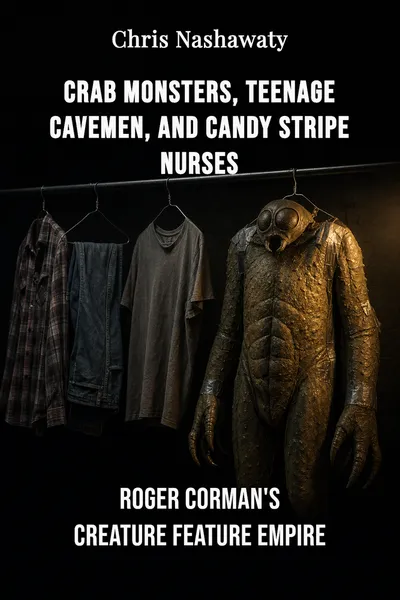
Crab Monsters, Teenage Cavemen, and Candy Stripe Nurses
Roger Corman's Creature Feature Empire
Description
Sometime in the mid-1950s, a young man with an engineering degree from Stanford and a brief, unhappy stint reading scripts at Twentieth Century-Fox decided he could make a monster movie faster and cheaper than anyone in Hollywood. His name was Roger Corman, and the boast turned out to be modest. Over the next four decades he would produce or direct somewhere north of three hundred films, most of them shot in days rather than weeks, most of them turning a profit before the ink dried on the poster. The titles alone tell you the register he worked in: Attack of the Crab Monsters, Teenage Caveman, Candy Stripe Nurses. Nobody mistook these for art. Corman didn't ask them to be.
Chris Nashawaty's book gathers the whole sprawling operation into one place — the oral histories, the lurid poster reproductions, the on-set photographs of rubber creatures held together with hope and gaffer tape. What emerges is not a portrait of a hack, though Corman happily wore the label. It's a portrait of a system: a way of making movies so lean, so relentless, and so indifferent to prestige that it accidentally became the most important training ground the American film industry ever had. The people who passed through it read like a roll call of New Hollywood.
That's the puzzle worth sitting with. The man who made the schlock also made the careers. The drive-in double bills and the future Oscar winners came out of the same office, on the same budgets, under the same impossible deadlines. Nashawaty's account keeps both halves in frame at once, which is the only honest way to tell it.
The question we’re asking : How did an assembly line for cheap monster pictures end up producing much of the talent that would remake American film?What we’ll see : An empire built on speed and thrift, and the names it launched from the margins of the business.
Table of contents
01Chapter 1 — Three-day monsters and a business that worked
Corman's genius was never visual, and he'd have been the first to say so. It was arithmetic. He worked out early that a film's profit lived almost entirely in what it cost to make, and that if you could shoot a picture for a few tens of thousands of dollars and sell it to distributors hungry for product, the math took care of itself. The drive-in circuit of the late fifties and sixties was voracious. It needed two features every week, and the studios, chasing prestige, weren't supplying them. Corman filled the gap with a discipline that bordered on the monastic: no wasted setups, no reshoots, no waiting for weather.
The stories that grew up around him have a legendary quality, and Nashawaty lets the participants tell them. The Little Shop of Horrors, the black comedy that later became a Broadway musical, was reportedly shot in a matter of days on a set left standing from another production — Corman disliked letting anything go to waste. He would build a whole film around a rubber suit he already owned, or a cave set that hadn't been struck yet, reasoning backward from the assets to the script. The screenplay was often the last thing to arrive and the first thing to be cut.

02Chapter 2 — The film school no one applied to
The most quoted fact about Roger Corman is the one that sounds invented, and Nashawaty confirms it was not. Working for Corman was the closest thing to a directing apprenticeship the industry offered, precisely because nobody else would hand a twenty-five-year-old a camera and a budget and simply expect a finished film in ten days. He hired the young and the hungry, paid them almost nothing, and gave them the one thing money couldn't buy: the chair. If you failed, it was cheap. If you succeeded, you had a movie with your name on it.
The list of graduates is the book's centerpiece and its argument in one breath. Francis Ford Coppola cut his teeth editing and directing for Corman before The Godfather. Martin Scorsese made Boxcar Bertha for him. Jonathan Demme, James Cameron, Ron Howard, Peter Bogdanovich, Joe Dante — all passed through, most of them getting their first real credit on a picture with a title Corman had chosen before anyone wrote a word. The actors were no different. A young Jack Nicholson, unemployable elsewhere, worked steadily in Corman's stock company for years, learning the trade in caveman costumes and dentist's chairs.
03Chapter 3 — The drive-in as a laboratory
It would be easy to file Corman's films as disposable, and most of them were designed to be. But the freedom that came with low stakes cut both ways. When nobody expects art, nobody polices it either, and Corman occasionally let his directors reach for something the majors would never have permitted. The cheapness bought a strange license. A monster picture could smuggle in real dread; a biker film could carry a genuine countercultural charge; a caveman romp could hide a joke at civilization's expense.
Corman himself directed the run of Edgar Allan Poe adaptations in the early sixties, starting with House of Usher, most of them starring Vincent Price and shot in gorgeous, lurid color on standing sets and recycled footage. They were made for pennies and they looked, improbably, like something. They also made real money, which mattered more to Corman than the praise, though the praise came too. He had proved you could be fast and cheap without being ugly, if you were clever about where the money didn't show.
04Chapter 4 — What the cheap movie really bought
Step back from the crab monsters and the candy stripe nurses and Corman's operation starts to look like an argument about how creativity actually gets funded. Hollywood's official story is that great films need great resources — the prestige budget, the long schedule, the room to get it right. Corman spent forty years quietly demonstrating the opposite: that scarcity, applied consistently, is a more reliable engine of talent than abundance. When the stakes are low and the turnover is fast, people get to fail cheaply and often, which is the only way anyone learns anything.
Nashawaty's book resists turning this into a tidy moral, and it's right to. Corman wasn't a philanthropist of cinema; he was a shrewd operator who paid poorly and worked people hard, and plenty of his films are exactly as bad as their titles promise. But the structure he built — high volume, low cost, real responsibility handed to unproven people — happened to be the structure a young industry needed and the majors had stopped providing. The apprenticeship system that Hollywood dismantled in the studio era survived, of all places, in the margins of the exploitation trade.
05Conclusion
Roger Corman kept making and distributing films well into old age, collecting an honorary Academy Award in 2009 for a body of work the Academy had spent decades not quite knowing how to categorize. He accepted it the way he made everything else — without pretense, with an eye already on the next project. The man who had been the industry's cheerful embarrassment turned out to be one of its quiet foundations, and the ceremony was a belated admission of a debt long overdue.
Related books