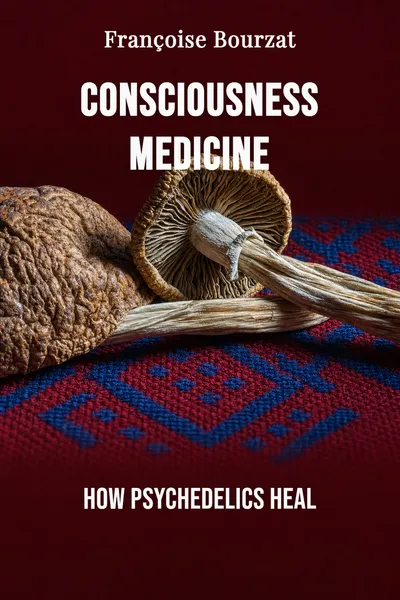
Consciousness Medicine
How psychedelics heal
Description
Sometime in the 1990s, a young Frenchwoman living in California travelled to the Mazatec mountains of Oaxaca, in southern Mexico, to sit through the night with a healer and a plate of mushrooms. The ceremony had a name — velada, a vigil — and a shape older than any clinic: candles, chanting, a curandera who had inherited the practice from her own lineage. Françoise Bourzat did not come away with a technique to bottle. She came away convinced that the substance was the smallest part of what had happened, and that the West, in its rush to study the molecule, kept losing the thing around it.
That intuition became a life's work. Bourzat spent decades as a counselor and guide, training practitioners and sitting with people through expanded states, and eventually wrote it down in a book called Consciousness Medicine. Its timing was almost too neat. As she was working, psychedelics were moving from the cultural margins back into the laboratory — psilocybin trials for depression, MDMA studies for trauma, a whole field rebranding itself as medicine. The word promised rigor. It also promised, to anyone paying attention, a shortcut.
Her book is an argument against the shortcut, written by someone who believes deeply in what these substances can do. It sits in an uncomfortable place: too reverent for the pharmacologists, too careful for the enthusiasts. What she is really describing is less a drug than a container — a set of relationships, intentions and practices without which the chemistry is just chemistry.
The question we’re asking : When a psychedelic experience actually heals someone, what is doing the healing — the molecule, or everything built around it?What we’ll see : How a guide trained in indigenous ceremony reframes these substances as one part of a much slower, more relational kind of work.
Table of contents
01 Chapter 1 — The mushroom velada and the séance that lasted a night
Bourzat's model doesn't begin in a research hospital. It begins on a dirt floor in the Sierra Mazateca, in the tradition made famous decades earlier when the curandera María Sabina let an outsider sit in on her veladas in the 1950s — an opening that arguably launched the whole Western fascination with psilocybin. Bourzat studied with Mazatec healers over many years, and what struck her was how little the ceremony resembled taking a drug and how much it resembled being held. The mushrooms were treated as sacred, addressed by name, taken with prayer. Nobody was in a hurry to measure anything.
The details matter because they are the opposite of what a pill promises. The healer sings through the night. The room is dark, then lit by a single candle. There is intention set out loud before anything is swallowed — a reason for being there, a question, a grief. The experience is understood to belong to a longer relationship between the person, the medicine, and the community that will still be there in the morning. The substance opens a door; the tradition decides what walking through it means.

02 Chapter 2 — Set, setting, and the guide who stays in the room
Two words carry most of the weight in Bourzat's practice, and neither is pharmacological. Set is the inner state a person brings — their intention, their history, their fears, what they actually came to face. Setting is everything outside: the room, the sounds, the presence of a trusted guide, the safety of the container. The terms go back to the earliest psychedelic research of the 1960s, but Bourzat treats them not as caveats in a study design but as the active ingredients. Change the set and setting, and you change what the medicine becomes.
Get them wrong and the same molecule can wound rather than heal. This is where her commitment to harm reduction lives. She is unromantic about risk — about the person who takes too much alone, the guide who oversteps, the vulnerability of someone in a wide-open state. A good guide, in her telling, does very little and never leaves. They hold the space, track the body, resist the urge to interpret or direct. The point is not to steer the journey but to make it safe enough that the person can go where they need to go.
03 Chapter 3 — The work happens after the medicine wears off
The most counterintuitive claim in Consciousness Medicine is that the ceremony is not the point. The experience, however vivid, is raw material. What turns it into change is integration — the slow, unglamorous work of bringing insight back into ordinary life and letting it reorganize how a person lives. A revelation on Tuesday night means nothing if by Friday it has evaporated into a good story. Bourzat spends much of the book on the part everyone wants to skip.
Integration, in her practice, is deliberate and ongoing. It might mean journaling, returning to a session with a guide over weeks, making art from what surfaced, changing a relationship or a habit that the experience exposed as unbearable. The expanded state loosens something; integration is what decides whether it sets in a new shape or snaps back. She frames it as the difference between having an experience and being changed by one — and only the second counts as healing.
04 Chapter 4 — Healing that refuses the shortcut
Step back from the sessions and the guides, and Bourzat's book is quietly picking a fight with the way its own moment wants to package these substances. The renaissance underway — clinics, startups, standardized protocols, the language of dosing and outcomes — is built to make psychedelics legible to medicine and to markets. That legibility is what lets a drug get approved and scaled. It is also what tends to sand off exactly the parts Bourzat considers load-bearing: the relationship, the meaning, the months of integration that no protocol can bill for cleanly.
Her whole framework implies that a culture wanting transformation on demand will keep mistaking the molecule for the medicine. It is an understandable error. A pill is easy to study, easy to sell, easy to imagine as a fix. A container — a guide who stays, a tradition that gives the experience meaning, a person doing slow work afterward — is none of those things. It resists the very efficiencies the modern system is built to reward. Bourzat is not against science; she wants the ancient and the clinical to meet. But she keeps insisting the clinical half cannot swallow the other.
05 Conclusion
We come back to the dirt floor in Oaxaca, the candle, the curandera singing through the night. What Bourzat carried out of that room was not a substance but a way of being with it — set, setting, a guide who stays, and the long integration that turns an experience into a life change. Everything in her book radiates from that first vigil: the conviction that these molecules heal not by acting on a passive body but by opening a door a person still has to walk through, slowly, with help, over time.
Related books