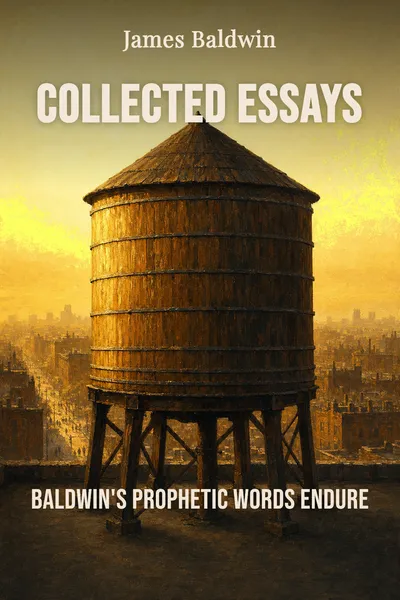
Collected Essays
Baldwin's prophetic words endure
Description
In 1948, at twenty-four, James Baldwin left New York for Paris with about forty dollars and no plan beyond leaving. He had grown up in Harlem, the eldest of nine children, a boy preacher in a storefront church before he was a writer of anything. He went to France not to find France but to get far enough from America to see it. The distance worked. Over the next four decades he produced a body of nonfiction — reviews, reportage, open letters, long autobiographical essays — that did something American writing had rarely managed: it looked directly at the country's central wound and refused to blink, flinch, or console.
Those pieces are gathered in Collected Essays, the Library of America volume edited by the Nobel laureate Toni Morrison in 1998, the most complete assembly of Baldwin's nonfiction ever printed. It holds the early collection Notes of a Native Son, the incandescent The Fire Next Time, the later, angrier No Name in the Street, and dozens of shorter pieces. Read together, they are less a career than a single sustained argument, returned to from a hundred angles across a changing country. The voice barely ages. That is the strange thing about opening the book now.
Because the sentences keep arriving on time. When a new movement fills the streets, when a documentary like Raoul Peck's I Am Not Your Negro sets his words against present-day footage, the essays don't feel exhumed — they feel addressed to the room. A writer who died in 1987 keeps turning up in arguments he could not have known about, saying the thing more precisely than the people having them.
The question we’re asking : How did a Harlem-born expatriate build a body of essays that keeps speaking, decades later, as if written this morning?What we’ll see : The making of Baldwin the witness, the form he chose, the moral demand at the center of it, and why the country keeps reaching back for the book.
Table of contents
01Chapter 1 — The witness who refused both roles
Baldwin arrived at the essay by refusing the two jobs America was ready to hand him. He could be the spokesman, the representative Negro who explained his people to white readers and reassured them. Or he could be the protest writer, producing the sociological novel that catalogued suffering and demanded pity. He rejected both, and his 1949 essay on the protest novel, which took aim at Richard Wright's Native Son and even at Uncle Tom's Cabin, cost him Wright's friendship. His objection was that such books flattened human beings into evidence. A person reduced to a case, however sympathetic, is still reduced.
What he wanted instead was to be a witness — a word he used with almost religious weight, carried over from the pulpit he had left. The witness does not argue on behalf of a group; he reports what he has seen, including what he has seen in himself. That meant Baldwin put his own life on the page without protection: his father's death and funeral in 1943, the riot in Harlem the same week, his own capacity for rage, his fear, his desire. The title essay of Notes of a Native Son turns a private grief into a diagnosis of a whole society, and never once lets the writer off the hook.

02Chapter 2 — The essay as the only honest weapon
The essay suited Baldwin because it is the form that shows its own thinking. A novel hides the author behind characters; an argument marches toward a conclusion decided in advance. The essay does neither. It moves, doubles back, admits complication, and arrives somewhere the writer did not fully see at the start. Baldwin's sentences enact this — long, winding, subordinate clause folding into subordinate clause, then landing on something short and unanswerable. The rhythm is the rhythm of a mind refusing to simplify what it knows to be complicated.
That cadence came straight from the church. The boy preacher never entirely left; the King James Bible and the call-and-response of the Black pulpit are audible in every paragraph. But Baldwin turned the sermon inside out. Where the preacher offers salvation, Baldwin withholds it. He builds the same rising pressure, the same moral heat, and then declines to deliver the comfortable resolution the form has trained the reader to expect. The reader is left standing in the discomfort, which was the point.
03Chapter 3 — Love, rage, and the refusal to hate
At the center of the essays sits a demand that is easy to misread as gentleness and is nothing of the kind. Baldwin talked constantly about love, but he meant something severe: not affection, not tolerance, but the willingness to see another person, and oneself, without the flattering lies. Love in his usage is a form of attention so honest it hurts. It is the opposite of the sentimentality he despised, and it asks more of the reader than hatred ever could, because hatred at least lets you off the work of understanding.
The rage is real and it is everywhere, and Baldwin never pretended otherwise. He wrote openly that to be Black and conscious in America was to be in a state of nearly continuous fury, and that the effort of not being destroyed by that fury was itself a daily labor. What he refused was the conversion of rage into a permanent identity or a license to stop thinking. He watched the movement change through the sixties, watched the murders of Medgar Evers, Malcolm X, and Martin Luther King Jr. — men he had known — and his later work, especially No Name in the Street, grows darker and less patient. The hope thins. The clarity does not.
04Chapter 4 — Why the pages keep reopening
Set beside most writing from the civil rights era, Baldwin's essays behave strangely: they do not date. A great deal of period nonfiction reads now as a record of its moment, valuable but sealed inside its year. Baldwin's does the opposite. Each time the country reopens the subject — a name that becomes a movement, a wave of protest, a film built from his own recorded words — the essays are pulled off the shelf not as history but as commentary on the present. Peck's I Am Not Your Negro, released in 2016, made this literal, running Baldwin's sentences over footage he never saw and finding no seam.
The reason is not that America has failed to change; it clearly has. The reason is that Baldwin wrote about the underlying mechanism rather than the surface event. He was interested in the story the country tells itself, the innocence it protects, the refusal to look at its own history — and that machinery has proven more durable than any particular law or leader. When the specifics shift but the pattern repeats, a writer who described the pattern rather than the specifics keeps being right.
05Conclusion
Baldwin died in 1987 in Saint-Paul-de-Vence, in the south of France, an expatriate to the end, still working. He had spent nearly four decades looking back at the country he could not stay in and could not abandon, and the record of that looking is what Toni Morrison gathered into one volume a decade after his death. Read whole, the essays turn out to have been a single act of attention sustained across a lifetime, patient and furious at once, refusing every comfortable exit the era offered him.
Related books