Cocktail Techniques
Japanese bartending secrets revealed
Description
Walk into a certain kind of bar in Ginza, Tokyo's most expensive district, and the first thing that hits you is the silence. No music, or barely any. The bartender wears a white jacket, moves without hurry, and greets you with a small bow. He remembers what you drank last time. When he shakes a cocktail, the sound is clean and rhythmic, and then it stops, and he strains a single drink into a chilled glass with a gesture that looks almost like calligraphy. You will pay a lot for that drink, and you will understand why only after the first sip.
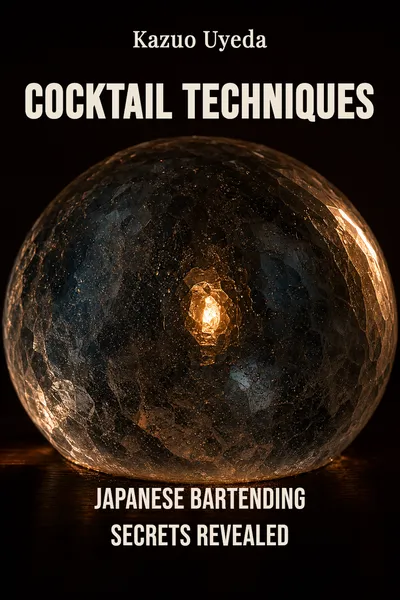
The man who did more than anyone to codify this world is Kazuo Uyeda, a bartender who spent decades behind the counter and eventually opened his own bar, Tender, in Ginza. Uyeda is the name attached to the "hard shake," a shaking method so precise it became legend among bartenders far beyond Japan. For years his craft circulated as rumor in the English-speaking cocktail world — half-understood, imitated, mythologized. Then his book, Cocktail Techniques, appeared in English, and the rumor finally had a text.
What that book delivers is stranger and quieter than the hype suggested. It is not a recipe collection. It is a manual about hands, about ice, about how a single degree of angle on a bar spoon changes what reaches the tongue. Uyeda treats bartending as a discipline in the old sense — something you refine for a lifetime and never finish. The drinks are almost a byproduct.
The question we’re asking : Why does a Japanese bartender spend a lifetime perfecting gestures most drinkers never notice?What we’ll see : How Uyeda's world turns pouring, shaking, and carving ice into a craft where the smallest movements carry the whole meaning.
Table of contents
01Chapter 1 — The bar as a place of quiet
Before Uyeda gets to a single drink, he spends his energy on something most cocktail books ignore entirely: the counter itself, and what it means to stand behind it. A Japanese bar of the kind he describes is small — a dozen seats, sometimes fewer — and built around the bartender the way a stage is built around one performer. The relationship is close, almost uncomfortably so. There is nowhere to hide. Every movement is watched, and every movement is meant to be worth watching.
This is where the tradition diverges sharply from the American bar it descends from. The cocktail arrived in Japan largely through hotel bars in the early twentieth century, imported gesture by gesture from Europe and the United States. But Japanese bartenders absorbed it into a service culture that already had a word for the host's attentive care — a whole ethic of anticipating the guest's needs before they are spoken. The drink became one expression of that ethic, not the point of it.

02Chapter 2 — The shape of the pour
The famous piece of Uyeda's craft is the hard shake, and it is worth being honest about how odd it sounds. The claim is that a particular shaking motion — a fast, three-dimensional figure that snaps the tin through a specific path — produces a smoother, colder, more aerated drink than an ordinary shake. Bartenders who watched Uyeda do it described the sound as unlike anything else, a crisp double rhythm. Whether the physics fully backs the mythology is still argued. What matters is what the obsession reveals: Uyeda believes the motion of the hand is an ingredient.
He treats stirring the same way. A stirred drink, in his telling, is not simply chilled and diluted; it is built by how the spoon travels around the mixing glass, how many rotations, how the ice is set moving so it cuts the liquid rather than crashing through it. Too aggressive and you bruise the drink, folding in air and melt you did not want. Too timid and it stays warm and thin. The right stir has a tempo, and the tempo is learned by feel over years, not read off a page.
03Chapter 3 — Ice, the ingredient we forget
If one thing separates the Japanese bar from the drink you make at home, it is ice — not as an afterthought but as a material to be worked. Uyeda devotes serious attention to it, because in his world ice is shaped by hand with a knife and an ice pick, carved from a large clear block into spheres and diamonds and rough-faceted lumps sized for a particular glass. The famous hand-cut sphere is not a party trick. A sphere has less surface area for its volume, so it melts slower and dilutes the drink less over the time you take to enjoy it.
The clarity matters as much as the shape. Cloudy ice is full of trapped air and dissolved gas; it fractures, melts unevenly, and clouds the drink. Clear ice, cut from slowly frozen blocks, is dense and stable and looks like glass in the tumbler. Uyeda treats the difference as fundamental, because temperature and dilution are half of what a spirit tastes like. Warm whisky over fast-melting ice is a different drink from the same whisky over a slow, dense sphere — not a little different, entirely different.
04Chapter 4 — The technique is the philosophy
Step back from the spheres and the shaking, and a question surfaces that Uyeda never quite states but the whole book answers: why bother? The guest at the counter cannot see the difference between a nine-rotation stir and a twelve-rotation stir. Most could not tell a hand-cut sphere from a machine one by taste alone. Uyeda knows this. He pursues the precision anyway, and the reason is the real subject of Cocktail Techniques.
In this tradition, technique is not a route to a result — it is a practice that shapes the person performing it. The Japanese craft ideal, whether in a knife maker's workshop or a tea room or behind a bar, holds that endless refinement of small gestures is itself the work. You do not master the hard shake to make one great martini; you make ten thousand martinis to keep refining the hard shake, and the discipline of that refinement is what turns a person into a bartender. The drink is real, but it is also the visible edge of something interior.
05Conclusion
Return to that quiet Ginza bar, the white jacket, the clean rhythm of the shake that stops all at once. What looked at first like mystique turns out to be the accumulated residue of choices — about ice, about angle, about the tempo of a spoon — made so many times they have become second nature. The drink you paid so much for is expensive because it carries decades inside it, most of them in gestures you were never meant to catch.
Related books