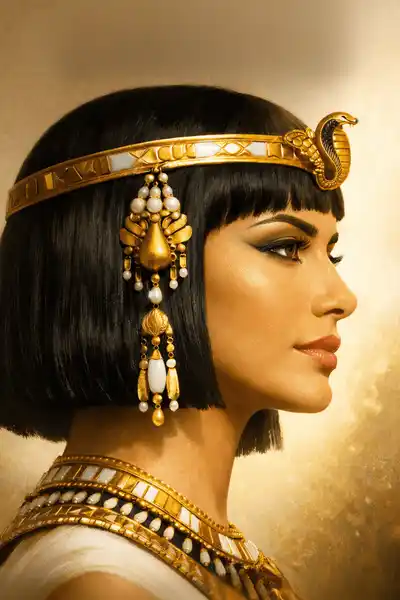
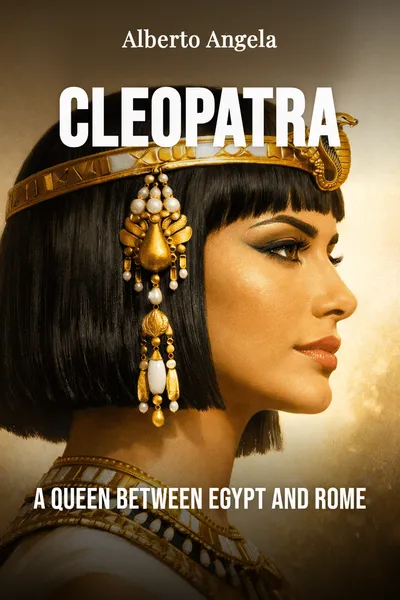
Cleopatra
A queen between Egypt and Rome
Description
In the summer of 30 BC, a woman in her late thirties took her own life in a palace in Alexandria rather than be paraded in chains through the streets of Rome. She was Cleopatra VII, the last pharaoh of Egypt, and by the time she died she had spent two decades running one of the wealthiest kingdoms of the ancient world while the Roman republic tore itself apart around her. The manner of her death — the asp, the fig basket, the two loyal handmaidens dying beside her — is one of the most retold scenes in Western memory. Almost everything we picture when we hear her name comes filtered through the people who defeated her.
Alberto Angela, in his book on Cleopatra, sets out to peel that filter away. He wants the operator underneath the legend: a ruler who spoke perhaps nine languages, who understood Egyptian grain, coinage and priestly politics better than any Roman general who ever sailed up the Nile. She was a Ptolemy, heir to a Greek-Macedonian dynasty that had governed Egypt for nearly three centuries, and she inherited a throne that was less a seat of power than a knife fight among siblings. To hold it, she had to be cleverer than everyone around her — including the two most powerful men Rome ever produced.
That is the story Angela reconstructs: not a romance, but a calculation. Cleopatra tied her survival, and Egypt's, to the rise of individual Romans at the exact moment the republic was collapsing into one-man rule. It was a brilliant bet, and it nearly worked. What went wrong, and what happened to her reputation afterward, is where the book earns its keep.
The question we’re asking : Who was Cleopatra before Rome turned her into a warning — and how did a Hellenistic queen come to stake everything on the men dismantling the republic?What we’ll see : How a shrewd ruler played the collapsing Roman world to keep her throne, and how the winners rewrote her afterward.
Table of contents
01Chapter 1 — The last of the Ptolemies
Cleopatra was not Egyptian in the way the movies suggest. She descended from Ptolemy, one of Alexander the Great's Macedonian generals, who took Egypt as his share when Alexander's empire was carved up after 323 BC. For nearly three hundred years the Ptolemies ruled from Alexandria as Greek monarchs, marrying brother to sister, speaking Greek at court, and treating the native Egyptian population as subjects to be taxed and placated. Angela stresses that Cleopatra broke a family habit here: she was, by most accounts, the first of her line who bothered to learn Egyptian, and she cultivated the role of pharaoh and living goddess in a way her ancestors had left to the priests.
The Egypt she inherited in 51 BC was staggeringly rich and dangerously fragile. Alexandria was the largest city in the Mediterranean, home to the famous Library and the lighthouse of Pharos, a hub of trade and learning. The Nile's annual flood made the kingdom the granary of the region, and grain was power. But the dynasty had rotted from within through generations of murder and civil war, and it was increasingly in debt to Rome, which hovered over Egypt like a creditor deciding whether to foreclose.

02Chapter 2 — The Roman she needed, and the one she chose
Julius Caesar arrived in Alexandria in 48 BC chasing his defeated rival Pompey, only to be handed Pompey's severed head by Ptolemy XIII's courtiers — a gift they assumed he would welcome. He did not. Caesar was now the most powerful man alive and, conveniently, present in the very kingdom whose throne was in dispute. Cleopatra grasped the opening immediately. Smuggled back into the palace to reach him directly, past her brother's guards, she made her case in person. Angela reads the famous carpet or bedding-sack story less as seduction than as sheer nerve: a queen physically inserting herself into the room where her fate was being decided.
The alliance that followed was real, and it produced a son, Caesarion, whom she presented as Caesar's heir. But Angela insists we keep the politics in the foreground. Caesar restored her to the throne, crushed her brother's faction in a hard winter of street fighting, and left Egypt tied to Roman interests through her. When she travelled to Rome and lived in Caesar's villa across the Tiber, she was not a mistress on display; she was a foreign monarch keeping her patron close while he consolidated power.
03Chapter 3 — Alexandria against Rome
For roughly a decade Cleopatra and Antony built something that looked, from Alexandria, like a genuine eastern power base. Antony spent long stretches in Egypt, drawing on its treasury, and in 34 BC he staged the so-called Donations of Alexandria — a public ceremony in which he handed out territories across the eastern Mediterranean to Cleopatra and her children, and formally recognised Caesarion as Caesar's son. To Cleopatra this was dynastic consolidation on a grand scale. To Rome, it looked like a Roman general giving away the republic's provinces to a foreign queen and her half-Egyptian brood.
Octavian, back in Italy, understood exactly how useful that image was. Angela shows how the confrontation was fought as much with words as with ships. Octavian could not easily declare war on a fellow Roman without reigniting civil war, so he declared war on Cleopatra instead, casting Antony as a man enslaved by an oriental sorceress who had made him betray Rome for the East. He even seized and read out Antony's will to inflame the Senate. The struggle for the Mediterranean was recast as a defence of Roman virtue against a decadent, feminine, foreign threat.
04Chapter 4 — The woman Rome invented
Cleopatra lost the war, and losers in the ancient world rarely got to write their own histories. Angela's sharpest argument is that the Cleopatra we inherited is essentially a Roman creation — specifically an Octavian creation, refined by the poets and historians who flourished under his rule once he became the emperor Augustus. Horace, Virgil, Propertius and later Roman writers gave us the drunken, scheming, insatiable queen, the fatale monstrum who threatened to dictate terms on the Capitol. That portrait was propaganda before it was memory, and it worked so completely that it stopped looking like propaganda at all.
The book asks us to notice what that image conveniently erased. It erased the administrator who managed a currency, a priesthood and a vast agricultural economy through years of famine and Nile failure. It erased the linguist and the diplomat. It flattened two coldly rational political alliances into the story of a woman who ruined great men with her body. Reducing Cleopatra to a seductress served Rome twice over: it excused Antony, a Roman who could be forgiven for falling under a spell, and it justified the annexation of Egypt as the rescue of a Roman from bewitchment rather than the conquest it was.
05Conclusion
The scene in the Alexandrian palace in 30 BC, with the asp and the two handmaidens, is where the legend usually begins and ends. Angela's reconstruction lets us see it as the last move of a long game rather than the tragic finale of a love affair. Cleopatra had bet Egypt's survival on individual Romans at the precise moment Rome was deciding whether one man could hold it all. She backed Caesar, then Antony, and both bets were sound until the men behind them died or fell. The one Roman she could not out-manoeuvre was the one who understood that the war would be won in the telling as much as at sea.
Related books