Classic Indian Cooking
Master Indian spices and techniques
Description
In 1980, a New York cooking teacher named Julie Sahni published a book that did something most cookbooks avoid. Instead of opening with recipes, Classic Indian Cooking opens with a curriculum. Before a single dish is cooked, the reader spends dozens of pages learning what cumin actually does when it hits hot oil, why turmeric is used in small quantities, and what separates a spice used whole from the same spice used ground. Over a hundred line drawings show hands folding samosas, jointing a chicken, tempering oil. It reads less like a collection of favorite dishes and more like the syllabus for a course that happens to end in dinner.
That approach ran against the grain of how Indian food was usually presented to Western readers at the time. The standard move was to hand over a curry recipe, list a dozen unfamiliar ingredients, and hope the cook muddled through. Sahni refused the shortcut. Her wager was that Indian cooking is not a mystery to be memorized but a system to be understood, and that anyone who grasps the system can improvise within it rather than clinging to instructions. The spices are the vocabulary. The techniques are the grammar. Learn both and the recipes take care of themselves.
What makes the book endure is the patience of its teaching. Sahni never assumes the reader is a beginner to be babied or an expert who needs no explaining. She translates constantly, reaching for the Western method the reader already knows and using it as a bridge to the Indian one. The result is a cookbook that changed how a generation of cooks outside India understood the food, and it did so by insisting the food could be learned properly rather than approximated.
The question we’re asking : How does a cookbook turn an unfamiliar cuisine into something a cook can genuinely understand rather than merely copy?What we’ll see : How Sahni builds Indian cooking from its spices and techniques upward, and why that method still works.
Table of contents
01Chapter 1 — The book that treats a kitchen like a classroom
Julie Sahni was not a chef by training. She had studied urban planning, moved to the United States, and started teaching Indian cooking almost by accident when friends kept asking how she made the dishes they ate at her table. That teaching background shapes every page of Classic Indian Cooking. The book is organized the way a good course is organized: fundamentals first, application second. A reader who wants to jump straight to lamb curry is gently told to read the spice chapter first, because the curry will not make sense otherwise.
The structure is deliberate and it is unusual. The opening sections are essentially reference material — a catalog of ingredients and a catalog of methods — written so they can be read straight through or returned to later. Sahni describes what each spice smells like raw, how it changes when heated, and what role it plays in a finished dish. She does the same for techniques, walking through each one slowly enough that a cook can picture it before ever attempting it. The line drawings do a lot of quiet work here, showing the exact angle of a hand or the stage at which onions have browned enough.

02Chapter 2 — Spices are ingredients, not seasonings
The heart of Sahni's argument is a reframing that sounds simple and turns out to be transformative. In much Western cooking, spices are a finishing touch — a sprinkle of something at the end to brighten a dish that is essentially already made. In Indian cooking, Sahni insists, spices are structural. They are cooked, layered, and combined at specific moments, and the timing changes everything. Cumin added at the start of a dish does something entirely different from cumin added at the end. The spice is not decoration. It is a load-bearing ingredient.
She builds this understanding one spice at a time. Turmeric, coriander, cumin, cardamom, cloves, mustard seed, fenugreek, asafetida — each gets its own careful description. Sahni explains what the spice contributes on its own and how it behaves alongside others, so the reader stops seeing a curry as a single mysterious brown flavor and starts hearing the individual voices inside it. She is precise about quantities and honest about which spices dominate and which recede, because a cook who knows that can correct a dish that has gone wrong instead of starting over.
03Chapter 3 — The techniques hiding under the flavor
If spices are the vocabulary, the techniques are what give Sahni's course its structure, and here her instinct for translation does its best work. She never presents an Indian method as something wholly alien. She reaches for the Western equivalent the reader already knows and uses it as a starting point, then shows precisely where the Indian version diverges. Braising, frying, steaming, simmering — the cook has done versions of these before. Sahni's job is to explain the specific twist that makes them Indian.
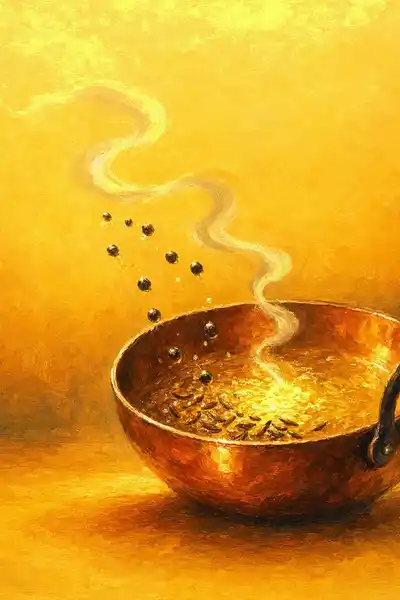
The technique she returns to most is the tempering of spices in hot fat, sometimes at the start of a dish and sometimes as a final flourish poured over the top. She explains what the oil should look like before the seeds go in, what sound to listen for, and how quickly the window closes before the spices burn. She describes bhuna, the patient frying-down of onions, garlic, ginger, and spices into a deep paste that forms the base of countless dishes, and she is candid that it takes longer than most Western cooks expect. Rushing it is the most common mistake, and she says so plainly.
04Chapter 4 — A cuisine reassembled from its parts
Step back from the recipes and Sahni's real subject comes into view. Classic Indian Cooking is a demonstration that an unfamiliar cuisine becomes learnable the moment it is broken into named parts. What looks impenetrable from the outside — a curry that seems to contain a single undifferentiated flavor, a technique that seems to require a childhood spent watching it — turns out to be a finite set of components arranged in patterns. Name the components, explain the patterns, and the wall comes down. The mystery was never in the food. It was in the way the food had been presented.
This is why the constant translation to Western methods matters so much. Sahni understood that people do not learn the genuinely new from scratch; they learn it by attaching it to what they already know. By anchoring every Indian technique to a familiar one, she gives the reader a foothold, and from that foothold the unfamiliar parts become manageable additions rather than a foreign system to be swallowed whole. The pedagogy is as much about respecting the reader's existing knowledge as it is about Indian food.
05Conclusion
Classic Indian Cooking has stayed in print for decades because it does more than feed a craving for particular dishes. It hands the reader a method, and the method outlasts any single recipe. A cook who has worked through the spice chapters and the techniques comes away able to open any Indian recipe, from any source, and understand what it is asking. The book teaches itself out of a job, which is the highest thing a teaching book can do.
Related books