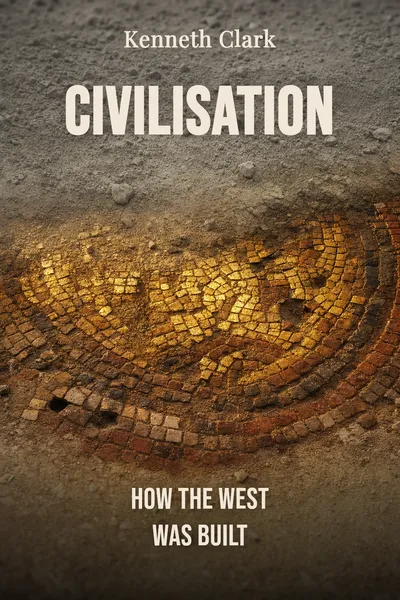
Civilisation
How the West was built
Description
In February 1969, the BBC broadcast the first episode of a thirteen-part series that nobody expected to work. A stooped, tweedy art historian named Kenneth Clark, then in his mid-sixties, walked the reader through cathedrals, palaces and picture galleries across Western Europe, talking to the camera in complete paragraphs, as if the whole of the Western past were a room he happened to know well. He called the series, and the book that came with it, simply Civilisation. The subtitle promised A Personal View, and he meant it — no committee, no thesis defended point by point, just one cultivated man saying, in effect, here is what we made and here is why it moved me.
The gamble paid off in a way that still surprises. The book sold in the millions, the series travelled the world, and a whole generation took its first real look at Chartres, at Giotto, at the Rome of the popes through Clark's eyes. And yet the story he tells is not a triumphant march. It opens not with glory but with near-collapse: a Europe where the roads had crumbled, the towns had emptied, and the accumulated learning of the ancient world hung by the thinnest of threads. Civilisation, in his telling, is not a birthright. It is something that was very nearly lost, and then rebuilt, slowly, by particular people in particular places.
That is the frame worth holding on to. Clark is not writing a textbook of dates and dynasties. He is asking a stranger question — what is it that a society needs, beyond food and safety, to make the things we later call great, and what makes that impulse falter. He never quite defines the word in the title. He prefers to point at buildings and paintings and say: this. But underneath the pointing there is an argument about what keeps the whole enterprise going.
The question we’re asking : What did Western Europe actually need to rebuild itself after Rome, and to keep making the art, buildings and ideas we call our inheritance?What we’ll see : One man's walk through a thousand years of European making, from a civilisation almost extinguished to one quietly unsure of itself again.
Table of contents
01Chapter 1 — The thing that almost didn't survive
Clark begins where most grand histories would rather not: at the bottom. The Western Roman Empire had come apart by the late fifth century, and what followed was not a clean handover but a long thinning-out. Towns shrank, aqueducts silted up, the habit of writing things down nearly disappeared in much of Western Europe. For Clark this is the crucial fact about our civilisation — that it came within a whisker of not existing at all. Whatever came later was built on ground that had very nearly gone dark.
His image for the survival is a small one, chosen on purpose. On the far edge of Europe, on rocky islands off the coast of Ireland and later on Iona and Lindisfarne, monks kept copying manuscripts through the worst of it. In cells barely larger than a monk himself, men who had renounced the world preserved the very books that would let the world be rebuilt. Clark stands at Skellig Michael, a spike of rock in the Atlantic, and makes the point plainly: for a few centuries, the whole of the Western mind was clinging to places like this.

02Chapter 2 — A god made visible in stone and paint
The first great flowering, for Clark, is medieval and it is religious to its core. By the twelfth and thirteenth centuries Europe had steadied enough to build on a scale that still stops people in their tracks. The Gothic cathedral is his central exhibit — Chartres above all — and he treats it not as engineering but as an act of collective conviction. Whole towns poured their labour and money into buildings most of them would not live to see finished, and did so out of a shared certainty that the effort mattered beyond any single life.
Clark's eye is always on what a work reveals about the people who made it. The soaring vaults and the flood of coloured glass at Chartres speak, he thinks, of a moment when European society had recovered its nerve and turned that recovered energy upward. There is joy in it, and order, and a sense of the whole community reaching for something larger than itself. It is confidence expressed in stone — the willingness to begin something enormous and trust that others would carry it on.
03Chapter 3 — The mind turns outward
With the Renaissance, Clark's story shifts key. The great change, as he tells it, is that the West begins to trust human reason and human capacity in a new way. In the Italian city-states, and Florence in particular, wealthy patrons and gifted individuals combine to produce an explosion of confidence in what a person can know, make and become. The scale of ambition is almost startling after the anonymous devotion of the cathedral builders — now individual names matter, and genius is celebrated as such.
He is drawn less to the swagger than to the balance the best of it achieved. Leonardo da Vinci embodies, for Clark, the ideal of a mind at once scientific and artistic, dissecting bodies and studying the flight of birds while painting faces of unrepeatable subtlety. The measure of the age is its attempt to grasp the whole of the world through observation and proportion — man, in the famous phrase, as the measure of things. There is a serenity in early Renaissance art, a faith that the world is intelligible and beautiful and that a human being can hold it steady in the mind.
04Chapter 4 — Confidence, and its slow leaking away
Step back from the buildings and the paintings and Clark's underlying claim comes clear. What holds a civilisation together, he thinks, is not chiefly its laws, its wealth or even its cleverness, but its confidence — a settled belief that the world has order and permanence, and that human beings and their works are worth the effort. It is confidence that lets a town start a cathedral it will not see finished, and confidence that lets Leonardo believe the world can be understood at all. Where that belief is strong, great things get made. Where it drains away, energy and nerve go with it.
This is why he keeps returning to moments of doubt as well as moments of glory. The vitality of Chartres and the calm of the early Renaissance are, for him, expressions of societies sure of themselves. The unease in late Michelangelo, the violence of the wars of religion, are the same civilisation losing that assurance. Clark reads art as a kind of instrument that registers a society's inner confidence far more honestly than its official pronouncements ever could.
05Conclusion
The series ends with Clark, back in his own library, admitting the limits of what he has done. He has shown us cathedrals and frescoes and manuscripts, and told us they add up to something he loves and cannot fully define. The story he traced runs from a Europe almost extinguished after Rome to one that rebuilt itself into Chartres and the Renaissance — and then, in his own time, seemed to grow unsure whether the whole inheritance still mattered. The near-collapse at the beginning and the quiet anxiety at the end are, deliberately, two versions of the same fragility.
Related books