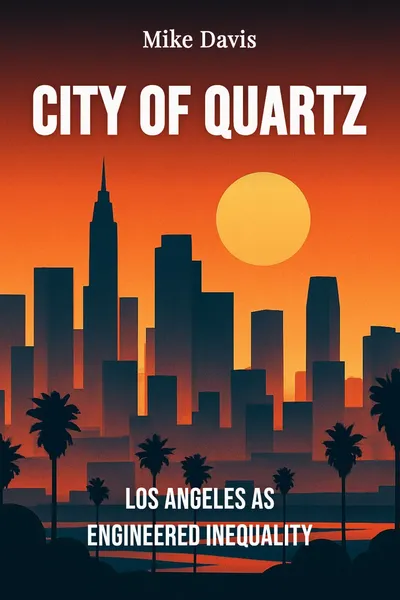
City of Quartz
Los Angeles as engineered inequality
Description
In 1990, a Marxist historian who had driven a truck and cut meat before he ever held a university post published a nearly five-hundred-page book about Los Angeles that almost nobody expected to sell. Mike Davis called it City of Quartz, and he wrote it from the outside — a native son who had watched the city he grew up around harden into something he no longer recognized. The book landed two years before the 1992 uprising set South Central alight, and when the fires came, critics reached for Davis's pages as if he had drawn the map in advance. He hadn't predicted a riot. He had done something stranger: he had shown that the explosion was already written into the concrete.
What made the book detonate was its refusal to treat Los Angeles as an accident. The sprawl, the gated foothills, the freeways that walled off one world from another, the police helicopters overhead — Davis argued none of it was chaos or drift. It was engineering. Somebody chose it, financed it, zoned it and sold it, decade by decade, and the beneficiaries wrote the story afterward as sunshine and opportunity. City of Quartz took that story apart with the patience of a demolition crew, brick by brick, until what was left standing was a city built to keep people apart and dressed up as paradise.
Los Angeles was supposed to be the future — the anti-city, horizontal and open, where anyone could own a lawn. Davis looked at the same landscape and saw walls. His question was not whether the dream had failed but who the dream had always been for, and what had to be spent, policed and hidden to keep it intact for them.
The question we’re asking : How does a city that sells itself as paradise get physically built to hold inequality in place?What we’ll see : How Davis reads Los Angeles through the people who owned it, the force that guarded it, and the myths that made both look natural.
Table of contents
01 Chapter 1 — The sunshine and the noir
Davis opens not with statistics but with two Los Angeleses that have always fought over the same ground. One is the sunshine version — the booster fantasy sold since the 1880s by railroad companies and real-estate men, a Mediterranean Eden of orange groves and single-family homes where the middle class could reinvent itself under a permanent tan. The other is the noir version — the dark, corrupt, doomed city of Raymond Chandler and Nathanael West, of studios and swindlers, where the dream curdles into something rotten. Most writing on LA picks one of these and runs with it. Davis's move is to argue that they are not opposites at all. They are two faces of the same machine.
The sunshine, he shows, was always a sales pitch, and the men who wrote it had material interests. The city grew by boosterism — by convincing hundreds of thousands of Midwesterners to move west and buy subdivided land, which meant the growth itself was the product. Property values were the point. And the noir, the disillusion that followed, was simply what happened when people discovered that the paradise had been priced, fenced and reserved. The two literatures were a running argument between the people selling the city and the people it had disappointed.

02 Chapter 2 — The homeowners who armed the map
If one force built modern Los Angeles, Davis argues, it was the homeowner. Not the developer, not city hall, but the organized suburban property owner defending the value of a house. From the postwar boom onward, whole tracts of the city were sold on a promise: buy here and your neighborhood will stay exactly as it is, which meant white, quiet and rising in price. Racially restrictive covenants wrote that promise into the deeds themselves until the courts struck them down, after which the same instinct migrated into zoning, incorporation and the slow-growth politics that would define the region for decades.
The genius of the arrangement was that it turned exclusion into a civic virtue. A homeowner protecting property values was not, in his own eyes, keeping anyone out — he was defending his family's single largest investment, the one asset that stood between the middle class and ruin. Davis takes this seriously rather than dismissing it. The house was, for millions of people, the whole economic bet of a lifetime, and its value depended on scarcity, on the neighborhood staying desirable, which in practice meant keeping the wrong people and the wrong buildings on the other side of a boundary.
03 Chapter 3 — Fortress LA, by design
The most quoted chapter of City of Quartz reads the built environment itself as a weapon. Davis walks through downtown and its edges cataloguing what he calls the militarization of urban space — the deliberate design of the city to repel the poor. Public benches curved so no one can sleep on them. Sprinklers timed to soak the ground where the homeless might lie down. Trash bins rebuilt as cages so nothing edible can be salvaged. The new corporate downtown sealed behind skywalks and blank walls, its plazas privately owned and its entrances funneled through parking structures, so that the affluent could move from car to office to restaurant without ever touching the street.
Alongside this hardened architecture, Davis places the Los Angeles Police Department, then under Chief Daryl Gates, as the other half of the fortress. He describes a force that had come to treat entire neighborhoods as enemy territory — the helicopter surveillance that gave South Central a permanent low ceiling of rotor noise, the sweeps and gang injunctions, the anti-gang operations that hauled in thousands of young Black and Latino men, most released without charge. Policing, in his reading, was not separate from the design of the city. It was the design continued by other means, the mobile wall that patrolled where the concrete one ran out.
04 Chapter 4 — When the myth becomes the blueprint
Step back from Los Angeles and what City of Quartz really offers is a method — a way of reading any city as a physical record of decisions about who belongs. Davis's argument is that a landscape is never neutral. Every wall, setback, zoning line and patrol route is the frozen result of somebody's interest, and if you trace those interests carefully enough, the map of a city becomes a confession. The genius of the book is to refuse the language of decay and accident that usually surrounds urban inequality. There is no mysterious blight in Davis's Los Angeles. There is only design, and the people who benefit from it.
This is why property, policing and myth have to be read together rather than as separate subjects. The property interests draw the boundaries; the police enforce them; the mythology of sunshine and opportunity makes both look like nature rather than choice. Remove any one of the three and the story falls apart. Take away the myth and the exclusion looks like what it is. Take away the policing and the boundaries cannot hold. Davis's insistence on keeping all three in frame at once is what lets him show a whole system where others saw isolated pathologies.
05 Conclusion
Mike Davis wrote City of Quartz as an outsider who never quite made peace with the city that shaped him, and the book carries that friction on every page. It refuses the sunshine, but it also refuses the easy despair of the noir — it does the harder work of naming who built the walls, why, and at whose expense. When the 1992 uprising came, the book looked prophetic, but Davis had not seen the future. He had simply read the present with more attention than anyone else, and found that the fortress had been under construction for a century.
Related books