China Airborne
China builds its own Boeing
Description
Fly into a second-tier Chinese city today and the odds are decent that the terminal you land in didn't exist a decade ago. When James Fallows was reporting the book that became China Airborne, more than two-thirds of the airports under construction anywhere on the planet were being built in China. The country's airlines were preparing to triple their fleets over the coming decade, which made China the single fastest-growing market for Boeing and Airbus — the customer that would, before long, decide how many wide-bodies rolled off assembly lines in Seattle and Toulouse.
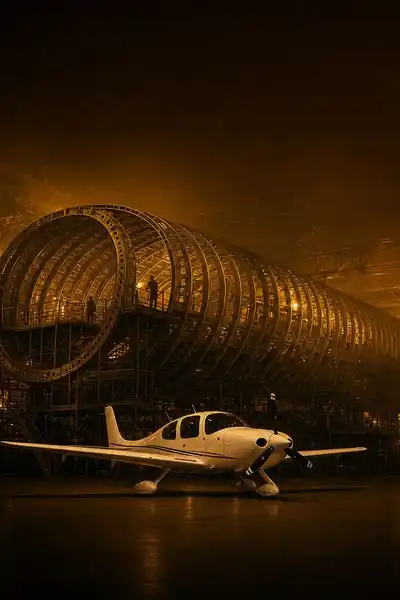
But being the world's biggest buyer was never the ambition. In 2011, Beijing folded a startling line into its Twelfth Five-Year Plan: a commitment to spend something on the order of a quarter of a trillion dollars to jump-start a homegrown aerospace industry. The goal wasn't cheaper regional jets or a bigger fleet of trainers. It was to build the Boeings and Airbuses of the future — to move from the country that assembles iPhones to the country that designs the airliner. To get there, China went shopping in America, quietly acquiring Cirrus Aviation, maker of the world's most popular small propeller plane, and Teledyne Continental, which builds the engines that power it.
Fallows, who learned to fly small planes himself and spent years living in China, treats aviation as an unusually honest gauge. A plane is a machine that punishes shortcuts, and an aerospace industry is a machine that punishes the habits of a controlled economy. Watching China try to build one, he argues, tells us something the growth statistics never quite do about where the country is actually headed.
The question we’re asking : Can a state that excelled at manufacturing at scale make the leap to inventing the hardest machines humans build?What we’ll see : An aviation boom, a national bet, an American shopping spree, and the deeper thing airplanes reveal about a country in a hurry.
Table of contents
01 Chapter 1 — A country building runways faster than it builds pilots
The scale of China's aviation expansion is hard to hold in the head. Fallows describes a landscape where new airports were opening at a pace no country had attempted before, where cities most Westerners couldn't place on a map were laying down runways long enough for jets. The demand was real: a rising middle class wanted to travel, distances inside the country are continental, and rail — even fast rail — couldn't cover everything. For Boeing and Airbus, China wasn't one market among many. It was the market whose orders kept the factories humming.
Yet the boom rested on foundations that hadn't grown at the same speed. Airplanes need pilots, mechanics, air-traffic controllers, and a whole invisible apparatus of maintenance and safety culture, and those take longer to build than concrete. China was importing pilots and training them abroad, hiring foreign expertise to run operations, and racing to close a gap that money alone couldn't close overnight. A runway can be poured in a season. A seasoned captain takes years, and a safety culture takes a generation.

02 Chapter 2 — The quarter-trillion-dollar bet on the Twelfth Five-Year Plan
In 2011, the aviation ambition stopped being an implication and became policy. The Twelfth Five-Year Plan named aerospace as a strategic priority and attached a number to it — on the order of a quarter of a trillion dollars aimed at building a domestic industry capable of competing with the giants. This was not a subsidy program in the ordinary sense. It was a declaration that China intended to stop being merely the customer and become the manufacturer, at the top of the value chain rather than the bottom.
The logic was the same logic that had already reshaped whole sectors. China had watched too much of its manufacturing wealth flow to the companies that owned the designs and the brands, while Chinese factories captured the thin margins of assembly. Aerospace was the ultimate version of that trap: the country would spend fortunes buying jets it could not build, importing the highest-value manufactured goods on earth. Climbing that ladder meant capturing the engineering, the certification, the whole system that surrounds an aircraft — not just the riveting.
03 Chapter 3 — Buying the know-how: Cirrus, Teledyne, and the C919
One way to skip years of trial and error is to buy the people who already know. That's the strategy Fallows traces through two American acquisitions. Chinese interests bought Cirrus Aviation, the Minnesota company behind the world's best-selling small propeller plane, famous for putting a whole-airplane parachute into a light aircraft. They also acquired Teledyne Continental, which builds the piston engines that power Cirrus and much of the general-aviation fleet. In one stroke, China owned both a beloved airframe and the engines to turn it.
The purchases tell you something about how the leap was meant to happen. Rather than reinvent the small-plane business from scratch, China acquired working companies with real engineering cultures, established customers, and — crucially — hard-won certification and know-how. The bet was that ownership would let that expertise migrate, seeding a general-aviation industry at home and training Chinese engineers in the disciplines that don't transfer from a textbook. It was the same instinct that had built other Chinese industries: buy the ladder rather than climb it.
04 Chapter 4 — What aerospace demands that China hasn't decided to give
Step back from the runways and the acquisitions and Fallows's larger argument comes into view: aerospace is a stress test for the kind of country China wants to be. Building airliners the world will fly requires more than engineering. It requires openness to outside scrutiny, tolerance for bad news traveling upward, transparent investigation when things go wrong, and a rule-bound predictability that lets foreign partners and regulators trust you. These are not incidental. They are the operating conditions of the industry.
And they sit uneasily with the instincts of a controlled state. An aviation safety culture depends on a mechanic being free to ground an aircraft, an investigator being free to publish an uncomfortable finding, a controller being free to overrule authority in the name of physics. Innovation at the frontier depends on information moving freely, on failure being examined rather than hidden, on the kind of open ferment that thrives in loosely governed spaces. China's political system was built, in many ways, to do the opposite — to keep control, manage information, and decide from the top.
05 Conclusion
Come back to those runways being poured across China faster than anywhere on earth. They were never really about airports. They were the visible edge of a wager that a country could will itself to the top of the hardest industry humans have built, spending a quarter of a trillion dollars and buying up American firms to shorten the climb. Fallows never pretends to know how the bet resolves. He shows instead that the answer depends less on capital or ambition — China had both in abundance — than on habits of trust, openness, and honest information that no five-year plan can appropriate.
Related books