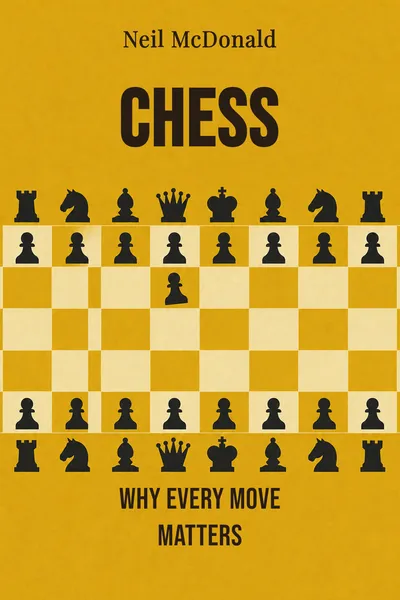
Chess
Why every move matters
Description
A chess game starts with thirty-two pieces standing in perfect symmetry, and for about two seconds the board looks like a fair fight. Then someone moves a pawn, and the symmetry is gone forever. That small, almost casual gesture — a pawn to the center, a knight to a modest square — has already begun to shape everything that follows. Neil McDonald builds his book around this observation, and it is a quietly radical one: a chess game is not a series of separate puzzles to be solved one at a time. It is a single continuous argument, and the last move is answering the first.
Most people who learn chess are handed the pieces, taught how each one crawls or leaps across the board, and then left to flail. They memorize a few opening tricks, hope to trap the opponent, and treat the middlegame as a scramble. McDonald's whole approach pushes against that. He takes the reader through one complete game — opening, middlegame, endgame — and at each turn he stops to ask the only question that matters: why this move and not another? What is it trying to do, and what will it cost later?
That is a different way of seeing the board. Not as a battlefield where you react to threats, but as a structure you are building, brick by brick, where a weakness invited on move eight might be the thing that sinks you on move forty. The reasoning is the point. The moves are just where the reasoning shows up.
The question we’re asking : How does a single chess game hold together as one connected line of reasoning, from the very first pawn to the final king?What we’ll see : How McDonald walks a game through its three phases and shows the thread of cause and consequence that ties them into one whole.
Table of contents
01Chapter 1 — The opening is a promise you have to keep
The opening, in McDonald's telling, is not about memorizing sequences of moves — it is about three modest goals that a good player pursues without even thinking of them as separate. Get the pieces off the back rank and into play. Put a stake in the center of the board. Tuck the king somewhere safe, usually by castling. These sound almost too simple to matter. But they are promises, and the rest of the game holds you to them. A player who ignores development to grab a pawn is borrowing time at a rate that comes due, often painfully, twenty moves later.
What McDonald wants the developing player to feel is that every opening move is a small commitment about the kind of game you want to play. Push a pawn two squares and you claim space but leave a hole behind it. Fianchetto a bishop out to the wing and you gain a long diagonal but concede the color of squares it can never touch. Nothing is free. The opening is a negotiation with the position you will have to live in, and the moves that look natural are natural precisely because they keep the most promises at once.

02Chapter 2 — Where plans are born and games are lost
Once the pieces are out and the kings are safe, the board reaches the moment McDonald treats as the heart of the game: the transition into the middlegame, where a player finally has to decide what they are actually trying to do. This is where beginners freeze. They have run out of memorized moves and there is no obvious threat to answer, so they shuffle a piece and wait. McDonald's remedy is to read the position for what it is telling you — where the pawns are fixed, which files are open, which squares neither side can defend — and to let the structure suggest the plan rather than inventing one out of hope.
Pawns do most of this talking. Because they cannot move backward, a pawn move is the most permanent decision on the board, and the skeleton the pawns form dictates almost everything that can happen around them. A backward pawn becomes a target the opponent will camp against for the rest of the game. An open file becomes a highway for a rook. A hole in front of a pawn chain becomes a home for a knight that cannot be dislodged. McDonald keeps returning the reader's eye to these features, because they are where the real plan lives.
03Chapter 3 — The middlegame is a negotiation, not a brawl
It is tempting to picture the middlegame as the moment the fighting starts — pieces crashing into each other, sacrifices, checkmate threats. McDonald gently corrects this. Most of the middlegame is maneuvering: repositioning a badly-placed knight to a better square, doubling rooks on a file before anything happens on it, provoking a small pawn weakness that will matter only much later. The dramatic combinations that win games are almost always the payoff of this patient groundwork, not a substitute for it.
He is especially good on the trade-offs of exchanging pieces, which developing players tend to do reflexively. Every trade changes the character of the position. Swap off the opponent's active piece and you have neutralized their initiative; swap off your own good piece for their bad one and you have handed them a favor. McDonald teaches the reader to ask, before every capture, whether the exchange helps the plan or merely simplifies for its own sake. The right trades sharpen your advantage; the wrong ones quietly dissolve it.
04Chapter 4 — The endgame remembers everything
When the pieces come off and a handful remain, the game does not become simpler so much as more honest. McDonald treats the endgame as the moment the board finally settles all its earlier accounts. The extra pawn you won in the middlegame, the weak square you created in the opening, the passive bishop you never activated — none of it disappeared. It was all being carried forward, and now, with fewer pieces to hide behind, it decides the result. A game is a chain of consequence, and the endgame is where the chain is pulled tight.
This is the deepest point in his book, and it reaches past chess. The endgame reveals that nothing on the board was ever an isolated event. The king, a liability all game long, suddenly becomes a fighting piece and marches toward the center. A pawn that looked like nothing becomes a queen if it can reach the far rank. The value of every piece has shifted because the context has shifted — and the context is simply the accumulated weight of every move that came before. Reading an endgame well means reading the history that produced it.
05Conclusion
McDonald's book takes a single game and refuses to chop it into lessons. Opening, middlegame, endgame — he treats them as three views of one continuous act of reasoning, where the pawn pushed on move six is still speaking on move fifty. The developing player he is writing for tends to arrive hoping for tricks and shortcuts, and he offers something better and harder: the habit of asking, before every move, what it is for and what it will cost. Understand that, and the named openings and memorized endings become what they always were — shorthand for reasoning you can now do yourself.
Related books