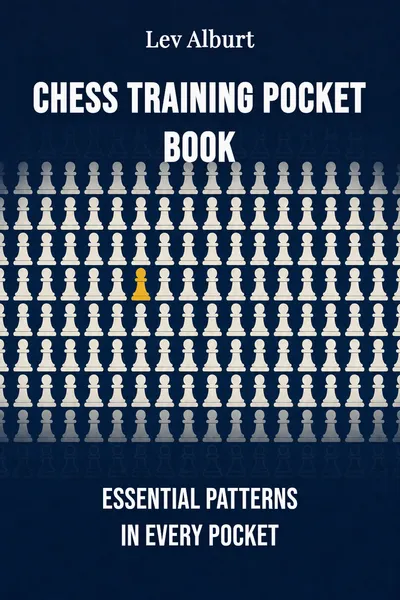
Chess Training Pocket Book
Essential patterns in every pocket
Description
Somewhere around the year 2000, an American grandmaster named Lev Alburt did something faintly unfashionable for a chess author. Instead of writing another five-hundred-page treatise on the Sicilian or a dense manual of endgame theory, he assembled a small book you could slip into a jacket pocket. Inside were three hundred positions — tactics, principles, key setups — each on its own page, with the diagram on one side and the answer on the other. No sprawling prose, no exhaustive variations. Just the position, the idea, and the instruction to come back to it again.
Alburt knew the terrain. Three-time U.S. champion, a defector from the Soviet chess machine that had produced most of the twentieth century's world champions, he had spent years teaching amateurs who all shared the same problem. They read chess books. They understood the explanations. And then, in an actual game, with a clock ticking, none of it surfaced in time. The knowledge was in there somewhere, but it wasn't reachable at the moment it mattered. The gap between understanding a chess idea and using it turned out to be the whole game.
The Chess Training Pocket Book is Alburt's answer to that gap, and it rests on a claim about improvement that runs against the instinct of most ambitious players. Getting better, he argues, is less about learning new things than about making a small set of essential things automatic. The book is built to be carried, opened at a spare moment, and reviewed until its positions stop being puzzles and start being reflexes.
The question we’re asking : How does a compact book of positions, meant to be reviewed rather than read, actually make a chess player stronger?What we’ll see : How Alburt boiled the game down to what a developing player must internalize — and why he bet on recognition and repetition rather than explanation.
Table of contents
01Chapter 1 — Three hundred positions, one pocket
The physical form of the book is not an accident, and Alburt is explicit about it. Chess study, for most amateurs, happens in stolen moments — a train ride, a lunch break, ten minutes before bed. A heavy volume of theory demands a desk, a board, and a stretch of uninterrupted concentration that busy adults rarely have. A pocket book demands nothing. You open it, you look at one diagram, you test yourself, you close it. The threshold to study drops close to zero, and Alburt's wager is that frequency beats intensity: many short encounters with the material work better than a few long ones.
What fills those three hundred pages is a deliberate selection rather than a survey. Alburt and his co-author, Larry Parr, chose positions that carry the highest practical return — the tactical motifs that decide the majority of amateur games, the strategic principles that come up in nearly every opening, the endgame positions a player simply must know to convert or hold. The aim is not encyclopedic coverage. It is the opposite: to identify the essential core and refuse everything else. A developing player, the reasoning goes, is drowning less in ignorance than in an unsorted heap of half-remembered ideas.

02Chapter 2 — The case for pattern over calculation
Beginners tend to believe that chess strength is calculation: the ability to see further, to work out longer sequences of moves than the opponent. It is a natural assumption, and it is mostly wrong. Alburt's book is built on the opposite premise, one that has been confirmed by decades of research into how strong players actually think. What separates a master from an amateur is far less the depth of calculation than the number of patterns he recognizes instantly, without calculating at all.
The classic demonstration goes back to the psychologist Adriaan de Groot in the 1940s and later Herbert Simon and William Chase in the 1970s. Shown a position from a real game for a few seconds, masters could reconstruct it almost perfectly, while weaker players could not. But shown a board of randomly scattered pieces, the masters lost their advantage entirely. They were not seeing individual pieces. They were seeing familiar chunks — recognizable configurations they had met thousands of times before. Estimates put a master's stored library somewhere in the tens of thousands of such patterns.
03Chapter 3 — Repetition as a training method
The instruction that runs through the whole book is deceptively plain: come back. A position is not meant to be solved once and abandoned. It is meant to be revisited, days and weeks later, until the solution surfaces without hesitation. Alburt treats the pocket book less as something you read than as something you rehearse, and the difference is the entire method. Reading is linear and finished; rehearsal is cyclical and never quite done.
This lines up with something learning research has understood for a long time, going back to Hermann Ebbinghaus and his memory curves in the 1880s. We forget most of what we take in, and we forget it fast, unless the material is revisited. But revisiting works best when it is spaced out over time rather than crammed, and when it forces active recall rather than passive rereading. Alburt's format quietly builds in both. Because each answer is hidden, every visit is a test, and because the book travels with the player, those tests can be spread across ordinary days.
04Chapter 4 — What a pocket-sized book says about how we learn a game
Step back from the diagrams and the format reveals a quiet argument about what mastery in chess really is. We tend to romanticize the game as pure intellect — the lone genius calculating deeper than anyone else, seeing moves nobody else can see. Alburt's little book insists on something more ordinary and, in its way, more encouraging: strength is mostly a vast, well-organized memory. The grandmaster's apparent brilliance at the board is often just the fast retrieval of things already stored, patterns met so many times they no longer feel like thinking.
If that is true, then improvement is not reserved for the naturally gifted. It becomes a matter of loading the right material and rehearsing it until it holds. The pocket book is a bet on this democratic view of talent. It says the difference between an amateur and a much stronger player is not a mysterious faculty but an accumulation — a library built one recognized shape at a time, by anyone willing to keep turning the pages. Alburt, who was trained inside the Soviet system that treated chess strength as something manufactured rather than born, carries that assumption naturally.
05Conclusion
The Chess Training Pocket Book ends up being a book about the mechanics of getting better far more than a book about chess positions, even though positions are all it contains. Its three hundred diagrams are the vehicle; the real content is a claim about how a player crosses the distance between understanding an idea and using it under pressure. Alburt's answer is that you close the gap not by learning more but by drilling less material deeper, until recognition replaces calculation and the right move arrives before the analysis does.
Related books