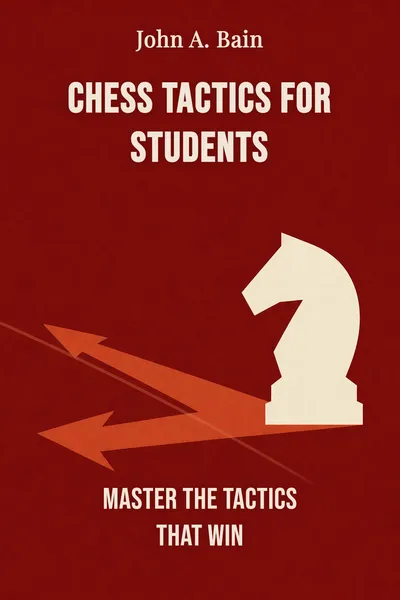
Chess Tactics for Students
Master the tactics that win
Description
Almost everyone who plays chess learns the rules in an afternoon. The pawn moves forward, the bishop travels on its diagonal, the knight jumps in its awkward L. A child can absorb all of it before dinner. And then, for most people, the game stalls right there — moves are legal, the pieces shuffle around, and games are won or lost by whoever blunders last. The distance between knowing how the pieces move and actually winning turns out to be enormous, and nothing in the rulebook tells us how to cross it.
John A. Bain, a longtime teacher of scholastic chess, built his workbook Chess Tactics for Students to attack exactly that gap. His premise is deceptively plain: the difference between a beginner who flails and a player who wins is not intelligence, patience, or some mysterious talent. It is recognition. Strong players see certain shapes on the board — a fork waiting to happen, a pinned piece that cannot run — the way a fluent reader sees words rather than letters. Bain's bet is that this seeing can be drilled, deliberately, one pattern at a time.
What makes the book worth sitting with is not a grand theory of chess but a method that quietly refuses the usual way of teaching it. There are no long lectures on strategy, no famous games annotated move by move. There are positions, hundreds of them, arranged so that the same shape returns again and again until the eye stops working and starts simply knowing.
The question we’re asking : How does a beginner cross the distance between knowing the rules and actually winning games?What we’ll see : How a small set of recurring shapes, drilled until they become automatic, turns flailing into calculation.
Table of contents
01Chapter 1 — The gap between rules and results
The rules of chess are finite and quickly learned; the game they produce is not. Bain's starting observation is that most instruction stops precisely where it should begin. Books hand the beginner the movements of the pieces, maybe a few opening principles about controlling the center, and then leave them to figure out the rest by losing. The losing does teach something, but slowly, and often the wrong lesson — the player concludes they are simply bad at chess rather than that they are missing a specific, learnable skill.
That skill, in Bain's account, is tactics: short, forcing sequences that win material or force checkmate, usually inside two or three moves. Tactics are where most games between newer players are actually decided. Somebody leaves a piece undefended, somebody's king gets a little too exposed, and the game swings on a handful of moves that had nothing to do with grand strategy. Bain's claim is that these decisive moments are not random. They arrive in recognizable forms, and the same forms recur constantly.

02Chapter 2 — The vocabulary of the fork, the pin, the skewer
The building blocks Bain teaches have names, and the names matter, because a pattern you can name is a pattern you can look for. The fork is the first and friendliest: a single piece attacking two enemy pieces at the same time, so that saving one loses the other. The knight is the great forker, because its jump can hit two targets that cannot defend each other, but pawns, bishops, queens, even the king can fork given the right arrangement. Once a student has seen fifty forks, the shape starts jumping off the board unbidden.
The pin is subtler and, in its way, crueler. A piece is pinned when moving it would expose something more valuable behind it — most sharply, when moving it would expose the king, which makes the move illegal outright. A pinned piece is a piece frozen in place, unable to do its job of attacking or defending, and Bain shows how a frozen defender can then be piled on and won. The skewer is the pin's mirror image: the valuable piece stands in front, is forced to move, and the piece behind it falls. Same geometry, reversed order.
03Chapter 3 — Why the workbook beats the lecture
The design choice that defines the book is that it is a workbook, not a treatise. Bain gives a short explanation of each pattern and then hands over the work: page after page of positions in which the student must find the winning move. The answers live in the back, but the point is the search, not the answer. Chess tactics, in this view, are not knowledge to be acquired once but a reflex to be conditioned through volume.
This mirrors how skill actually forms. A person does not become fluent in a language by studying grammar tables; they become fluent by encountering the same structures hundreds of times until comprehension stops being effortful. Bain arranges his exercises so that a single pattern is hammered repeatedly before the next one appears, and then earlier patterns are folded back in so they do not fade. Recognition that is not refreshed decays, and the sequencing is built to keep it alive.
04Chapter 4 — What a tactic teaches beyond the board
Step back from the sixty-four squares and the workbook is quietly making a larger argument about how anyone gets good at anything. The instinct, faced with a beginner who keeps losing, is to reach for explanation — to describe the principle more clearly, more thoroughly, in the hope that comprehension will convert into skill. Bain's method assumes the opposite. Skill is what remains after the explanation has been forgotten and the eye has taken over. The tactic works because it has stopped being a thing you know and become a thing you notice.
This reframes what we usually call chess talent. A strong player calculating a combination in seconds is not thinking faster than the rest of us; they are recognizing rather than reasoning. The shape is stored, retrievable whole, so the mental work is nearly instant. What looks like intelligence is really an enormous library of patterns built through exposure. Bain's promise to students is that this library is not the private property of the gifted — it is built one exercise at a time, and the building is available to anyone willing to do the reps.
05Conclusion
The distance that opened the book — between knowing how the pieces move and actually winning — turns out to have a concrete shape and a concrete crossing. Bain's answer is that games between developing players are decided by tactics, that tactics come in a small set of nameable patterns, and that those patterns can be drilled into automatic recognition through volume. The fork, the pin, the skewer, the discovered attack, the back-rank mate: master these by finding them hundreds of times, and the board stops being a wall of possibilities and starts organizing itself into meaning.
Related books