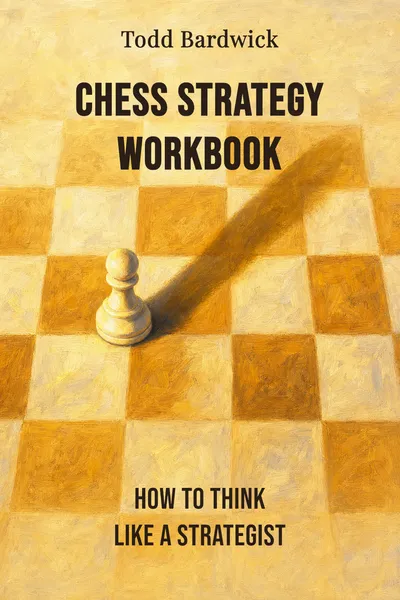
Chess Strategy Workbook
How to think like a strategist
Description
Sit two amateurs down at a board and watch the openings. For a dozen moves, both play like people who've read the same books — knights out, castle early, don't hang the queen. Then the memorized lines run out, the position turns quiet and unfamiliar, and something changes. One player keeps making moves. The other starts staring. The pieces are all developed, nothing is under immediate threat, and there's no book to tell them what to do next. This is the moment where most club players quietly lose the game, long before any piece actually falls.
That silence is what Todd Bardwick built a whole book around. A chess instructor who has spent years coaching students in Colorado, Bardwick noticed that his players could calculate short tactics and recite opening theory, but froze the instant a position asked them to have a plan. They knew how the pieces moved. They didn't know what to want. His Chess Strategy Workbook is his attempt to fix exactly that gap — not with more lines to memorize, but with a repeatable way of looking at a position and deciding what it's asking for.
The premise is almost stubbornly practical. Strategy, in Bardwick's hands, isn't mystical intuition reserved for grandmasters. It's a habit: evaluate what's actually on the board, notice the features that matter, and let those features hand you a plan. The workbook is less a treatise than a training floor — examples to study, positions to judge, moves to justify out loud. What it really teaches is a way of thinking that outlives any single game.
The question we’re asking : How does a player move from making legal moves to making purposeful ones — and can that be trained?What we’ll see : How Bardwick turns positional judgment into a repeatable method, and what that method reveals about learning any hard skill.
Table of contents
01Chapter 1 — The move that feels obvious and the move that works
Bardwick starts by naming the enemy, and it isn't the opponent. It's the move that looks good. Beginners, he argues, play reactively — they see a piece they can take, a check they can give, a square that looks inviting, and they grab it. The move feels productive. Something happened. But a move that responds only to the surface of a position, without asking what the position as a whole needs, is usually a wasted turn. Over a full game, a stack of individually reasonable-looking moves with no thread connecting them adds up to a loss that no single blunder explains.
The workbook's whole architecture pushes against this reflex. Bardwick keeps insisting that before you decide what to do, you have to decide what kind of position you're in. Is it sharp or quiet? Are you ahead in space, behind in development, sitting on a structural weakness the other side hasn't noticed yet? Only after that reading does a move stop being a guess. The point he returns to again and again is that good moves aren't found; they're deduced from what the board already tells you.

02Chapter 2 — Reading the board before touching a piece
If the first lesson is to stop grabbing, the second is what to do with the pause. Bardwick breaks position evaluation into a set of concrete features a player can actually check, one by one, instead of hoping insight arrives on its own. Material is the obvious one, but he treats it as only the beginning. King safety, pawn structure, piece activity, control of key squares and open files, space, and the initiative — each is a lens, and a position looks different depending on which one you hold up to it.
The workbook trains these as habits rather than facts. Take pawn structure: Bardwick shows how an isolated pawn or a set of doubled pawns isn't automatically good or bad, but a feature that suggests plans for both sides — the side with the weakness wants activity to compensate, the side facing it wants to blockade and grind. A weak square deep in enemy territory becomes an invitation to plant a knight where it can't be chased. The reader learns to see the board not as thirty-two pieces but as a landscape of pressures and openings.
03Chapter 3 — From evaluation to a plan that holds
Evaluation is diagnosis; the plan is treatment, and Bardwick is careful not to let the reader stop at the first. Seeing that your opponent has a weak pawn is useless if you don't convert that observation into a sequence of moves aimed at exploiting it. A plan, in the workbook's terms, is a short chain of intentions — improve this piece, open that file, provoke this weakness — that gives every move a reason to exist. Without one, a player drifts, and drifting against someone with a plan is how good positions quietly turn bad.
The book insists that plans grow out of the position's features rather than being imposed on them. If you own more space, the plan tends toward squeezing and restricting the opponent's pieces. If you're cramped, the plan is to trade pieces and find breathing room. If there's an open file, the plan involves getting a rook onto it. Bardwick keeps tying the abstract idea back to the concrete evidence, so the reader never learns a plan as a slogan — they learn to derive it from what's in front of them, which means it transfers to positions the book never showed them.
04Chapter 4 — Where the drills stop and the thinking starts
Step back from the diagrams and Bardwick's workbook is making a claim that reaches past chess. Most of what people call learning a skill is really memorization dressed up as understanding — the opening lines, the tactical patterns, the moves that worked last time. That kind of knowledge is real and useful, but it has a hard ceiling. It works only in situations that resemble the ones you've already seen. The moment the board turns novel, memorized knowledge goes quiet, and you're left with whatever judgment you actually built underneath it.
The workbook is essentially an argument that judgment can be trained, but only by a particular kind of practice. Not repetition of answers, but repetition of the process that produces answers — look, evaluate, plan, decide, check. Bardwick never lets the reader off with the solution alone; he wants the reasoning that got there, because the reasoning is the part that generalizes. A chess player who has memorized a thousand positions is fragile. One who has internalized a way of interrogating any position is not.
05Conclusion
Come back to those two amateurs and the quiet position where one of them froze. Bardwick's whole project is aimed at that frozen player — not to hand them the right move, but to give them something to do when no move is obvious. Evaluate the features. Notice where the tension lives. Let the position suggest a plan, act on it, and re-check when the board shifts. The silence stops being paralysis and becomes the moment where the real game begins, the point where a trained eye finally has more to say than a memorized one.
Related books