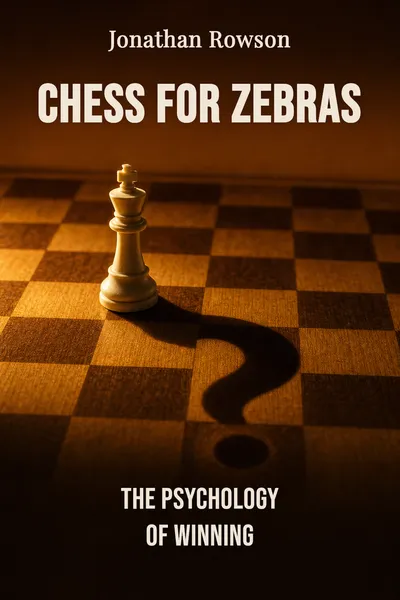
Chess for Zebras
The psychology of winning
Description
Jonathan Rowson was a three-time British chess champion and a grandmaster when he sat down to write a book about why so many committed players stop improving. He had noticed something odd in himself and in the ambitious amateurs around him: they read the books, they memorized the openings, they drilled the tactics puzzles, and their ratings barely moved. The effort was real. The results were not. Something in the standard recipe for getting better was quietly failing the people who followed it most faithfully.
His answer, published in 2005 as Chess for Zebras, refuses the usual promise of a chess manual. It offers almost no opening theory to memorize and few positions to file away for later. Instead it turns the question inward. Rowson argues that adult players plateau not because they lack knowledge but because of how they think, how they feel while they think, and how skillfully they lie to themselves about both. The board becomes a place to watch the mind at work under pressure.
What makes the book unusual is that a grandmaster is willing to talk about doubt, discomfort, and the strange asymmetry of sitting down as White versus Black — the psychological texture that most instruction treats as noise to be filtered out. Rowson treats it as the actual signal. The zebra of the title is a reminder that we tend to see the game in black and white when the interesting truths live in the stripes between.
The question we’re asking : Why do serious, hard-working chess players so often stop improving, and what would it take to start again?What we’ll see : How a grandmaster relocates the real work of chess from the board to the mind sitting in front of it.
Table of contents
01Chapter 1 — Why grown-ups stop getting better
Rowson starts from a frustration most improving players know intimately. You buy the books, you study the games of the masters, you run through tactics until the patterns feel automatic — and the rating chart flatlines anyway. The conventional explanation is that you simply need more of the same: more theory, more practice, more hours. Rowson thinks that explanation is not just wrong but actively harmful, because it keeps people pouring energy into the one channel that has already stopped paying out.
The problem, he argues, is that adults acquire knowledge much more easily than they acquire skill. Knowledge is the stuff you can state — this opening move, that endgame rule, this evaluation of a pawn structure. Skill is the capacity to do the right thing in a live position under a ticking clock, and it lives somewhere the textbook cannot reach. Piling up more knowledge feels like progress because it is measurable and comforting, but past a certain point it stops converting into stronger play. You end up knowing more and playing the same.

02Chapter 2 — The color you play is a state of mind
One of the book's most distinctive moves is to take seriously something players feel but rarely examine: that playing White and playing Black are not merely two sides of one game but two different psychological situations. White moves first, holds the initiative, and carries the burden of proving an advantage. Black responds, absorbs pressure, and looks for the moment to seize the game back. Rowson argues these are not just strategic conditions — they are mindsets, and most players fail to adopt the right one for the color in front of them.
With White, he says, the danger is passivity dressed up as solidity. Many players treat the first move as a license to sit on a small edge and wait, which quietly surrenders the very initiative that made White worth having. Rowson pushes for ambition with White — an active, questioning attitude that keeps posing problems rather than protecting a lead that evaporates the moment you stop pressing. The advantage is real but perishable, and it rewards nerve, not caution.
03Chapter 3 — The lies we tell ourselves at the board
If the first half of the book relocates chess in the mind, the second half looks squarely at what the mind does to protect itself. Rowson is unusually candid, for a grandmaster, about the role of emotion and self-deception in play. We do not calculate coldly. We calculate while frightened, hopeful, bored, or proud, and those feelings bend the analysis without announcing themselves. The player who believes they are being objective is often the one most thoroughly fooled.
The most common lie is the one we tell to feel comfortable. Faced with a position that demands a hard, sharp decision, we quietly talk ourselves into the safe, familiar move and then invent a justification for it after the fact. Rowson describes how players convince themselves a position is equal because they want it to be, or dismiss a threat because seeing it clearly would be alarming. The wish shapes the assessment, and the assessment then feels like plain observation.
04Chapter 4 — Skill you can't quite explain
Step back from the sixty-four squares and Rowson's argument becomes a claim about expertise in general. The reason strong players cannot fully explain their best moves — the reason a grandmaster will say a position simply feels wrong before they can articulate why — is that mastery lives largely in tacit knowledge, the kind you have in your hands and your intuition rather than in words. This is knowledge you cannot fully write down, which is precisely why it cannot be transferred by reading. It has to be grown.
That single idea reframes why the study-more instinct fails. Books, databases, and lessons trade in the explicit, statable part of the game, because that is the only part that fits on a page. But the decisive part of skill is the wordless pattern-sense built up through thousands of lived encounters with real positions. You can no more read your way to it than you can read your way to riding a bicycle. Information is cheap and abundant; the embodied understanding that turns information into good moves is neither, and no amount of the former substitutes for the latter.
05Conclusion
Rowson set out to explain why devoted players stop improving, and his answer turns the usual advice inside out. The bottleneck is rarely a missing piece of knowledge. It is the way we think under pressure, the color-blind mindset we bring to White and Black alike, and the small, constant deceptions we practice to stay comfortable. Getting better, in his telling, means catching yourself in those habits and choosing the harder path on purpose — courting the discomfort that signals you are actually at the edge of what you can do.
Related books