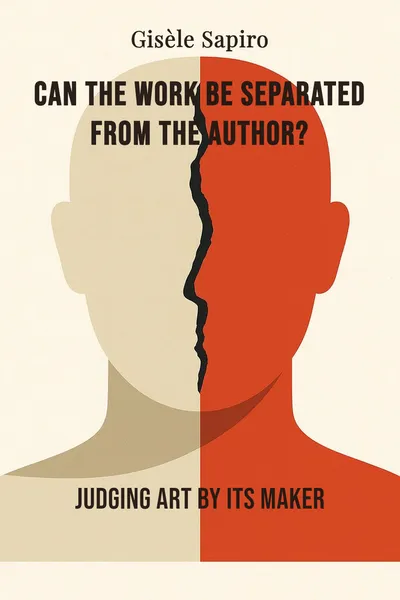
Can the Work Be Separated from the Author?
Judging art by its maker
Description
In the autumn of 2017, the same photographs and testimonies that toppled Harvey Weinstein began circulating through the art world, and a question that had lived quietly in philosophy seminars suddenly turned up at dinner tables and in bookstore aisles. Can we still read Louis-Ferdinand Céline knowing what he wrote in his antisemitic pamphlets? Should the Cinémathèque française have honoured Roman Polanski? Was it acceptable to keep publishing the accused? These were not new dilemmas. What was new was that everyone was being asked to have an answer, and fast, as if the whole matter could be settled with a yes or a no.
The French sociologist Gisèle Sapiro, who has spent her career studying how literature and its institutions actually work, watched the debate curdle into two camps. On one side, the purists of the text: the work stands alone, the life is irrelevant, judging a novel by its author is a category error. On the other, the moralists: a monster's art is tainted, and consuming it makes us complicit. Both positions, she noticed, shared the same flaw. They treated the link between a work and its maker as a fixed fact, when it is nothing of the kind.
Her short book takes the question apart the way a sociologist would — not to hand down a verdict, but to show why the verdict keeps shifting depending on who is asking, about whom, and when. The bond between creator and creation, she argues, is built, negotiated and occasionally dismantled by people and institutions, and that is where the real story lives.
The question we’re asking : When we condemn or excuse a work because of who made it, what are we actually doing — passing moral judgment, or something more social than that?What we’ll see : How a moral panic reveals the machinery that quietly binds a name to a book, and decides which names survive.
Table of contents
01Chapter 1 — The trials that made the question unavoidable
Sapiro's instinct is to reach for cases where the abstract question became concrete, and few are sharper than the courtroom. When Gustave Flaubert stood trial in 1857 for Madame Bovary, and Charles Baudelaire the same year for Les Fleurs du mal, the prosecution's move was precisely to fuse the author with the work: the immorality of the pages proved the immorality of the man, who must answer for both. Flaubert's defence built the opposite argument. The novelist disappears behind his characters; Emma's sins are Emma's, not Gustave's. That courtroom split is the ancestor of the debate we are still having.
What the trials establish is that the question is never purely aesthetic. It arrives loaded with legal, moral and political stakes, and the answer given depends on what is at risk. A censor wants the author bound tightly to the text so that punishing one punishes the other. A defender wants the two prised apart so that the book survives whatever the man did. Neither is describing an eternal truth about art. Each is arguing for a relation that suits the moment.

02Chapter 2 — A relation, not an equation
Instead of asking whether work and author can be separated, Sapiro reframes the whole thing: what kind of relation binds them in the first place? Her answer is that there is no single bond but several, layered on top of each other, and confusing them is what makes the debate so slippery. There is a legal relation — the author holds rights, bears liability, signs a contract. There is a moral relation, in which we hold a person accountable for what they said or did. And there is a properly literary relation, the way a body of work carries the mark of a sensibility we call a style.
These relations do not move together. A writer can be legally guilty and stylistically brilliant, morally repugnant and formally innovative, personally decent and artistically negligible. The mistake of both camps in the 2017 debate was to collapse the layers into one. The purists erased the moral and legal relations to protect the literary one. The moralists let the moral relation swallow everything, until the prose itself became evidence for the prosecution. Sapiro's move is simply to keep the layers distinct and watch how they interact.
03Chapter 3 — What responsibility a signature actually carries
If the author is bound to the work by a signature, Sapiro wants to know what that signature actually commits a person to. Here she leans on a distinction between the writer as a private individual and the writer as a public authority who lends a name to a cause. When Émile Zola signed "J'accuse" in 1898, he was not offering a novel for aesthetic appreciation; he was staking the whole of his accumulated prestige on a political intervention. The signature was the point. The responsibility was total and deliberate.
This is the intellectual's characteristic gesture, and it cuts both ways. The same mechanism that lets Zola convert literary fame into moral force lets a Céline convert it into the amplification of hatred. When a celebrated writer publishes a pamphlet, the fame is not incidental — it is what gives the words their reach. Sapiro argues that we are right to hold such authors accountable, but the accountability attaches to the act of public engagement, not to fiction as such. The novelist speaking through invented characters and the polemicist signing in his own name are doing different things with a name.
04Chapter 4 — The market that decides who gets forgiven
Step back from the ethics and a colder mechanism comes into view, which is where Sapiro's sociology does its real work. Whether a given work survives its author's disgrace is decided less by the strength of moral arguments than by the institutions that assign and withdraw value — publishers, prize juries, universities, festivals, critics, and the reading public whose attention is itself a currency. The question "can the work be separated from the author?" turns out to be, in practice, a question about reputation: how it is built, banked, spent and occasionally seized.
Reputation in the cultural field is a form of capital, accumulated slowly and unevenly distributed. A writer with a vast stock of consecrated prestige — the Nobel, the canon, the syllabus — can absorb a scandal that would erase a newcomer entirely. Position matters as much as offence. The dead are treated differently from the living, the canonical differently from the emerging, the foreign differently from the domestic. This is why the same conduct produces a quiet footnote in one case and a career-ending rupture in another. The moral facts may be identical; the reputational holdings are not.
05Conclusion
The debate that erupted in 2017 promised a clean answer and never delivered one, and Sapiro's book explains why it could not. There is no fixed bond to be affirmed or severed once and for all. There are several relations — legal, moral, literary — layered onto a single name, each tightening or loosening according to genre, situation and the stakes at hand. The courtroom of 1857 and the prize committee of 2019 were arguing about the same thing, and reaching opposite conclusions, for reasons that had less to do with the works than with what everyone needed those works to be.
Related books