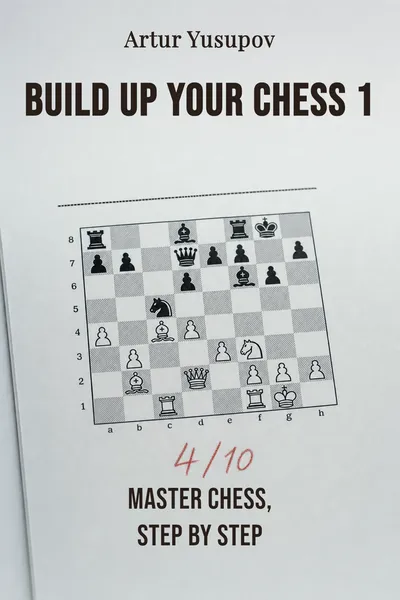
Build Up Your Chess 1
Master chess, step by step
Description
Sometime in the mid-2000s, Artur Yusupov sat down to solve a problem that has nothing to do with winning games and everything to do with teaching. Yusupov was, by any measure, one of the strongest players in the world — for a stretch in the late 1980s he was ranked number three, behind only Kasparov and Karpov, the two names that defined the era. But the project he took on after his competitive peak was quieter and, in its own way, more ambitious. He wanted to write down, in order, everything an improving player needs to know. Not a collection of brilliant games. A course.
The result was a series of books, and "Build Up Your Chess 1" is where it starts. It looks unassuming: twenty-four short chapters, each built around a single idea, each ending with exercises and a points system that tells you, coldly, whether you understood the lesson or only thought you did. There is no promise that you will beat anyone by Friday. There is a promise that if you work through it honestly, the floor under your game will be more solid than it was. That is a different kind of book, and it asks a different kind of reader.
Most of us who play have learned the way you learn a city by wandering it — a trick picked up here, a blunder regretted there, a vague sense of which squares feel dangerous. Yusupov's wager is that wandering has a ceiling, and that the way through it is not more games but better structure. The book is the argument for that wager, made in lessons rather than in words.
The question we’re asking : How do you actually get better at chess — and what does Yusupov's course change about the answer?What we’ll see : How a world-class player turned improvement into a syllabus, and why the exercises matter more than the explanations.
Table of contents
01Chapter 1 — The grandmaster who decided to teach
Artur Yusupov was born in Moscow in 1960 and came up through the Soviet chess school, the most productive training system the game has ever seen. He won the World Junior Championship in 1977, became a grandmaster, and by the late 1980s was a genuine contender for the world title — he reached the Candidates matches more than once and was, for a time, ranked third in the world. Players at that level are rare enough. Players at that level who then sit down and build a patient, from-the-ground-up training manual are rarer still.
What makes his teaching credible is not the résumé alone. Yusupov worked for years with Mark Dvoretsky, and together they ran a school for talented young players that became something of a legend among coaches. The pair produced training material that other grandmasters quietly used to prepare. So when Yusupov writes a beginner-to-intermediate course, he is not slumming or cashing in a famous name. He is applying methods he refined on players who went on to compete at the top.

02Chapter 2 — A syllabus, not a grab bag
The organizing choice that defines the book is simple to state and unusual to execute: the material is broken into twenty-four self-contained lessons, and those lessons rotate across the three great domains of the game. Tactics. Strategy. Endgames. Rather than marching through one theme for two hundred pages, Yusupov alternates, so that a chapter on a tactical motif is followed by one on positional judgment, then by one on a basic endgame technique, then back around again.
The rotation is not decoration. It reflects a real conviction about how competence is built — that a player needs all three faculties developing in parallel, because a game does not politely stay in one phase. You calculate a combination, then you have to understand the resulting structure, then you have to convert an ending. A player strong in only one domain is like a three-legged stool missing a leg. So the book refuses to let any single subject run away with the reader's attention.
03Chapter 3 — The exercise as the real teacher
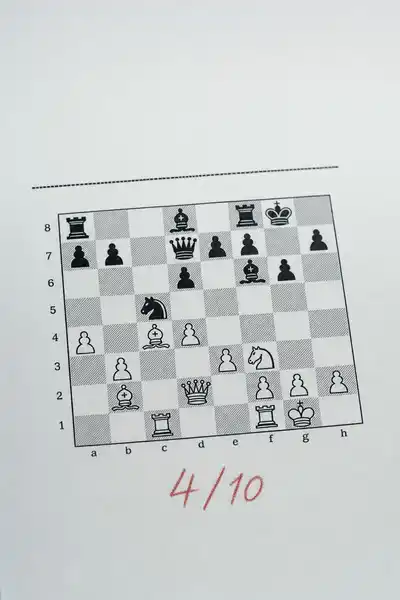
The heart of "Build Up Your Chess 1" is not the lessons. It is the exercises that close each one — a set of positions the reader must solve alone, with a pen and a board, before turning the page. This is the part most readers are tempted to skip, and it is the part Yusupov cares about most. Reading a solution and nodding is not learning. Finding it yourself, or failing to and understanding why, is.
To make that discipline stick, the book uses a points system. Each exercise is worth a stated number of points, harder problems worth more, and at the end of every chapter the reader adds up their score and compares it against thresholds Yusupov provides. Cross a certain line and you have mastered the chapter; fall short and the message is unambiguous — go back. The scoring turns a passive book into something closer to a graded course, with the reader as their own examiner.
04Chapter 4 — What it means to train, not just play
Step back from the chessboard and the book starts to look like a small, precise argument about how any hard skill is actually acquired. Yusupov's method rests on a distinction that most of us blur in our own lives: the difference between doing something a lot and deliberately training at it. A player can log thousands of blitz games and stay exactly where they were, the same way a person can drive for decades without becoming a better driver. Repetition without correction is just repetition.
The course is built on the opposite principle. It isolates one component at a time, sets a task at the edge of the reader's ability, demands a real attempt, and then delivers a verdict. That loop — focused challenge, effortful attempt, honest feedback, repeat — is what researchers who study expertise call deliberate practice, and it is conspicuously unlike the way most people spend their hours on the things they want to be good at. Yusupov did not invent the idea, but he built one of the cleaner working instruments of it, aimed at a game where the results can be measured move by move.
05Conclusion
The book ends where it began, with a points total and a plain instruction: if the score is high enough, move on; if not, do the work again. There is no fanfare, no final flourish about the beauty of the game. Yusupov, the grandmaster who once stood third in the world, closes his beginner's course the way a good teacher closes a term — by handing the responsibility back to the student. The improvement, from here, is theirs to earn.
Related books