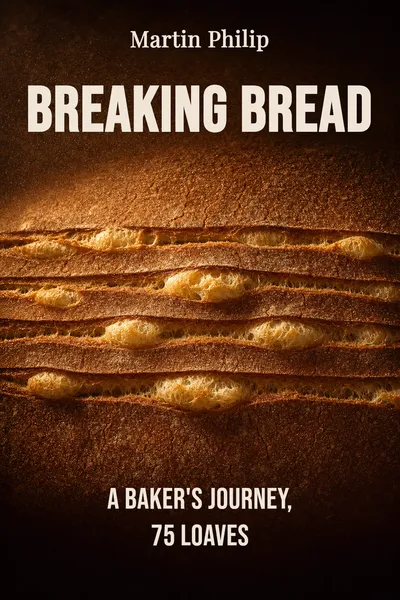
Breaking Bread
A baker's journey, 75 loaves
Description
Martin Philip did not come to bread the way most professional bakers do. Before he was the head bread baker at King Arthur Flour in Norwich, Vermont, he was a classically trained singer, a Missouri kid with a music degree who spent his twenties chasing opera and a life in New York. Bread arrived slowly, then all at once — a hobby that turned into an obsession, an obsession that turned into a job, a job that eventually reorganized his whole sense of what a good day looks like. His 2017 book, "Breaking Bread," is where he set all of that down: part memoir, part atlas, part working manual, with seventy-five recipes threaded through the story of how he got here.
The number matters. Seventy-five loaves is not a round, decorative figure — it is a working baker's range, from a weeknight sandwich loaf to the long, cold-fermented country breads that take the better part of two days. And the recipes are not stacked in a pile at the back. They live inside the telling: a bread tied to a place he traveled, a technique learned from a mentor, a formula worked out over hundreds of repetitions until his hands knew it. The book reads less like a reference shelf and more like a conversation with someone who has made the same dough enough times to have opinions about it.
Which is the interesting thing about a book that is, on its surface, a collection of formulas. Anyone can print a recipe. What "Breaking Bread" is really after is the thing underneath the recipe — the judgment, the feel, the willingness to stand in front of a stubborn dough at six in the morning and figure out what it needs today, which may not be what it needed yesterday.
The question we’re asking : What does a professional baker actually put into a book that is equal parts recipes, memoir, and travel — and what is he trying to hand over?What we’ll see : How a singer became a baker, how the country ended up inside the loaves, and what all that flour and time is quietly teaching.
Table of contents
01 Chapter 1 — From opera to oven
The origin story in "Breaking Bread" is not the usual one. Martin Philip grew up in Missouri and trained as a classical singer, the kind of path that points toward audition halls and conservatories, not walk-in coolers and 500-degree ovens. He moved to New York to pursue music, and for a while that was the plan. Bread was the thing he did on the side — the weekend project, the flour on the counter, the loaf that came out slightly better than the last one and made him want to try again.
What comes through in his telling is how the two lives are not as far apart as they look. Both are disciplines of repetition. A singer runs the same passage until the voice stops thinking about it; a baker shapes the same boule until the hands stop needing instructions. Both reward patience over cleverness. Both punish the shortcut. When Philip describes learning to feel when a dough is properly developed, he is describing the same kind of embodied knowledge a musician builds — something you cannot look up, only earn.

02 Chapter 2 — The country in a loaf
The travel is where "Breaking Bread" stops being just a baker's memoir and becomes a map. Philip built much of the book around movement — trips across the country, visits to other bakers, the specific places and people that shaped how he thinks about a given bread. A loaf, in this book, tends to come with an address. It is tied to a mill he visited, a farmer he met, a technique he watched someone else's hands perform before he tried it with his own.
This gives the seventy-five recipes a texture they would not have as a bare list. A rye is not just a rye; it carries the memory of where he learned to respect rye's particular stubbornness. A regional style comes attached to the region. Philip is drawing on a truth that anyone who bakes seriously eventually meets: bread is agricultural and local at its root. The wheat came from somewhere. It was milled by someone. The water and the air and the season all leave fingerprints on the dough. To bake honestly is to be in a relationship with a place.
03 Chapter 3 — What the dough is actually doing
For all the memoir and travel, "Breaking Bread" is a serious working manual, and Philip does not talk down to the reader. He wants people to understand what is happening inside the dough, not just to follow steps. That means explaining fermentation as the living process it is — flour, water, and time hosting a slow biological transformation, wild yeasts and bacteria doing the actual work while the baker mostly manages conditions. The baker does not make bread rise. The baker makes a place where rising can happen.
He is candid that this is harder than a recipe card suggests, because a recipe is a snapshot and baking is a moving target. The same formula behaves differently in July than in January. A humid kitchen, a cold house, a slightly older starter — each nudges the timing. Philip's answer is to teach reading over obedience: watch the dough, feel it, learn what full fermentation looks and feels like, and treat the written times as approximations rather than commands. This is the difference between someone who can make one loaf and someone who can bake.
04 Chapter 4 — Bread as a way of paying attention
Step back from the formulas and the road trips, and "Breaking Bread" is arguing for something larger than a well-made loaf. It is a book about attention. Bread, in Philip's hands, is a daily discipline of noticing — the feel of the dough, the temperature of the room, the color at the edge of the crust, the smell that tells you fermentation has gone far enough. None of these things announce themselves. You have to be present to catch them, and presence is exactly what the modern day tends to shred.
This is why the memoir and the manual belong in the same book. The singer's training and the baker's craft converge on the same demand: show up, repeat, pay close attention to something small until it opens up. Philip's move from music to bread was not a break from a serious discipline into a hobby — it was a lateral step between two crafts that ask the same thing of a person. The through-line of his whole story is a preference for work that rewards patience and cannot be faked.
05 Conclusion
By the time we close "Breaking Bread," the seventy-five loaves have stopped feeling like the point and started feeling like the evidence. They are what a life spent leaning toward one craft produces — a range of breads that carry places, teachers, seasons, and a decade of early mornings inside them. Martin Philip set out to write a book that was recipes and memoir and travel all at once, and the reason it holds together is that, for him, those were never separate things. The bread was always the story, and the story was always in the bread.
Related books