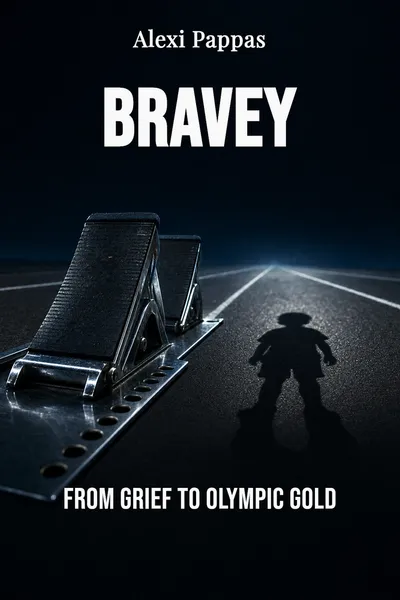
Bravey
From grief to Olympic gold
Description
Alexi Pappas was four years old when her mother took her own life. That fact sits at the beginning of everything she has written and run toward since, and in her memoir Bravey she refuses to let it stay in the background where grief usually gets filed. Her mother struggled with mental illness for years; her death left a house in Northern California with a father, an older brother, and a little girl who would spend the next two decades trying to assemble, out of scattered parts, the woman her mother might have shown her how to become.
Her father's instinct, in the years after, was to keep her busy. He signed her up for teams — soccer, then basketball, then eventually running — less as a grand plan than as a way to fill the hours. What he could not have predicted was that those gyms and fields would become the first place his daughter found women to model herself on. Female athletes, coaches, older teammates: these were the people who showed her what wanting something and going after it looked like. Somewhere in there, a specific and slightly outlandish dream took hold. She wanted to be an Olympian.
In 2016, at the Rio Games, she ran the 10,000 meters for Greece and set a national record. The line from a four-year-old's loss to a starting line in Rio is not a straight one, and Pappas is honest about how much of it was mess, doubt, and repair. Bravey is her account of building a self around a goal, and of what that goal did and did not fix.
The question we’re asking : How does a person invent the self they were never handed — and what does chasing a dream actually repair?What we’ll see : We follow Pappas from a motherless childhood through the daily labor of becoming an athlete, and into what she learns once the finish line is behind her.
Table of contents
01 Chapter 1 — A house without a mother
Pappas doesn't dramatize the loss so much as describe living inside its aftermath. She was too young to hold real memories of her mother, which she treats as its own particular grief — not the ache of remembering someone, but the vertigo of missing someone you cannot picture. What she had instead were fragments: stories, a few photographs, her father's careful, protective silences. She grew up assembling a mother out of secondhand pieces, aware the whole time that the pieces would never add up to a person she could actually talk to.
Her father, an immigrant's son and a lawyer, did the thing many grieving parents do: he held the family together through routine and forward motion. He was, in her telling, both her anchor and someone doing his best without a manual. There was love in the house, and there was also a specific absence — the absence of a woman to watch, to imitate, to ask the unspoken questions girls tend to bring to their mothers. Pappas describes searching for that figure everywhere, scanning the adult women around her for someone to borrow a self from.

02 Chapter 2 — Learning to want something out loud
The dream did not announce itself as destiny. It accumulated. On teams, Pappas found the female figures she'd been hunting for — coaches who took her seriously, older athletes who moved through the world with a confidence she wanted to steal. She was, by her own account, not an obvious prodigy. What she had was appetite and a willingness to say the goal out loud, which turns out to be harder and more consequential than it sounds. Naming a dream makes it something you can fail at in public.
She coins a word for the mindset the book is built around: a bravey, someone who chases their dreams while being honest about the fear that comes with the chase. The point is not fearlessness. Pappas is explicit that being brave and being afraid happen at the same time, in the same body, and that the trick is to keep going anyway. She had plenty to be afraid of — that she wasn't fast enough, that she'd inherited her mother's fragility, that wanting something this badly was itself a kind of exposure.
03 Chapter 3 — The math of becoming an athlete
Bravey is unusually candid about the grind, and about the parts of the grind that don't photograph well. Becoming an Olympic-caliber runner meant years of mileage, injuries, disappointing races, and the slow, unglamorous work of getting incrementally less bad at something until you are suddenly good. Pappas breaks the effort into pieces she can control — the workout in front of her, the recovery she owes her body, the small daily deposits that eventually compound into a result. She calls this treating your goals like a series of tiny, doable steps rather than one enormous, paralyzing leap.
She is also frank that mental health was not something she left behind in childhood. After she finally made the 2016 Olympics — running the 10,000 meters for Greece, drawing on her father's heritage, and setting a Greek national record in Rio — she crashed into a severe depression. The achievement she had organized her entire life around did not deliver the deliverance she'd half expected. If anything, arriving revealed how much of her drive had been powered by the chase itself. She sought treatment, named the illness plainly, and wrote about it precisely because the silence around her mother's illness had cost so much.
04 Chapter 4 — What a dream actually costs
Step back from the races and the medal, and Bravey is really about a method for manufacturing a self when no one hands you a blueprint. Pappas didn't inherit an identity from her mother; she built one, deliberately, out of borrowed examples and repeated choices. The Olympics were the visible outcome, but the underlying project was quieter and never really finished: deciding who to become and then doing the daily labor of becoming her. A dream, in her hands, is less a destination than a discipline — something you maintain, not something you reach and retire.
The mentors matter more than the medal here. Pappas turns the ordinary human habit of looking up to people into a conscious practice. Because she had to go find her female role models rather than being born beside one, she learned to seek guidance on purpose, to ask for it, and eventually to become that figure for others — which is arguably the truest close of the loop the book offers. The four-year-old who had no mother to imitate grows into a woman who deliberately makes herself imitable, writing the book she wishes someone had handed her.
05 Conclusion
The girl who spent her childhood collecting fragments of an absent mother ended up in Rio, running under a country's flag and writing her name into its record book. But Pappas closes the loop somewhere quieter than the stadium. The through-line of her life turns out not to be running at all, but the search that running enabled: the hunt for women to learn from, and the slow work of becoming a self worth learning from in turn.
Related books