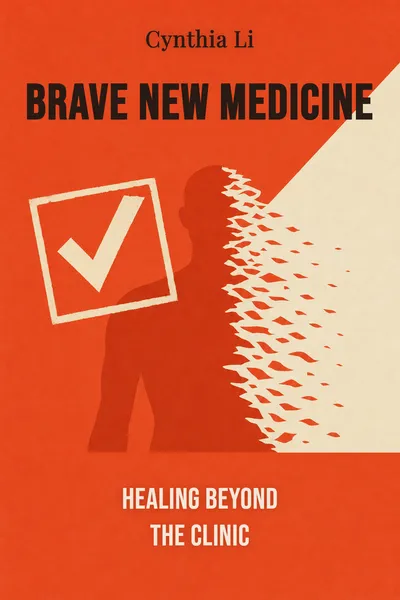
Brave New Medicine
Healing beyond the clinic
Description
In 2008, a young internist named Cynthia Li was practicing medicine in the Bay Area, seeing patients, trusting the tools she had been trained to use. Then, shortly after the birth of her first child, her own body began to fail in ways her training had no name for. Crushing fatigue, a heart that raced when she stood, dizziness, symptoms that migrated and multiplied. She ran the tests she would have ordered for anyone else. They came back clean. On paper, she was fine. In her body, she was disappearing.
What followed was years of a strange kind of exile: a physician who could no longer work, shuttled between specialists who each saw a fragment and none of whom saw her. Some suggested it was in her head. Eventually the label landed on autoimmune thyroid disease and dysautonomia, but the label did not make her well. The system she had devoted her life to had a sharp answer for the acute and the surgical, and almost nothing for a chronic illness that refused to sit inside a single organ or a single appointment.
Brave New Medicine is the account of what she did next, and what she learned when she stopped waiting for the clinic to save her. It is part memoir, part argument about where conventional medicine ends and something else has to begin. Li did not abandon Western science; she went looking for what it had left out.
The question we’re asking : What happens when a doctor becomes the patient her own training can't help?What we’ll see : A physician's collapse, the gaps it exposes in modern medicine, and a wider way of thinking about what it means to be well.
Table of contents
01 Chapter 1 — The doctor who couldn't be diagnosed
Li had trained the way most American physicians train: to find the lesion, name it, and treat it. The model is superb when the problem is a fracture, an infection, a tumor you can cut out. Her own case fit none of that. She had a constellation of symptoms that drifted across systems, worsened without warning, and left no clean fingerprint on a lab report. The machine that had made her a competent doctor had no slot for what was happening to her.
The experience of being on the other side of the exam table changed how she understood the whole enterprise. She learned what it feels like to be told the numbers are normal when your life is unravelling. She learned how quickly a patient without a tidy diagnosis becomes a nuisance, a person the specialist wants to hand off. The implicit message was that if the tests could not see it, it was not quite real. She knew, because she had once sent that message herself, to patients she had privately filed as anxious or exaggerating.

02 Chapter 2 — What the body knows how to do
The turn in Li's story comes when she stops asking only what is wrong with me and starts asking a different question: under what conditions does a body heal itself? It is easy to forget that healing is the default. A cut closes, a bone knits, an infection is cleared, most of it without a physician's help. The body is not an inert machine waiting to be repaired from outside; it is a self-regulating system with a deep, built-in capacity to restore its own balance when the conditions are right. The physician's job, in that light, is less to override the body than to clear its path.
That reframing sent her toward integrative medicine, which she is careful not to present as a rejection of science. Integrative medicine, as she describes it, keeps the diagnostics, the pharmacology, and the emergency care of the West, and adds to them approaches aimed at the terrain rather than the symptom: nutrition, sleep, movement, the nervous system, and traditions of healing that long predate the modern hospital. The goal shifts from suppressing the signal to removing the obstacles that keep the body from doing its own work.
03 Chapter 3 — Illness is not only physical
The deepest thread in Li's recovery is the refusal to keep the body sealed off from the rest of a life. Her symptoms, she found, could not be separated from her emotional state, her relationships, her sense of purpose, or the environment she lived in. This was not a soft consolation to make sickness bearable. It was a physiological claim: that fear, grief, and chronic stress leave measurable marks on the nervous and immune systems, and that a body locked in sustained threat cannot easily shift into the mode where it repairs itself. The nervous system, stuck on alert, keeps the healing switch turned off.
So part of the work was inward. She had been, by her own account, a high-achieving physician who overrode her own limits as a matter of professional pride, who had learned to treat rest as weakness and self-care as an indulgence. The illness forced her to notice how she had been living, and to see that the way she pushed her body was itself part of the terrain that had made her sick. Healing meant learning to listen to signals she had spent a career training herself to ignore, and to grant herself the rest she had always considered a failure of will.
04 Chapter 4 — Who gets to be an expert on your body
Step back from the symptoms and the remedies, and Brave New Medicine is really an argument about authority: who holds it, and what happens when it is misplaced. The conventional arrangement makes the physician the expert and the patient a largely passive recipient of instructions. That arrangement works when the patient is unconscious on a table. It works far less well over the long arc of a chronic illness, where the person who lives inside the body has access to information no test can capture.
Li's own case is the cleanest illustration of the problem. She was a fully credentialed physician, and even she could not get the system to help her until she stopped waiting to be rescued and became an active partner in her own care. If that was true for a doctor, the implication for everyone without the training or the vocabulary is stark. A model that treats the patient as a problem to be solved rather than a participant in the solving is bound to fail the people it fails, and to leave them doubting their own bodies in the bargain.
05 Conclusion
Cynthia Li did eventually recover much of her health, and she did it not by finding the one specialist who finally cracked the code, but by rebuilding, slowly, the conditions that let her own body do its work. She returned to practicing medicine changed, carrying into the exam room the thing her training had never given her: the memory of what it is like to be the patient nobody can see. The book closes that loop, a doctor made whole again by becoming, first, a patient who paid attention.
Related books