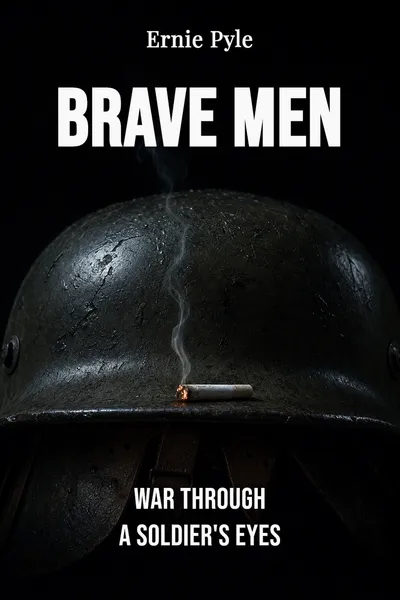
Brave Men
War through a soldier's eyes
Description
In the spring of 1943, a slight, balding, forty-two-year-old reporter from Indiana was crouched in the mud of Tunisia, sharing cigarettes and cold rations with men half his age. Ernie Pyle already wrote a syndicated column that ran in hundreds of American newspapers, but he had no interest in filing from a press tent behind the lines. He wanted to be where the infantry lived, which meant the ditches, the ruined farmhouses, the field hospitals, and the long night marches. He caught the same dysentery, froze in the same rain, and learned the first names of men who would be dead within the week.
Out of that closeness came "Brave Men," the collection of dispatches that followed American soldiers from the invasion of Sicily up the brutal Italian peninsula and on to the beaches of Normandy and the liberation of Paris. This was decades before television carried combat into the living room. For millions of families, Pyle's column was the war — not the maps and the arrows and the generals' communiqués, but the specific, human texture of what their sons and husbands were actually going through.
He wrote about the war from underneath it. Where the official reports counted divisions and objectives, Pyle counted the small things: a mule train on a mountain trail, a man's hands shaking as he lit a match, the way a company grew quiet after losing its lieutenant. He never pretended combat was noble or clean, and he never pretended it was only horror. He simply reported what the men in front of him endured, and let that stand.
The question we’re asking : How did one reporter turn the vast machinery of a world war into something a family at a kitchen table could actually feel?What we’ll see : How Pyle lived alongside the infantry, what he saw on the long grind up Italy and into France, and why he kept the ordinary soldier at the center of the story.
Table of contents
01Chapter 1 — The correspondent who moved into the foxhole
Pyle's method was almost embarrassingly simple: he went and stayed. Most war correspondents flew in, gathered what they needed, and filed from somewhere with a working typewriter and a hot meal. Pyle attached himself to a unit and lived the way its men lived, sometimes for weeks. He slept on the ground, ate what they ate, marched when they marched. When shells came in, he lay in the same dirt they did. That physical fact — that he was choosing the discomfort he could have avoided — was the whole foundation of the trust the soldiers gave him.
What this bought him was detail no briefing could supply. He noticed how a man rationed his cigarettes, how the veterans could sleep through anything while the replacements lay awake, how everyone developed a hundred-yard stare after enough time up front. He wrote these things down in a small notebook, in a plain style stripped of heroics. He was suspicious of the word "hero" and used it sparingly, because he had watched what the men actually did and knew that mostly they were just trying to stay alive and not let their friends down.

02Chapter 2 — Sicily, Italy, and the arithmetic of exhaustion
The Sicily landings in July 1943 and the long Italian campaign that followed gave Pyle his hardest material. Italy was not a war of dramatic breakthroughs. It was a war of mountains, mud, and mules — a slow, grinding climb up a peninsula the Germans defended ridge by ridge. Pyle understood before most people at home that the romance of the maps concealed a reality of pure attrition. Men went up, took a hill at terrible cost, and looked across at the next hill exactly like it.
He wrote about the mule trains that carried supplies up trails too steep for any vehicle, and about the men whose war had shrunk to the few hundred yards in front of them. He was honest about fear in a way the propaganda posters never were. He described the shakes, the sleeplessness, the way courage was not the absence of terror but the decision to function inside it. He grasped that a soldier's endurance was a finite resource, spent down day by day until there was nothing left, and that the army kept spending it anyway because it had to.
03Chapter 3 — Normandy, and the price of a hedgerow
By June 1944, Pyle had followed the war to England and then across the Channel to Normandy. He came ashore not long after the first assault waves and walked the beach at low tide, and what he wrote about it has lasted. He described the long stretch of sand littered with the debris of the invasion — the wrecked vehicles, the abandoned equipment, and among it the personal effects of the dead: a soldier's Bible, snapshots of home, a tennis racket, writing paper. The strewn belongings said more about the cost than any casualty figure could.
Then came the hedgerows. The Norman countryside was divided into small fields bordered by thick, ancient earthen banks topped with dense brush, and the Germans turned each one into a fortress. The Americans had to take them field by field, and Pyle watched the infantry pay for every one. There were no sweeping charges here either, just the same grim work of men crawling forward against machine guns, clearing a hedge, and finding another beyond it. He conveyed how the geography itself became an enemy, how progress measured in yards could cost a company its strength.
04Chapter 4 — The infantry that history forgets to thank
What Pyle insisted on, dispatch after dispatch, was that this enormous war belonged to the ordinary foot soldier. The strategy, the industrial might, the air power, the naval guns — all of it, in his accounting, existed to move one tired man with a rifle a few hundred yards forward. He wrote openly of his admiration for the infantry, whom he called the underdogs of the army: the least glamorous branch, the worst-fed and worst-rested, the ones who absorbed the highest losses and got the least credit. His whole body of work was an argument that these were the men who actually won it.
This was not sentimentality. It was a corrective. The natural tendency of a nation reading about its war is to focus on the sweep of it — the landings, the breakthroughs, the flags on the maps. Pyle understood that this framing quietly erased the individual, folding a million separate ordeals into a single triumphant story. By naming the private from a specific street, by lingering on the dead captain and the shaking hands, he kept forcing the abstraction back into a human shape. He would not let readers keep a comfortable distance from what their sons were doing.
05Conclusion
"Brave Men" endures because Pyle refused the correspondent's usual altitude. He would not write the war from the map room or the press briefing. He wrote it from the mud, the mule trail, the wrecked beach, and the dark hillside where men came to say goodbye to a dead captain. The book is not a history of campaigns; it is a record of what those campaigns cost the individual men who carried them out, told in a plain voice that trusted the facts to do the feeling.
Related books