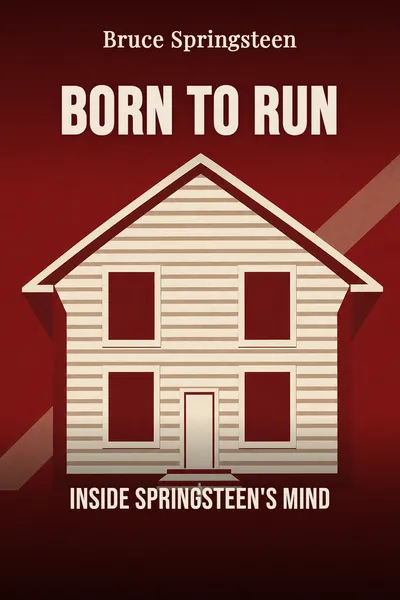
Born to Run
Inside Springsteen's mind
Description
In 2009, Bruce Springsteen played the Super Bowl halftime show, slid across a stage on his knees into a camera, and for twelve minutes was about as famous as a person can get. Somewhere in the days after, he sat down and started writing — not lyrics, not a set list, but sentences about himself. He kept at it for seven years. When Born to Run came out in 2016, it was 500-odd pages long, and the surprising thing was not that a rock star had written a memoir. It was how much of it took place before anyone had heard of him, in a small house in Freehold, New Jersey, that he never really left.
Springsteen had spent forty years turning his life into three-minute stories — the cars, the girls, the highway out of town, the promised land somewhere past the county line. The songs are about leaving. The book is about the opposite. It circles back, again and again, to the people he came from, the father he couldn't reach, the church at the end of the street, and a mind that never once let him rest. He wrote it himself, in longhand, no ghostwriter, and it reads like a man determined to get the account right before someone else got it wrong.
He put the stakes plainly somewhere in those pages: writing about yourself is a funny business, but the writer has made one promise, to show the reader his mind. That is a strange thing for a performer to say — a man whose whole art was performance, who admits in the book that much of what he sold as autobiography was invention. So what happens when he stops performing and tries, for once, to just tell the truth about what it was like in there?
The question we’re asking : What does Springsteen actually show us when he sets out to reveal his own mind on the page?What we’ll see : The house he came from, the band he built, the darkness he kept fighting, and the reckoning of a man looking at his own life from the inside.
Table of contents
01Chapter 1 — The house on Randolph Street
Springsteen opens the book not with a stage but with a street. He grew up in Freehold, an industrial town in central New Jersey, in a house shared with his grandparents that he describes in almost forensic detail — the smell, the peeling walls, the copper beech tree out front, the Catholic church and the school right there at the corner. His grandmother had lost a daughter years before he was born, and she raised young Bruce with a smothering, grief-warped devotion that let him do anything he wanted. He recalls being a strange, feral little kid, king of a decaying household, formed by loss he didn't yet understand.
The center of the book, and the center of his life, is his father, Douglas Springsteen. Doug worked factory jobs, drove a bus, sat in the dark kitchen at night drinking, and could barely speak to his son. Bruce writes about him with a tenderness that took decades to earn — the man was almost certainly living with untreated mental illness, and the silence between them shaped everything. The boy grew up wanting a word, a look, some sign of approval that mostly never came. Much of what Springsteen later did on stage, he admits, was a performance staged for a father who wasn't watching.

02Chapter 2 — The band was never a metaphor
For a man whose songs celebrate the lone rider heading out at night, Springsteen's real story is stubbornly collective. The book spends chapter after chapter on the players, the bars, the shore scene in Asbury Park in the late 1960s, the endless auditions and blown gigs and van breakdowns. He was a bandleader before he was a star, running outfits with names nobody remembers, learning to hold a room in clubs where fights broke out and nobody had come to hear him. He treats these years not as prelude but as the actual education — where he learned that a band is a small, difficult society you have to lead.
When the E Street Band came together in the early 1970s, he describes it in the language of family, which is to say with love and friction in equal measure. He was, he admits without flinching, the boss — a benevolent dictatorship, he calls it, because a democracy would have sunk them. He signed with Columbia in 1972, made two records that sold poorly, and nearly got dropped before Born to Run, the 1975 album, finally landed. The famous line about tramps like us was earned in a studio where he agonized over every second, driving everyone half-mad chasing a sound he could hear but couldn't yet reach.
03Chapter 3 — The thing he couldn't outrun
The most striking part of the memoir is the part Springsteen had never really made public. Somewhere in his thirties, at the peak of his fame, he fell into a depression severe enough that he began seeing a psychoanalyst — a relationship that, he reveals, lasted decades. The man who sang about being born to run was, off stage, often unable to get out of a chair. He writes about crushing episodes in his sixties, weeks and months underwater, and about the medication he takes to stay level. It is a rock memoir that turns, unexpectedly, into one of the frankest accounts of mental illness a famous man has put on paper.
04Chapter 4 — What a life looks like from the inside
Read whole, Born to Run is a book about the distance between the myth a man makes and the person keeping the accounts behind it. Springsteen is remarkably honest about the fabrication. The tough working-class hero in the T-shirt and jeans was a construction — he never worked in a factory, he tells us; his father did. The car songs came from a kid who couldn't drive until he was in his mid-twenties. He built a character out of the materials of his childhood and then spent a lifetime inhabiting it so completely that even he sometimes lost the seam. The memoir is his attempt to name the seam out loud.
What the book keeps returning to is that the escape was never the real subject. Every highway song was really about the house he left, the father he was trying to reach, the town he kept driving back to in his sleep. He writes about buying a farmhouse only miles from where he grew up, about the pull of the same landscape, the same church bells. The man who wrote the definitive American songs about getting out spent his life demonstrating that you carry the place with you, that leaving and returning are the same motion. The distance he put between himself and Freehold was the distance a song travels before it comes home.
05Conclusion
The book closes where the life keeps circling: near Freehold, near the beech tree, near the ghosts. Doug Springsteen died in 1998, and by then the two men had made a fragile peace — his father, in one late scene, telling Bruce he'd been a good father, which Bruce knew wasn't quite true and accepted as the closest thing to what he'd waited his whole life to hear. The performer who slid across the Super Bowl stage and the boy watching the dark kitchen turn out to be the same person, and the memoir refuses to pretend otherwise.
Related books