Blue Trout and Black Truffles
Europe's lost culinary kingdoms
Description
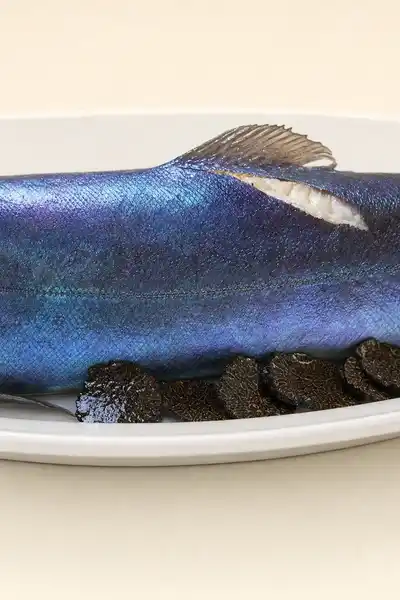
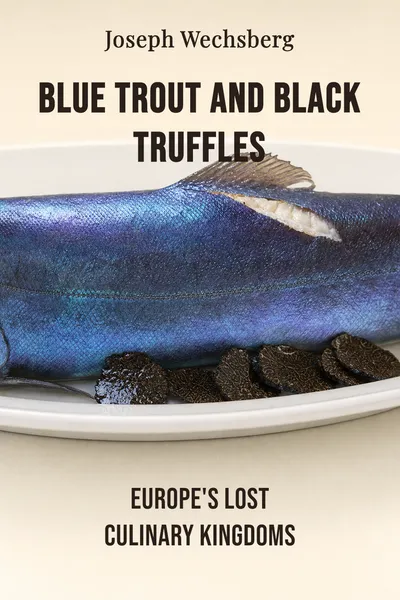
Joseph Wechsberg was a boy in Ostrava, in the Moravian corner of the Habsburg empire, when he first understood that eating could be a serious matter. He grew up to be a Czech-born American who wrote for The New Yorker with the ear of a trained violinist and the appetite of a man who had gone hungry in two world wars. In 1948 he published a book with a title that reads like a menu written by a poet: Blue Trout and Black Truffles. It is not a cookbook, and it is barely a travel guide. It is the record of a man chasing the finest meals Europe could still produce, before the century finished dismantling the world that produced them.
What he found, mostly, was France — its three-star kitchens, its cellars, its patient sommeliers and terrifying maîtres d'hôtel. But the book keeps drifting back east, toward Vienna and Budapest, toward Meissl and Schadn where a waiter could recite twenty-four cuts of boiled beef from memory, toward Gundel's on the Pest side of the Danube. These were the cathedrals of central European cooking in their prime, and by the time Wechsberg wrote them down, most of them were already gone, taken by war, occupation, and a general impatience with anything that took three hours to eat.
So the book is really an act of preservation, written by someone who knew the smell of the dining rooms he was describing and knew, too, that they were not coming back. He wrote with pleasure, never with a lecture. And underneath the truffles and the trout runs a quieter worry about what a world gains, and loses, when it decides that a meal should be quick.
The question we’re asking : What was Wechsberg actually trying to save when he wrote down the great meals of a vanishing Europe?What we’ll see : A man raised in a collapsing empire, apprenticed to its dining rooms, who spent his life eating his way toward the last kitchens still doing it properly.
Table of contents
01Chapter 1 — A boy learns to eat in a doomed empire
Wechsberg was born in 1907 into the twilight of Franz Joseph's monarchy, a sprawling patchwork of Czechs, Germans, Hungarians, Poles and a dozen others held together by an old emperor and a shared fondness for the table. His family were bankers in Ostrava, comfortable enough that a good dinner was neither rare nor ostentatious. It was simply the shape of a civilised evening. He learned early that food was a language, and that the people who spoke it best were not chefs alone but the whole apparatus around them — the market women, the waiters, the uncles who argued for an hour about where to find the proper carp.
The empire he grew up in prized the pleasures of the mouth in a way that now seems almost unhinged. Vienna and Budapest treated dining as a civic art, with institutions to match. A café was not a place to grab coffee but a second living room where a man might spend a whole afternoon. A restaurant was a stage. This was a culture that had outsourced a great deal of its emotional life to the dinner table, and it did so with a seriousness that the modern reader can find either enviable or faintly absurd.

02Chapter 2 — The theatre of the boiled beef
The heart of the book's central European chapters is a dish that sounds like nothing: boiled beef. In Vienna they called it Tafelspitz, and at Meissl and Schadn, the great restaurant behind St. Stephen's, it was raised to a discipline. Wechsberg describes a house that offered, by his account, some two dozen distinct cuts of boiled beef, each with its own name, its own texture, its own devotees who would eat nothing else. The waiter did not hand you a menu of them. He interviewed you about your mood, your teeth, your intentions for the afternoon.
This is where Wechsberg is at his best — not on the food itself but on the ceremony around it. The head waiter at Meissl was a figure of real authority, a man who could seat an archduke and refuse a boor in the same breath. The regulars had their tables, their moods, their standing feuds. To eat there was to enter a society with its own laws, and the laws mattered as much as the beef. He renders it all with affection and a straight face, letting the sheer excess speak for itself.
03Chapter 3 — The pilgrimage to the temples of France
If central Europe is the book's lost homeland, France is its living promised land — the place where the great tradition had not yet been broken, where a man could still eat at the summit of the possible. Wechsberg travels the country like a pilgrim, from the Michelin three-stars of Paris to provincial temples where a single family had cooked at the same address for generations. He is unashamed about the expense and the effort. Getting the meal right was, to him, a legitimate way to spend a life.
He is fascinated by the machinery of perfection. A great French restaurant, in his telling, is a small state with departments and rivalries — the kitchen brigade under its chef, the dining room under its maître d'hôtel, the cellar under a sommelier who guards the wine like a jealous parent. He watches a sole prepared, a sauce reduced, a bottle chosen to marry a dish, and he understands that what looks like effortless pleasure is in fact the visible tip of decades of drilled craft.
04Chapter 4 — When the great table becomes a museum piece
Read now, the book is unmistakably a farewell, and Wechsberg half knew it. He wrote in the late 1940s, at the moment the frozen dinner and the fast-food counter were about to reorganise how the West would eat. He does not rage against them — he was too good a writer for that — but the contrast hums under every chapter. On one side, a meal that costs an evening and rewards a lifetime of attention. On the other, food engineered to be fast, cheap and forgettable. He knew which way the century was tilting.
The deeper subject is not nostalgia for rich food but the fate of a craft that depends on patience nobody can afford. The great restaurants he loved were labour-intensive in a way that had become economically fragile. They rested on cheap skilled labour, on customers with time, on continuities of family and place that two wars and a new economy had shredded. When those supports fall away, the cooking does not merely get worse. It becomes impossible to reproduce, because it was never only a set of recipes. It was a whole way of organising human effort around pleasure.
05Conclusion
Wechsberg went on writing about music, banking, and Europe for another three decades, but Blue Trout and Black Truffles remained his signature — the book of a man who ate his way back into a homeland that no longer existed. Meissl and Schadn was rubble, the Habsburg leisure that filled it was gone, and even the French temples he adored would spend the coming decades adapting, thinning out, or closing. He caught them at the last possible moment, with a fork in one hand and a notebook in the other.
Related books