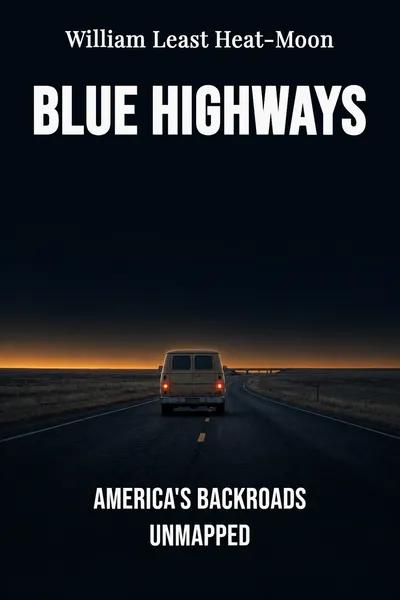
Blue Highways
America's backroads unmapped
Description
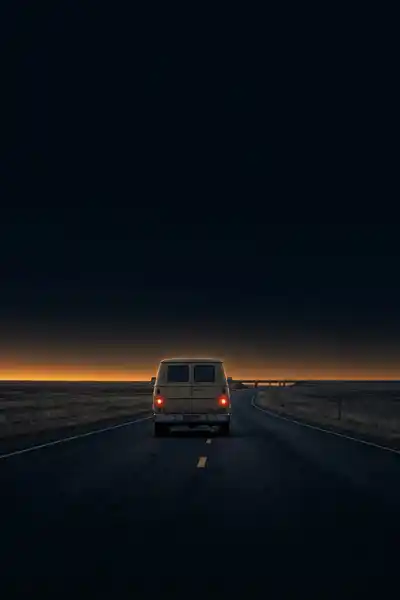
In the winter of 1978, a man named William Trogdon lost his job teaching English at a college in Columbia, Missouri, and learned the same week that his marriage was over. He was thirty-eight. He had a name he had partly reclaimed from his Osage heritage, William Least Heat-Moon, and a 1975 Ford Econoline van he called Ghost Dancing. So he did what people in that state of collapse sometimes fantasize about and almost never do. He packed the van with a sleeping bag, a couple of cameras, some books, and drove out of town with a plan that was barely a plan: to circle the United States without touching a single major highway.
The rule was the whole idea. On the old road atlases, the interstates and big federal routes were printed in red, and the small forgotten roads — the two-lane county blacktop that goes through the middle of towns instead of around them — were printed in blue. Heat-Moon decided he would stay on the blue ones. No fast lanes, no bypasses, no chain motels lit up at the off-ramp. Roughly thirteen thousand miles, clockwise around the country, on roads that most Americans had stopped using the day the interstate opened a few miles away.
What came back from that trip was published in 1982 as Blue Highways, a book that spent most of a year on the bestseller lists and is still read as one of the finest things ever written about the American road. It is not really a travelogue about scenery. It is a book about a man who has been emptied out by loss and goes looking for the country in the places the country forgot, and finds it, mostly, in the people willing to talk to a stranger who has nowhere in particular to be.
The question we’re asking : What does a man who has lost almost everything actually go looking for when he drives off onto the smallest roads he can find?What we’ll see : A journey around a country that mostly lives in the towns the interstate was built to skip.
Table of contents
01Chapter 1 — The night the whole life came apart
The book opens with a sentence that has become a little famous among people who love it: a man who can find nothing better to do with himself than telephone the woman he is separated from, at midnight, to hear that she is seeing someone else, is a man in trouble. That is roughly where Heat-Moon starts. The teaching job at Stephens College had not been renewed. The marriage to the woman he calls the Cherokee in the book had ended. He was, by his own account, adrift in the particular way that makes a person either fall apart or leave.
He chose to leave, and he was honest about why the escape was not noble. Running is running. But he framed the trip with an idea he had carried a long time: that a man who couldn't make things go right could at least go, and that a person could reset something by moving through the world slowly enough to actually see it. The van, Ghost Dancing, was named half in irony and half in earnest, after the Plains Indian movement that believed a dance could bring back a vanished way of life.

02Chapter 2 — Old roads, old maps, the color blue
The organizing conceit of the book is almost too simple, which is why it works. On the Rand McNally atlases of that era, the main arteries were red and the secondary roads were blue, and the blue lines went through the middle of everything the red lines had learned to avoid. By the late 1970s the interstate system was essentially finished, and it had done exactly what it was designed to do: move people and freight across enormous distances at speed, past the towns rather than into them. The blue highways were what got left behind when the traffic moved over.
Heat-Moon's route was a loose clockwise loop. Out of Missouri and down into the South, along the Gulf, across Texas and the Southwest, up the coast of California and Oregon, east across the northern tier, and eventually home. He gave the chapters the names of the directions of the medicine wheel, a nod to the Native framing he brings to the whole enterprise, and he wrote as much about the map as about the ground. He liked place names the way some people like fossils, as evidence of what a spot once thought it was. Nameless, Tennessee. Dime Box, Texas. Whynot, Mississippi.
03Chapter 3 — The people at the end of the counter
The real substance of Blue Highways is not landscape, it is talk. Heat-Moon had a gift for getting strangers to open up, and much of the book is transcribed conversation with people he met over coffee, at gas pumps, on porches, at the far end of a diner counter. He had a private rating system for cafes, counting the calendars on the wall — the more calendars, the better and more local the food — and he used places like that as listening posts for the country.
The portraits are what people remember. In Nameless, Tennessee, an elderly couple named Watts talk about their store and their dead and the way the town got its name. In Hat Creek, a man works out a whole philosophy of self-reliance. In a Louisiana town he meets a young monk; on the Georgia coast he meets Gullah descendants living the way their grandparents did. There is a boat builder in Maine who has spent his life on one craft, and a woman here and there who cuts through the loneliness of the road with a directness that stops him cold. He lets them talk at length, and he mostly stays out of the way.
04Chapter 4 — What a country looks like from below
Step back from the trip and Blue Highways is making a quiet, stubborn claim about where a country actually is. Not on its interstates, not in its statistics, not in whatever a capital says it is, but in the ten thousand small places that the fast roads were built to avoid. Heat-Moon's wager was that if you want to know America, you have to travel at a speed that lets America talk back, and the interstate, by design, does not.
This is a book written at a hinge moment. The federal highway system had just knit the country into a single high-speed grid, and that grid was efficient in exactly the way that erases difference. A traveler on the interstate can cross a dozen distinct regions and experience only the same gas stations and the same fast food. Heat-Moon's blue roads were the last easy access to a pre-national America — regional accents, local food, towns that still made their living from the immediate surrounding country rather than from a distribution center off exit 43. He caught it just before it thinned out for good.
05Conclusion
William Least Heat-Moon came back to Missouri after roughly thirteen thousand miles with notebooks, tape, and photographs, and spent four years turning them into the book that made his name. Blue Highways appeared in 1982 and stayed on the bestseller lists for most of a year, and it has never really gone out of print since. The man who left town because his job and his marriage had both collapsed came home having reassembled himself out of borrowed conversations at the end of a thousand counters.
Related books