
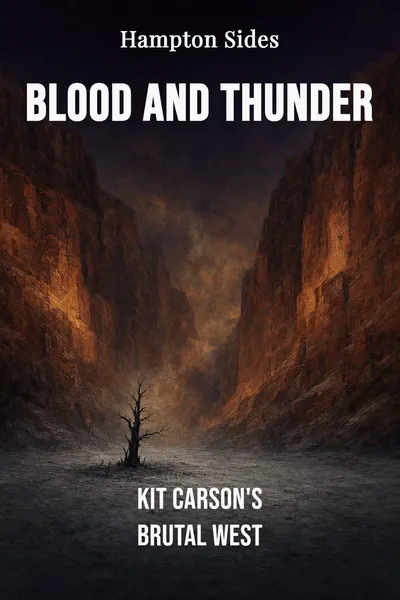
Blood and Thunder
Kit Carson's brutal west
Description
Kit Carson could not read. When the dime novels started appearing in the 1850s — lurid paperbacks in which a heroic Carson single-handedly slew dozens of Indians and rescued fair-skinned maidens — he had to have them read aloud to him. In one telling, later recounted, he came across a rescue scene involving a white woman held captive and connected it to a real raid he had joined, where the woman had been killed before they arrived; among her belongings they found one of those very novels, its cover showing a fictional Carson saving a woman exactly like her. He is said to have been quietly haunted by the gap between the printed hero and the man doing the actual work in the dust.
That gap is the engine of Hampton Sides's Blood and Thunder. The book follows a small, plainspoken trapper from Missouri as he becomes the human hinge of American expansion into the Southwest — guide to John C. Frémont, soldier in the war against Mexico, and finally the officer who forced the Navajo off their land. Sides builds the story from letters, military records, and Navajo oral memory, refusing to let either the frontier legend or the later condemnation settle into something simple. Carson is neither the storybook hero nor a cartoon villain. He is harder to hold than that.
What emerges is a portrait of conquest told through one contradictory life. The same man who married into two Native families and spoke several Indigenous languages also carried out a scorched-earth campaign that ended a people's world. Sides sets that life inside the machinery that made it possible: the ideology of Manifest Destiny, the ambitions of officers and politicians far to the east, and the collision of cultures that no one on the ground fully understood.
The question we’re asking : How does one modest, semi-literate frontiersman become both the instrument and the emblem of an empire's westward push?What we’ll see : A life lived between two worlds, told against the war, the removal, and the myth that grew larger than the man.
Table of contents
01Chapter 1 — The illiterate scout who became a legend
Christopher Carson was born in Kentucky in 1809 and grew up on the Missouri frontier, one of many children in a family that lived close to the edge of poverty. Apprenticed to a saddle-maker as a teenager, he ran off west around 1826, drawn by the fur trade that was then opening the Rocky Mountains to a rough brotherhood of trappers. He was small, quiet, and unassuming — nothing in his manner suggested the figure the country would later invent. What he had instead was an almost uncanny competence: he could track, hunt, survive brutal winters, and read a landscape the way other men read a page.
In the mountains Carson lived among Native peoples rather than simply against them. He learned to speak Spanish and several Indigenous languages, and he married twice into Native families — first an Arapaho woman named Singing Grass, then a Cheyenne woman. Sides is careful to show that this intimacy was ordinary in the trapper world, not exceptional. Carson moved through Indigenous societies as a participant, understood their customs, and depended on them. The later idea of him as a simple Indian-fighter obscures how thoroughly his early life was woven into the very cultures he would eventually help destroy.

02Chapter 2 — The conquest of a Spanish-speaking republic
When Americans imagine the West of the 1840s, they rarely picture the Southwest as Mexican territory — yet that is exactly what it was. New Mexico, with its ancient capital at Santa Fe, had belonged to Spain and then to independent Mexico, a Spanish-speaking Catholic society layered over the older Pueblo world. Carson himself had settled in Taos and married Josefa Jaramillo, from a prominent local family. His life, again, straddled a border the United States was about to erase by force.
The Mexican-American War, which broke out in 1846, was in large part a war of acquisition, driven by the conviction that the continent was America's to take. Carson found himself carrying dispatches across deserts, guiding troops, and fighting in California, where the campaign to seize the province was a chaotic mix of ambition, improvisation, and cruelty. Sides does not present this as a clean story of liberation. He shows officers jockeying for credit, orders misunderstood, and violence spilling well past any military logic — including the killing of unarmed Californios during Frémont's operations.
03Chapter 3 — The long walk that broke the Navajo
The Navajo — the Diné, in their own language — were the great unresolved problem of the new American Southwest. Numerous, mobile, and fiercely independent, they had raided and traded with New Mexican settlements for generations and had never been conquered by Spain or Mexico. Their leaders, among them Manuelito, saw no reason to submit to yet another distant government. To the settlers and the army, Navajo raiding was intolerable; to the Navajo, the encroachment on their canyon country was equally so. The two views could not be reconciled, and by the early 1860s the United States decided the matter by force.
The architect of that decision was General James Henry Carleton, a hard, righteous commander who envisioned rounding up the entire Navajo nation and confining them at a remote reservation called Bosque Redondo, where he imagined they would be remade into peaceful farmers and Christians. Carson, by then an aging officer, was chosen to carry it out. He did so reluctantly, Sides suggests, but thoroughly. Rather than fight the Navajo directly, he waged war on their means of survival — burning cornfields, cutting down peach orchards, slaughtering sheep, and driving them from the depths of Canyon de Chelly.
04Chapter 4 — When a man and his myth stop matching
Blood and Thunder keeps circling one uncomfortable fact: the country needed Carson to be simpler than he was. A trapper who married Native women, spoke their languages, and privately doubted the campaigns he led does not fit neatly into any patriotic frame. So the culture flattened him — first into the fearless hero of the dime novels, then, generations later, into a symbol of colonial brutality. Both versions are true enough to be useful and false enough to be misleading. Sides's achievement is to hold the whole man in view, refusing the comfort of either portrait.
What that gap reveals is how expanding nations write themselves into legend. The real work of conquest — the burning fields, the forced marches, the deals made and broken — is messy, morally compromised, and full of ordinary people doing terrible things for reasons they half-believe. A nation cannot easily celebrate that. So it selects a figure, strips away the contradictions, and offers him back as proof that the whole enterprise was heroic and clean. Carson was ideal for the role precisely because he was silent, competent, and unbothered by ideology. He could be filled with whatever meaning the moment required.
05Conclusion
The man who had to have his own legend read aloud died in 1868, not long after the Navajo were permitted to go home. Carson never wrote the heroic account others wrote for him; the words that made him famous were always someone else's. He passed out of a West he had helped remake beyond recognition — Mexican territory turned American, a nation of trappers giving way to soldiers and settlers, and whole peoples pushed to the margins of land they had held for centuries. The dime novels outlived him, and so did the wound he left in Navajo memory.