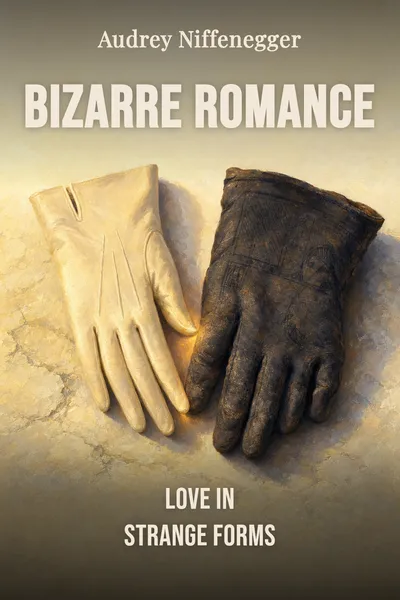
Bizarre Romance
Love in strange forms
Description
In 2011, the novelist Audrey Niffenegger married the graphic artist Eddie Campbell. She was already famous for The Time Traveler's Wife, a bestseller that had sold in the millions and become a Hollywood film about a man who keeps disappearing out of his own marriage. Campbell was known in a narrower, fiercer world — the illustrator behind From Hell, the sprawling Jack the Ripper comic he made with Alan Moore. Two artists who worked in different mediums, on different continents, in different registers of the strange. And then they started making things together.
Bizarre Romance, published in 2018, is the record of that collaboration. It gathers sixteen short pieces, some as illustrated prose, some as full comic panels, one as a spread of paper dolls you could in theory cut out. The genres refuse to sit still: fractured fairy tales, historical fiction, a ghost who haunts a bookstore, a scene of pure domestic ordinariness rendered with tenderness. What holds it together is not a plot or a moral but a shared appetite for love told slant — love as it actually behaves, which is to say oddly.
A collection like this could easily have been a curiosity, a between-projects lark. Instead it works as something more deliberate: a two-handed argument about what a love story is allowed to be. The book celebrates romance and satirizes it in the same gesture, often on the same page, and it does so by letting the shapes multiply rather than settling on one.
The question we’re asking : What does it mean to tell a love story sideways — through the strange, the fantastical, the deliberately odd — rather than head-on?What we’ll see : A married pair of artists, the sixteen shapes their collaboration takes, the friction where prose meets drawing, and what the whole odd assembly understands about affection.
Table of contents
01Chapter 1 — A book made by a couple, about couples
The premise of Bizarre Romance is not neutral. It is a book about love made by two people who are in love, and who happen to be professionals at rendering the interior weather of relationships — one in sentences, one in ink. Niffenegger wrote the stories. Campbell drew most of them, sometimes in his loose, wet-looking line, sometimes in a mode that borrows the flatness of an old children's book. The pairing is the whole point: she supplies the situation, he supplies the face it makes.
This matters because the subject and the method mirror each other. A marriage is also two sensibilities agreeing to occupy the same frame without dissolving into one another. Campbell has said the collaboration was not always smooth — that translating another person's prose into pictures involves arguments about what a scene actually looks like, about whose imagination gets to win. That friction is legible in the book. Some pieces feel fully fused; others feel like two artists politely disagreeing across a page, which is arguably the more honest picture of what living with someone is.

02Chapter 2 — Sixteen ways to bend a love story
The organizing wager of the collection is variety. Sixteen pieces, and almost no two share a shape. One reworks a fairy tale until the happily-ever-after curdles. Another sets its lovers inside a piece of historical fiction, letting the period detail do half the emotional work. A ghost falls for the living. A woman's relationship is told through the mundane rhythm of a shared apartment, with nothing supernatural at all — which, placed among the fantastical pieces, starts to look like the strangest one.
What the variety buys is range of feeling. Romance in popular culture tends to arrive pre-shaped: the meet-cute, the obstacle, the reconciliation. Niffenegger keeps swapping the mold. A love story told as paper dolls is a joke about how we dress up the people we adore and pose them to our liking. A fractured fairy tale is a way of admitting that the stories we inherit about love are lies we half-believe anyway. Each genre is a different lens, and the book trusts that no single lens tells the truth.
03Chapter 3 — Where the writing meets the drawing
The most interesting seam in Bizarre Romance runs between word and image. Some pieces are illustrated prose: Niffenegger's text carries the story, and Campbell's drawings punctuate it, the way illustration has worked in books for centuries. Others are true comics, where the panels carry the narrative and the words are minimal — dialogue, a caption, a beat of silence between frames. The book keeps switching modes, and the switching is part of what it is about.
Comics do something prose cannot: they let you feel two things simultaneously. A caption can say one thing while the picture says another, and the reader holds both. Campbell, whose work on From Hell made him a master of the dense, ambiguous panel, uses that doubleness for romance rather than horror. A tender line of text sits over a drawing that undercuts it slightly, and the gap becomes the joke, or the ache. This is the satire working at the level of form, not just content.
04Chapter 4 — What a strange book knows about love
Step back from the sixteen pieces and a quieter claim emerges: that love is best approached obliquely. The book almost never looks straight at its subject. It comes at romance through a ghost, a fairy tale, a set of paper dolls, a stretch of ordinary Tuesday. The strangeness is not ornament. It is the method. Niffenegger and Campbell seem to believe that the head-on love story — the one culture keeps selling — flattens the thing it describes, and that the truer portrait arrives sideways, in the odd detail and the wrong angle.
This is consistent with everything Niffenegger has done. The Time Traveler's Wife told a marriage through the device of a man who cannot stay put in time, and the fantastical premise turned out to be the most accurate way to render the plain grief of loving someone who keeps leaving. Bizarre Romance extends that instinct across a whole collection. The bizarre is the realism. The genre-bending is a way of getting under the defenses that a conventional love story leaves intact.
05Conclusion
Bizarre Romance ends the way it began: as a double act. Sixteen small experiments, no two alike, held together by two hands that never fully merge. What could have been a slight, between-books project turns out to have a spine — the conviction that love resists the shapes we keep pouring it into, and that the honest thing to do is keep changing the mold. The paper dolls and the ghosts and the fractured fairy tales are not evasions of the subject. They are the closest the book can get to it.
Related books