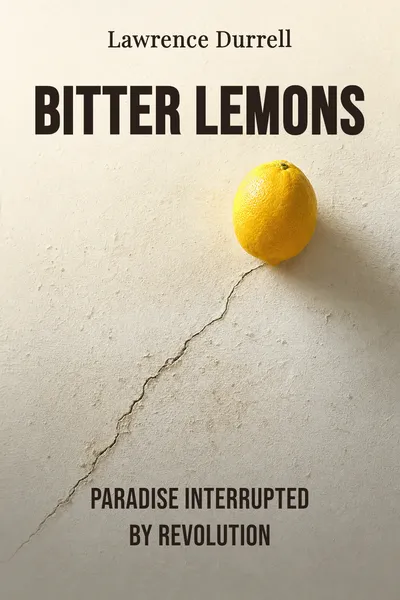
Bitter Lemons
Paradise interrupted by revolution
Description
In 1953, a British writer with a working knowledge of Greek and very little money stepped off a boat at Kyrenia and decided to stay. Lawrence Durrell was between careers and between lives. He had spent the war years drifting around the eastern Mediterranean, teaching, translating, writing poems that a few people admired, and he had come to Cyprus half by accident, drawn by the light and the cheapness of things. He settled in Bellapaix, a hill village above the sea, in a house he did not yet own, among people who took him in before they had any reason to. For a while the island gave him exactly what he had come for.
Then, a few years later, the whole thing came apart in his hands. The Cyprus that welcomed a curious foreigner was also a colony, and beneath the almond blossom and the village gossip ran a current that Durrell either did not see or chose not to. Greek Cypriots wanted enosis — union with Greece — and they wanted it badly enough to fight the British for it. By the time the shooting started, Durrell was no longer just a householder and schoolteacher. He had taken a government post, and the men on the other side of the barricade included people he had eaten with.
Bitter Lemons is his account of that arc, from arrival to departure, written a couple of years after he left. It is not a war book and not quite a travel book. It is the record of a man who fell for a place and then watched the place turn into something he could no longer stay inside. Durrell tells it in the prose that made his reputation — sensuous, exact, a little heartbroken — and never lets the politics erase the pleasure that came first.
The question we’re asking : What happens to a foreigner's love for a place when that place decides it wants him gone?What we’ll see : A writer's slow immersion in one Cypriot village, and the political fracture that eventually made his position — and his affection — impossible.
Table of contents
01Chapter 1 — A house in Bellapaix, bought the Cypriot way
Durrell arrived without much of a plan beyond wanting to live somewhere warm and write. He rented a place, taught himself the rhythms of Kyrenia's cafés, and then set his heart on Bellapaix, a village strung along a hillside beneath a ruined Gothic abbey the crusaders had left behind. What follows is one of the funniest sequences in the book: the acquisition of a house, conducted entirely through the logic of the village rather than the logic of contracts. Nothing about it is straightforward, and nothing about it can be hurried.
The central figure in the transaction is Sabri, a Turkish estate agent whose patience and theatrical skill Durrell watches with open admiration. Buying property in Cyprus, he learns, is not a matter of price but of a long, ritualized dance in which enthusiasm is a fatal weakness and haste is an insult. The seller must be coaxed, flattered, offended, reconciled. A donkey figures in the negotiations. So does the seller's formidable relative, who has strong views. Durrell renders it all with the delight of a man who understands that the process is the point, and that the house is almost incidental to the performance around it.

02Chapter 2 — The girls, the meatballs, and the classroom
To make the house pay, Durrell took a teaching post at a high school in Nicosia, instructing Cypriot girls in English. It was meant to be a practical arrangement and it became one of the warmest threads in the book. The classroom brought him into daily contact with the coming generation of Cypriots, and it gave him a vantage point on the island's mood that his village idyll could not. The girls were bright, forward, and entirely unimpressed by British reserve.
They also, more or less collectively, fell in love with him — a state of affairs Durrell describes with rueful amusement rather than vanity. The tributes arrived daily: roses, hand-copied poems, small offerings left on his desk. There was, memorably, a particular kind of meatball prepared by one devoted pupil, delivered with a ceremony that left him no polite means of escape. He was flattered and faintly overwhelmed, and he understood that the affection was real and largely innocent, the surplus enthusiasm of adolescents who had found a teacher who took them seriously.
03Chapter 3 — A friendship that could not survive the flag
As the situation hardened, Durrell took a job that placed him squarely on the wrong side of his own affections. He became Press Adviser — effectively the information officer — for the colonial government, a post he held for roughly two years while EOKA, the armed movement for enosis under Colonel Grivas, escalated its campaign against British rule. He tells himself, and us, that he took it partly to explain each side to the other, to keep some channel open between a government that understood little and a population that had stopped listening.
The self-appointed role of interpreter proved unworkable. Durrell could speak the language and read the mood, but reading the mood is not the same as changing it, and his employers were not interested in nuance. He found himself defending policies he doubted, issuing statements he knew rang hollow, and watching the island he loved be governed by men who saw it as a strategic asset rather than a home. The violence spread. Bombs went off in Nicosia. Friends and neighbours were pulled in on both sides, and the easy sociability of the early chapters curdled into suspicion.
04Chapter 4 — The place where a person and a politics collide
What gives Bitter Lemons its lasting force is that it is honest about a position most memoirs of empire quietly flatter: the sympathetic outsider who believed his sympathy would be enough. Durrell was not a colonial administrator of the old type. He spoke the language, married himself to a village, taught the children, and genuinely loved the people. He assumed, as such people do, that private affection could hold a place open even when public forces were tearing it apart. The book is the slow, unsparing record of learning that it cannot.
The lesson is not that the Cypriots were ungrateful or that Durrell was naïve, though he lets himself look naïve in places. It is that individual goodwill and collective politics run on different tracks, and that when a movement decides an entire category of people must go, no amount of personal charm exempts you from the category. Durrell's neighbours could love the man and reject the Englishman, and the tragedy of the book is that they were not being inconsistent. He was both, and only one of those identities was up for negotiation.
05Conclusion
Durrell left Cyprus in 1956, resigning a post he had come to find indefensible, and carried the island with him in the form of this book, written soon after in a kind of extended farewell. The title is exact: the lemons that were sweet in the first chapters are bitter by the last, and the taste is the taste of a love that could not be kept. He does not blame the Cypriots for wanting their union, nor does he defend the government he served. He simply records what it felt like to be caught in the middle of it, holding on to friendships that the times would not permit.
Related books