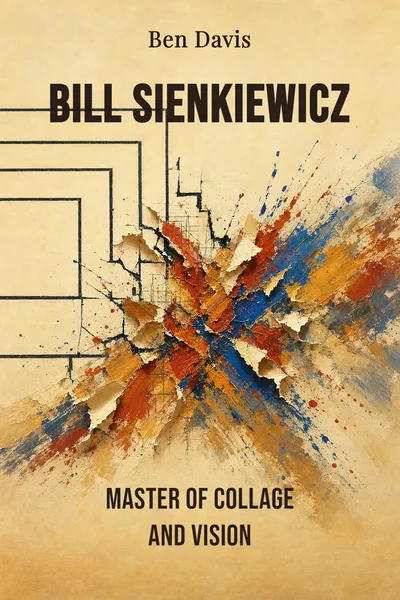
Bill Sienkiewicz
Master of collage and vision
Description
Open a Marvel comic from around 1980 and the pages behave. Clean ink lines, figures that stand where they should, a grid of panels the eye reads left to right like a paragraph. That was the deal: the art served the story, and the story moved in an orderly march toward the last page. Bill Sienkiewicz started inside that deal, drawing a superhero book called Moon Knight in a style so close to the industry's reigning craftsman, Neal Adams, that readers assumed the older man was ghosting for him. He was doing what a young comics artist was supposed to do — draw beautifully, invisibly, in service of the panel.
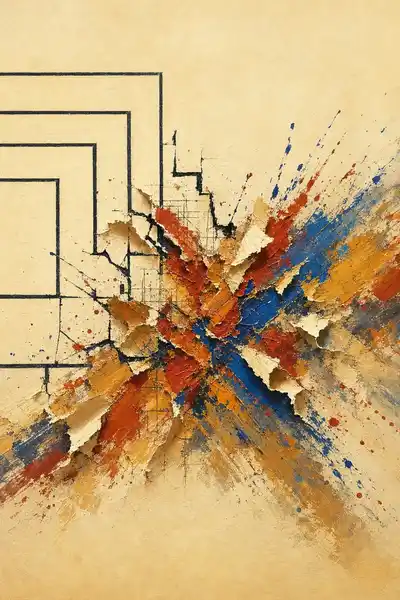
Then, over a handful of years in the early and mid-1980s, he stopped. The clean line gave way to paint, to torn paper, to photographs glued into the frame, to backgrounds that dissolved into abstraction and figures that looked scraped rather than drawn. On a mainstream Marvel title aimed at teenagers, he began treating the comics page the way a painter treats a canvas — as a surface to attack, not a window to look through. Editors were nervous. Some readers were baffled. And the work became some of the most influential American comic art of its era.
Ben Davis's volume gathers that work and the story around it: the striking imagery set beside commentary, a career surveyed across painting, collage and graphic storytelling. It makes a quiet argument by simply putting the pictures on the table — that this restless, mixed-media artist belongs among the most inventive visual minds the comics medium has produced, and that his experiments changed what the form was allowed to look like.
The question we’re asking : How did one artist turn the tidy comic-book page into a surface for paint, collage and open experiment — and take the industry with him?What we’ll see : A career built from a near-perfect imitation into a full-blown revolt against the panel, and what that revolt did to comics as a visual art.
Table of contents
01Chapter 1 — The apprentice who painted like Neal Adams
Bill Sienkiewicz — the surname is Polish, and he has spent a career spelling it out phonetically for interviewers — broke into comics young, and he broke in by being uncannily good at sounding like someone else. His first sustained assignment was Moon Knight, a second-tier Marvel character launched into his own title in 1980. The art was polished, anatomically confident, full of dramatic lighting and elastic camera angles. It was also, by his own cheerful admission, deeply indebted to Neal Adams, the artist who through the 1970s had defined what a modern, realistic superhero page should look like.
The resemblance was close enough to cause confusion. Fans wrote in convinced Adams had a hand in the pages; some assumed Sienkiewicz was a pseudonym. For a beginner, this is usually the whole ballgame — you learn the house style, you execute it cleanly, you become reliable. The apprenticeship model in commercial comics rewards exactly that: an artist who can hit a monthly deadline in a legible, established manner is an artist who keeps working.

02Chapter 2 — New Mutants, and the moment the page stopped behaving
In 1984, Sienkiewicz took over the art on The New Mutants, a Marvel book about teenage students at the X-Men's school, written by Chris Claremont. On paper it was a mainstream superhero title with young readers and monthly deadlines — the least likely place for a formal revolution. That is exactly where he staged one. The clean line disappeared almost overnight. In its place came painted pages, ragged textures, figures rendered with a violence of mark-making that had no precedent on a spinner-rack comic.
The most discussed sequence involved a villain called the Demon Bear, which Sienkiewicz rendered not as a clearly drawn monster but as a churning mass of paint and shadow, a shape the eye could never quite pin down. Dream sequences bled off the panel edges. Characters' emotional states warped the very ink describing them. He began pulling in photographic collage, cutting and pasting real imagery into the drawn world so that the surface of the page announced itself as a made object rather than a transparent window.
03Chapter 3 — Elektra, Stray Toasters, and the war on the panel
The New Mutants experiment was a hijacking of someone else's franchise. The work that followed was Sienkiewicz off the leash. In 1986 and 1987 he collaborated with writer Frank Miller on Elektra: Assassin, a limited series that abandoned almost every convention of superhero storytelling at once. The painted pages fractured, doubled and layered; the narrative jumped through time and unreliable memory; the imagery swung between grotesque caricature and startling beauty. It looked like nothing else Marvel was publishing, because in a sense it was barely a comic in the received meaning of the word.
Then came Stray Toasters, a project he both wrote and drew, published starting in 1988. Here there was no franchise to answer to and no co-writer to negotiate with — just Sienkiewicz alone with the full range of his methods. The result is dense, difficult, saturated with paint and collage and a storyline that resists easy summary. Davis presents it as the purest expression of the artist's ambitions and also the point at which his work asked the most from its readers, a book that treats the graphic page as a place for open experiment rather than efficient communication.
04Chapter 4 — When a drawing refuses to sit still
Step back from the individual books and Sienkiewicz's career reads as a long argument about what comics are allowed to be. For most of its commercial history the medium had accepted a modest ceiling on itself: it was illustration in service of story, craft measured by clarity and speed, an industrial art that valued legibility above all. The gallery and the comic shop were understood to be different worlds. What his work did, page by page, was refuse that division — to insist that a mass-market comic could carry the ambition, texture and difficulty usually reserved for painting.
This is why Davis's volume situates him among the most innovative visual artists to come out of the medium rather than merely its most technically gifted draftsman. Technical gift he had from the start, and he could have coasted on it for decades. What sets him apart is that he treated the comics page as an unsolved problem — a surface whose conventions were provisional and worth attacking. His mixed-media style was not a signature look bolted onto ordinary storytelling; it was a genuine investigation into how paint, collage and drawing could combine to mean something on a printed page.
05Conclusion
The arc is almost too neat to be true, except that the pages are there to prove it. Sienkiewicz began as the young artist who could imitate the industry's best so perfectly that readers thought he was a fake, and he ended as the artist whose work no one could mistake for anyone else's. The clean line he mastered in his Moon Knight days was never the goal — it was the complete education in a grammar he intended to break. Every torn photograph, every churning field of paint, every panel that dissolved at its edges was made by someone who knew exactly what a well-behaved comic looked like and chose otherwise.
Related books