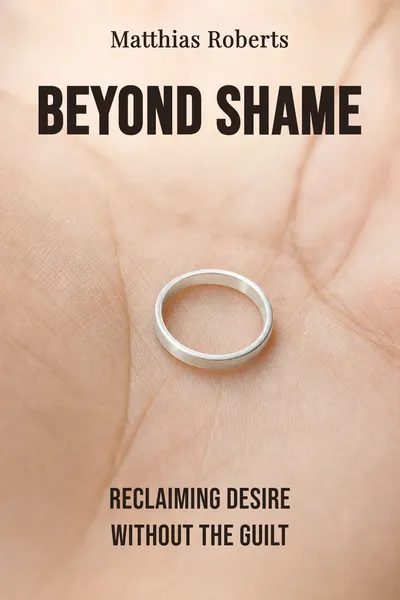
Beyond Shame
Reclaiming desire without the guilt
Description
A young man sits across from a therapist in Seattle and describes, in careful language, a life that looks fine from the outside. Steady relationship, decent job, a faith community he still cares about. What he cannot say out loud, at first, is that every time desire surfaces — a want, an attraction, a fantasy — something in him flinches. Not toward the thing itself, but toward himself for wanting it. Matthias Roberts, the therapist, has heard some version of this hundreds of times. The details change; the reflex does not. People arrive not asking to feel more pleasure but asking to feel less like a problem.
Roberts trained as a psychotherapist after growing up inside American evangelical culture, the world of purity pledges and true-love-waits rings, where sexuality was framed as a threat to be managed rather than a part of a person to be understood. In his 2020 book Beyond Shame, he sets out to name what that framing does to people long after they have stopped believing the sermons. His argument is not that religion is the villain, or that anything goes. It is quieter and harder: that shame, whatever installed it, tends to make our relationship with desire worse, not safer — and that most of us have never learned the difference between shame and its more useful cousin, guilt.
That distinction sounds academic until you feel the weight of it. Guilt says I did something I regret. Shame says I am something wrong. One points at an action and leaves room to change. The other points at the self and leaves nowhere to stand. Roberts spends the book working out how a person raised on the second kind might find their way toward the first — and toward a desire they can meet honestly, on terms they actually chose.
The question we’re asking : What does sexual shame actually do to us, and how does someone raised inside it build a healthier relationship with their own desire?What we’ll see : How inherited messages settle into the body, why the usual escape routes fail, and what a therapist means when he says acceptance has to happen on your own terms.
Table of contents
01 Chapter 1 — The message underneath the message
The messages Roberts is interested in are rarely delivered as arguments. Nobody sits a child down and explains a theory of sexuality. Instead it arrives sideways — in the tone a parent uses, the joke that lands wrong, the silence when a question is asked, the youth-group talk comparing a non-virgin to a chewed piece of gum. What gets transmitted is not information. It is a feeling: that this whole domain is dangerous, that wanting is suspect, that the safest posture is vigilance against yourself.
Roberts calls this the message underneath the message. On the surface, a purity culture promises protection and belonging. Underneath, it teaches that your desires are the enemy and that your worth is contingent on controlling them. A child who absorbs that does not grow into an adult who simply disagrees with it. They grow into an adult whose nervous system still runs the old program, flinching at wants they can no longer even name as wrong.

02 Chapter 2 — Two ditches on the same road
Faced with inherited shame, most people reach for one of two exits, and Roberts thinks both are dead ends. The first is doubling down — becoming stricter, more controlled, more certain that if they just manage themselves hard enough the discomfort will resolve. This is the road most religious frameworks recommend, and it can look like health from the outside. Inside, it is a person at war with themselves, and the war never ends, because the enemy is their own wanting.
The second exit is the opposite: throwing everything off. If shame said no, the logic goes, then freedom means yes to everything, as loudly and quickly as possible. Roberts is careful here, because this move gets coded as liberation, and sometimes it genuinely is a step out of a cage. But he has watched enough people take it to notice something. Reactive rebellion is still being driven by the old rules — just in reverse. You are not free if every choice is a rejection of what you were taught. You are still letting it steer.
03 Chapter 3 — What the body was trying to say
A recurring move in Roberts's approach is to stop treating unwanted feelings as verdicts and start treating them as information. Arousal, longing, even the ones that arrive at inconvenient moments or point in unexpected directions — his instinct as a therapist is not to ask whether they are allowed, but what they are telling us. Desire, in this reading, is not a moral test the body keeps setting. It is closer to a language the body has been speaking all along, one shame taught us to stop translating.
This is where his clinical training does real work. Trauma-aware therapy has long understood that the body keeps score — that experiences we never consciously processed still shape how we react, tense up, shut down. Roberts extends this to sexuality. The person who cannot be touched a certain way without dissociating, the one whose desire goes flat inside safe relationships and sharp inside dangerous ones, is not broken and not sinful. They are carrying a history their body remembers more accurately than their mind does.
04 Chapter 4 — When healing stops being a destination
Step back from sex specifically and Roberts's book is really about how a borrowed morality becomes a person's felt sense of themselves — and how hard it is to tell the two apart. The messages he traces did not stay as opinions we could inspect and update. They sank below language and became the water we swim in, the reflex that fires before thought. That is what makes inherited frameworks so powerful: by the time we might question them, they no longer feel like beliefs. They feel like us.
This is why Roberts is wary of any tidy endpoint. The culture around healing loves an arrival — the breakthrough, the before-and-after, the version of you that finally has it figured out. He offers something less satisfying and more honest. Building a healthier relationship with desire is not a wall you climb over once. It is ongoing, uneven, occasionally circling back to ground you thought you'd covered. Shame does not get deleted; it gets known well enough to lose its authority.
05 Conclusion
The young man in the counseling room does not leave with a new rulebook. That was never the point, and swapping one set of instructions for another would only reproduce the trap. What changes, over time, is smaller and more consequential: the flinch loosens its grip. He learns to notice a want without immediately deciding it condemns him, to ask where it comes from before ruling on it, to tell the difference between a value he chose and a fear he inherited. Desire stops being an alarm and starts being information he can actually use.
Related books