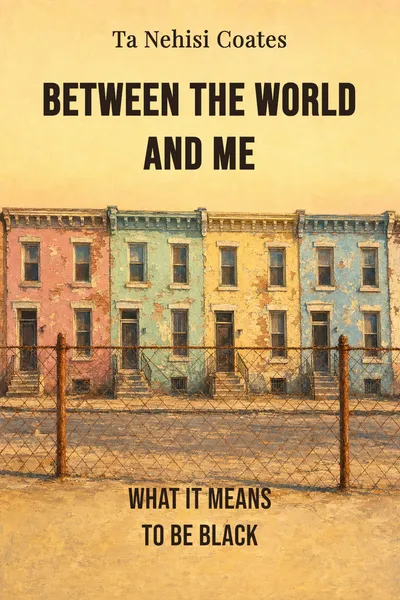
Between the World and Me
What it means to be Black
Description
In the summer of 2015, a journalist named Ta-Nehisi Coates published a slim book, barely a hundred and fifty pages, addressed to his fifteen-year-old son. It was called Between the World and Me, after a Richard Wright poem, and it arrived in the form of a letter — a father writing to a boy about what it means to live in a Black body in the United States. Coates had grown up in West Baltimore, the son of a former Black Panther, and had spent years at The Atlantic writing about American history and its long machinery of race. This time he wasn't writing to explain policy. He was writing to a child he loved, and could not fully protect.
The frame was borrowed on purpose. In 1963, James Baldwin had opened The Fire Next Time with a letter to his own nephew, and Coates took that structure and that intimacy as his inheritance. Toni Morrison, reading the result, wrote that Coates filled the intellectual space Baldwin had left behind. The book won the National Book Award for Nonfiction that year and was a Pulitzer finalist the next. But the praise almost misses the point of the form. A letter to your son is not an argument you win. It's something you hand over, knowing the person receiving it will have to live with it.
What Coates hands over is heavy, and he refuses to lighten it. There is no arc toward reconciliation, no closing note that says it will all come right. The book takes a word people use loosely — race, Blackness, the body — and insists on its literal weight, the actual flesh that can be broken. That insistence is what makes it hard to read and hard to put down.
The question we’re asking : What does Coates tell his son it means to inhabit a Black body in America, and why does he refuse to soften it?What we’ll see : A father's letter that turns history, memory, and a stubborn refusal of comfort into a single act of honesty.
Table of contents
01Chapter 1 — A letter, and a body to protect
Coates begins with a scene most parents know: a television interview, a question about hope, and himself failing to give the answer people wanted. The host asked what it meant to lose his body to the forces of American history. He fumbled. Then he went home to his son and started writing, because the honest reply was too long and too painful for a studio segment. The letter is the reply he couldn't give on air.
The word that anchors the whole book is the body. Coates keeps returning to it, refusing the abstractions that usually cushion talk of race. Racism, in his telling, is never only an idea or an attitude. It lands on flesh — it breaks bones, it stops hearts, it removes people from the world. He tells his son that in America there has always been a tradition of destroying the Black body, and that this is not a metaphor. It is the physical fact underneath the history, and he wants the boy to feel it as physical.

02Chapter 2 — Baltimore, and the education in fear
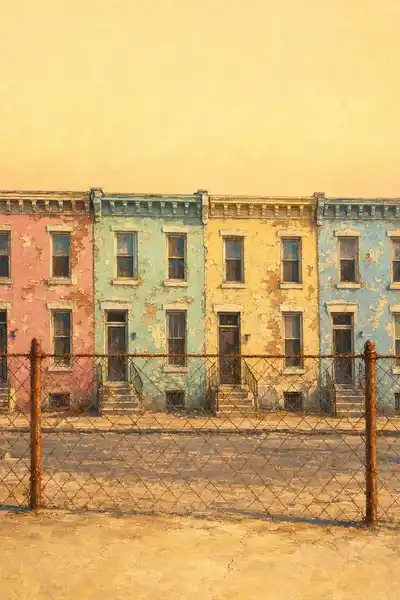
To explain the country, Coates goes back to his own boyhood in West Baltimore in the 1980s. It is not a nostalgic account. He describes a childhood organized around fear — the fear that governed which streets you could walk, how you held your body, who you looked at and for how long. He remembers a boy pulling a gun outside a 7-Eleven, and the way the memory taught him that his life could end over nothing, that the margin for error was cruelly thin.
The fear had a logic, and Coates traces it to the institutions meant to guide young people. School, in his telling, did not protect him; it disciplined him, demanded obedience it never explained, and punished the curiosity that might have set him free. The streets demanded their own kind of obedience, a hardness worn as armor. Both systems, the classroom and the corner, taught the same lesson from opposite directions: control your body, make yourself small, or risk losing it. He came to see these as two arms of the same arrangement.
03Chapter 3 — The Dream, and the people who believe they are white
The book's sharpest idea is what Coates calls the Dream. He means the picture of American life sold as ordinary and deserved — the lawns, the treehouses, the block parties, the sense of safety taken as a birthright. The Dream is pleasant, and that is the problem. Coates argues to his son that this comfort rests on the plunder of Black bodies, that the peace of the Dreamers has always been paid for by someone else's danger. The people inside it get to not notice the cost, and the not-noticing is part of how it works.
Coates refuses to use race as though it were a natural fact. He writes that there are no white people or Black people in any biological sense — that these are inventions, and specifically that people who believe themselves white made themselves so through hierarchy and violence. Race did not produce racism, he insists; racism produced race. Whiteness, in his account, is not a skin color but a claim to the top of a ladder, and the ladder is built out of other people's bodies. Naming it this way strips the Dream of its innocence.
04Chapter 4 — What the letter refuses to promise
What sets Between the World and Me apart is what it declines to do. American writing about race tends to move toward redemption — the arc that bends toward justice, the promise that suffering will be repaid with progress, the closing note that lets the reader exhale. Coates removes that exit. He writes to his son that he will not offer the comfort of a happy ending, because the comfort would be false and false comfort is a kind of abandonment. The book ends without resolution on purpose.
This refusal is not despair, though it has been read that way. Coates is asking for something harder than hope: attention that does not require a reward. He wants his son, and his reader, to be able to look at the plunder squarely without needing the promise that it will end soon. To insist on a redemptive arc, in his view, is often to insist that the sufferer make the observer feel better. He will not put that burden on his child.
05Conclusion
Coates returns, at the end, to the people who did not survive — to a Howard classmate named Prince Jones, killed by a police officer who was never charged, whose death sits at the moral center of the book. He drives to see the young man's mother, a doctor who had risen far and still could not keep her son safe. That visit is his answer to anyone who believes achievement is protection. The plunder does not check credentials. It reached her house the same way it reaches everyone else's.
Related books