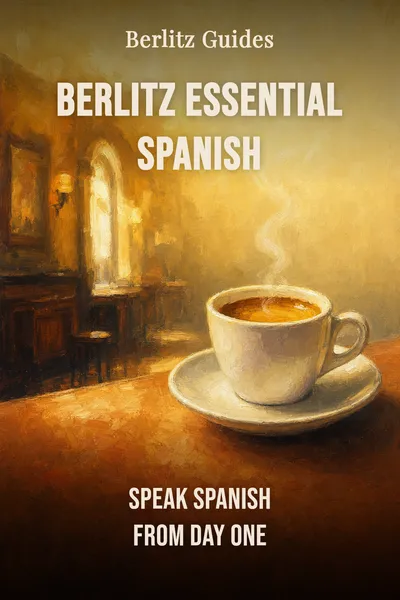
Berlitz Essential Spanish
Speak Spanish from day one
Description
There's a particular moment familiar to anyone who has ever booked a trip to Madrid or Mexico City with good intentions. You buy the app, maybe a fat textbook, and you promise yourself that this time you'll learn properly, from the ground up, conjugation by conjugation. Then the trip arrives, and at the pharmacy counter or the train station you're still miming, pointing, and saying the one word you're sure of, louder. Berlitz Essential Spanish was built for people caught in exactly that gap — between the ambition to master the language and the very real need to order a coffee tomorrow morning.
Berlitz has been in this business a long time. The method traces back to Maximilian Berlitz in the 1870s, whose whole idea was that people learn to speak by speaking, not by memorizing tables of rules first. The Essential Spanish guide is the compact, self-study descendant of that idea: a pocket-sized foundation in vocabulary, phrases, and just enough grammar, arranged so you can find what you need at the moment you need it. It does not pretend to make you fluent. It promises something narrower and more useful — that you can say something real from day one.
That promise is worth taking seriously, because it reflects a genuine argument about how beginners should spend their limited attention. A guide like this makes choices: what to include, what to leave out, what to trust a nervous first-timer to handle in a foreign country. Those choices are the whole book, and they add up to a small philosophy of learning that's easy to miss under the vocabulary lists.
The question we’re asking : How does a compact self-study guide turn a total beginner into someone who can actually speak Spanish in everyday situations?What we’ll see : How the book organizes phrases, doses out grammar, and anchors everything to the moments a real learner walks into.
Table of contents
01Chapter 1 — A phrasebook that assumes you'll actually talk
The organizing unit of Berlitz Essential Spanish is not the word but the phrase you'd actually use. Instead of handing you a naked list of nouns to memorize, the guide gives you whole functioning sentences — how to ask where something is, how to order, how to say you don't understand and could someone please repeat that more slowly. This is the old Berlitz instinct showing through: language is a thing you do, not a thing you file away. A word alone rarely gets you through a counter transaction. A phrase does.
Everything comes with pronunciation help, rendered in a simplified phonetic guide so you're not left guessing whether that j sounds like an h or something stranger. Spanish is friendlier here than most languages — it's largely written the way it sounds, once you learn a handful of rules about vowels and stress — and the book leans on that. It front-loads the sounds so that the phrases you learn later can be spoken with some confidence rather than mumbled and hoped over.

02Chapter 2 — Grammar in small doses, on purpose
Grammar is where most beginner guides either overreach or flinch. Berlitz Essential Spanish takes a middle path: it gives you the structural rules that unlock the most sentences, and it leaves the rest for later, or for never. You get gender — the fact that Spanish nouns are masculine or feminine, and that the words around them have to agree — because you cannot build a correct phrase without it. You get the present tense of the verbs you'll lean on hardest. You do not get a full drill through every irregular conjugation in the subjunctive mood, because a first-timer at a hotel desk does not need it.
This restraint is a deliberate bet. The book treats grammar as a tool in service of speaking, not as a subject to be mastered before speaking is permitted. That inverts how a lot of us were taught in school, where we conjugated for months before we were trusted to say anything real. Here the logic runs the other way: learn the pattern that lets you ask for a room, use it, and absorb the finer rules as you keep going. Understanding follows use rather than gating it.
03Chapter 3 — The situations a traveler really lands in
The spine of the guide is a set of everyday scenarios, and this is where its practicality is most visible. Arriving somewhere and needing directions. Checking into a hotel and asking whether breakfast is included. Ordering in a restaurant and, crucially, asking what a dish actually is before it arrives. Shopping, handling money, understanding prices. Getting to a doctor or a pharmacy when something's wrong. Each situation comes with its own compact kit of phrases, so the book functions less like a course and more like a field manual you consult in the moment.
The choice of situations tells you who the guide imagines its reader to be: a traveler, or a beginner learning in the context of a real life abroad, rather than a student preparing for an exam. There are no essay prompts, no literary vocabulary, no phrases you'd only need to discuss politics. There's the stuff of arrival and survival — transport, lodging, food, health, money, the small emergencies of being somewhere unfamiliar. It's a portrait of language as the thing that carries you through a day.
04Chapter 4 — The quiet confidence of good enough
Step back from the phrase lists and the situations, and Berlitz Essential Spanish is making a broader claim about how adults learn a language — one that runs against a lot of received wisdom. The dominant fantasy is that you learn thoroughly, in sequence, and emerge one day fluent. The Berlitz claim, inherited from its founder's method and distilled into this small book, is that you learn by using an incomplete, imperfect version of the language, early and often, and that the completeness arrives, if it arrives at all, as a byproduct of all that flawed talking.
This reframes what a beginner is actually short on. It's rarely knowledge — most people who've studied any Spanish know more than they use. What they're short on is permission and confidence: the willingness to open their mouth with a broken sentence and trust that it'll work well enough. The guide is engineered to lower that threshold. Every design choice — the ready-made phrases, the light grammar, the pronunciation crutches, the scenario layout — exists to get a nervous person to speak sooner and feel less exposed doing it.
05Conclusion
Come back to that traveler stuck at the counter, miming and pointing and saying the loud one word. Berlitz Essential Spanish is the object that fits in the pocket precisely for that moment, and its answer to the predicament is disarmingly simple: here is the sentence, here is roughly how to say it, go on and use it. It doesn't hand over the whole language. It hands over the small, load-bearing part that turns a silent gesture into an actual exchange, and it trusts that the exchange itself will teach the rest.
Related books