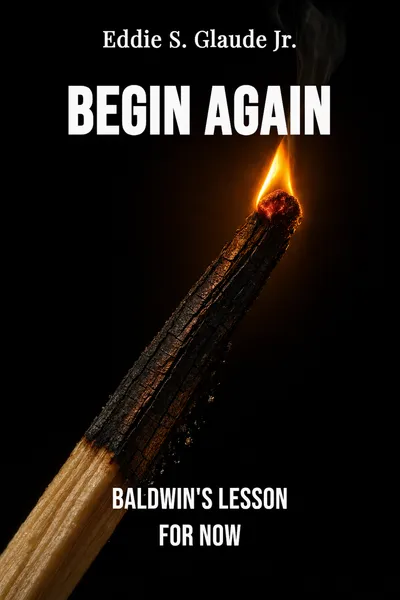
Begin Again
Baldwin's lesson for now
Description
In the late 1960s, James Baldwin kept coming home to a country he no longer recognized, and that no longer seemed to recognize him. The great movement he had helped give voice to was buckling. Medgar Evers had been shot in his own driveway in 1963. Malcolm X was gunned down in 1965. Martin Luther King Jr. was killed in Memphis in April 1968. Baldwin had known all three. He would carry their deaths the way you carry a wound that never fully closes — and he started, in those years, to write differently, angrier, more exposed.
Eddie S. Glaude Jr. calls this stretch of Baldwin's life the after times: the period once the exhilaration burns off and the country you tried to change decides, quietly and then loudly, that it would rather not. Between The Fire Next Time in 1963 and No Name in the Street in 1972, Baldwin turned into an openly political writer, and it cost him — critics cooled, the work got harder to place, the despair was real. Glaude, a scholar of African American studies at Princeton, reads that passage not as decline but as instruction. He wrote Begin Again in the middle of the Trump years, convinced we had landed in after times of our own.
The book braids biography, history, and Glaude's own memory into a single argument: that Baldwin, precisely because he refused both easy hope and total despair, left a usable map for a country that keeps failing the same test. This is not a tidy hero story. It is an account of a man learning what to do when the confrontation he demanded does not come.
The question we’re asking : What did Baldwin learn about surviving a movement's defeat without lying to himself — and what does Glaude take from it for now?What we’ll see : How a disillusioned Baldwin found a way to keep bearing witness, and why Glaude thinks that discipline is the one the present demands.
Table of contents
01Chapter 1 — The country Baldwin came back to
Baldwin had left for Paris in 1948, a young writer fleeing an America that seemed determined to break him. He returned, over and over, drawn back by the movement gathering in the South. For a stretch in the early 1960s he was something like its literary conscience — The Fire Next Time, published in 1963, sold enormously and put him on the cover of Time magazine that May. He toured, he lectured, he sat in living rooms with organizers half his age. He believed, or made himself believe, that the country might actually turn and look at what it had done.
Then the killings started, and did not stop. Glaude lingers on how personal the losses were. These were not abstractions to Baldwin; they were men he had eaten with, argued with, admired. Each death chipped at the possibility he had staked himself on. And the country's response — the backlash, the exhaustion, the white insistence that enough had already been given — told him something he did not want to know: that the confrontation he had called for was not going to happen on the timeline he had imagined, and maybe not at all.

02Chapter 2 — The value of the evidence
Glaude keeps returning to a phrase Baldwin used again and again: the price of the ticket. The ticket was the story white America told itself to feel innocent — that the country was fundamentally good, that its cruelties were exceptions, that Black suffering was somehow separate from the national self-image. Baldwin's whole project was to refuse that story, to insist that the evidence of a life, his own and others', be admitted as testimony against the myth.
No Name in the Street, published in 1972, is where Glaude locates this at its rawest. The book is fractured, furious, hard to read comfortably — and that difficulty is the point. Baldwin had stopped trying to reassure his white readers. He wrote instead as a witness in the old sense, one who has seen a thing and will not pretend he didn't, whatever it costs him to say so. Glaude reads the disorder of the prose as honesty: a mind refusing to impose a false coherence on a country that had none.
03Chapter 3 — The lie, and the work of unmasking it
At the center of Begin Again sits what Glaude, following Baldwin, simply calls the lie. It is not one falsehood but a whole architecture: the conviction, buried deep in the national character, that white people matter more than everyone else, dressed up as innocence, as tradition, as ordinary common sense. The lie is powerful precisely because it doesn't announce itself. It lives in what a country chooses to remember and what it agrees to forget.
Glaude reads the Trump years through this lens, and the parallel with Baldwin's era is the book's engine. He points to Charlottesville in August 2017, where marchers carried torches and a counter-protester was killed, and to the family separations at the southern border — moments where the lie stopped hiding. For Glaude these were not aberrations breaking the story of American progress. They were the story, surfacing again, answering the hope of the Obama years the way the backlash of the late 1960s had answered the civil rights movement. We had, he argues, been here before.
04Chapter 4 — Beginning again is not starting over
The title carries the whole argument, and Glaude is precise about what it does and does not mean. To begin again is not to wipe the slate and pretend the wreckage never happened. That fantasy of a fresh start, unburdened by the past, is itself part of the lie — the American habit of skipping the reckoning and calling it renewal. Baldwin's beginning again is the opposite. It starts from the wreckage, insists on it, and asks what can be built by people who have stopped lying about the ground they stand on.
This is why Glaude treats the after times as a recurring condition rather than a passing crisis. Every generation that pushes America toward the truth about race meets a retrenchment, and every retrenchment produces its own disillusioned witnesses who must decide what to do with their defeat. Baldwin's answer, hard-won across those bruising years, was that despair and hope are not the only options. There is a third posture: to keep bearing witness without the guarantee of victory, treating the work as a duty owed to the truth rather than a bet on the outcome.
05Conclusion
Baldwin died in France in 1987, the confrontation he had spent his life demanding still unmade. Glaude does not tidy that away. The man who came home again and again to a country that kept disappointing him never got to see it turn and look honestly at itself. What he left instead was a way of living inside that disappointment without being consumed by it — the practice of telling the truth as testimony, whether or not anyone is ready to hear it.
Related books