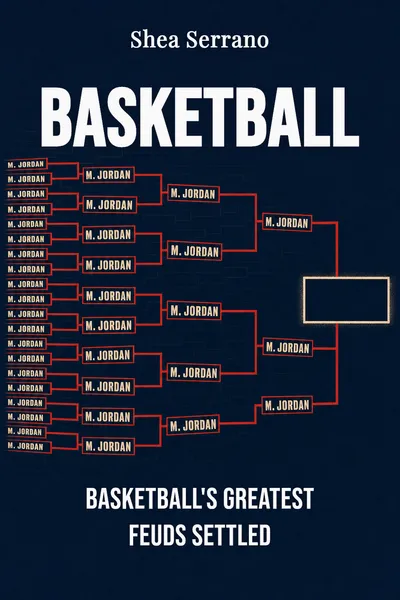
Basketball
Basketball's greatest feuds settled
Description
There is a specific kind of conversation that happens after midnight, usually with a drink going flat somewhere nearby, where two people who love basketball try to settle something that cannot be settled. Who is the greatest dunker who ever lived. Whether you can call a foul on your own teammate at the park. Which Michael Jordan, of all the Michael Jordans, was the actual best one. These arguments have no answer. That has never once stopped anyone from having them, loudly, for hours. Shea Serrano built a whole book out of taking them seriously.
That book is "Basketball (and Other Things)," published in 2017, illustrated throughout by Arturo Torres, and it does something that sounds simple and turns out to be rare. It treats fan arguments — the dumb ones, the impossible ones, the ones you'd swear you'd never write down — as if they deserved real evidence, real structure, and real stakes. Serrano assigns point values to shots. He ranks disrespectful dunks by how disrespectful they were. He asks, in complete sincerity, whether a particular pickup-game player should be allowed to keep playing.
What comes out is funnier than a stats page and more honest than a highlight reel. The jokes are load-bearing; underneath them is a real argument about how basketball actually lives in the people who watch it. Not in the box score. In the debate about the box score.
The question we’re asking : What does Serrano actually do when he sits down to settle a basketball argument that has no answer?What we’ll see : How the book turns unwinnable fan feuds into structured cases, and what that method quietly says about loving a sport.
Table of contents
01Chapter 1 — The arguments nobody was having, until now
The premise of "Basketball (and Other Things)" is that the arguments we already have are the wrong size. Fans debate the same three or four Greatest Of All Time questions until the words lose meaning. Serrano's move is to go sideways — to invent the disputes nobody realized they'd been waiting for, then chase them all the way down. Not "who is the GOAT," but questions with more angles and better jokes hiding inside them.
So he asks things like: how many years, exactly, was Kobe Bryant the single best player in the league? Not a career-long shrug, a year-by-year audit. He asks who deserves the title of most disrespectful dunker, treating an insult delivered by human body as a thing that can be graded. He asks, with a straight face, what different shots would be worth if basketball had assigned them fairer point values across history — a full alternate economy of the sport.

02Chapter 2 — Ranking the versions of a single man
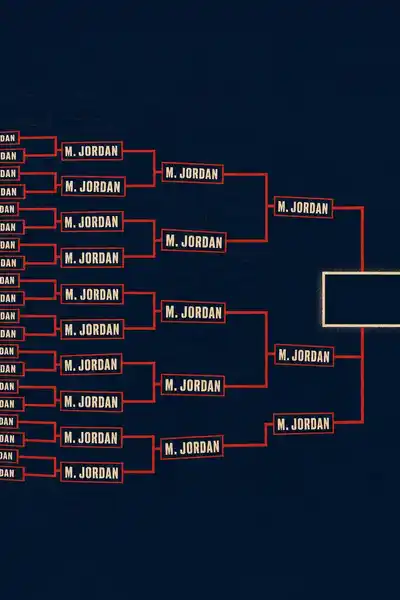
The most Serrano question in the book might be the one about Michael Jordan — not whether Jordan was the best, which he takes as settled enough, but which Jordan was the best. Because there wasn't one. There was Rookie Jordan, all raw hang-time and no rings. There was the scoring-title Jordan before the Bulls could win anything. There was the three-peat Jordan, then the baseball detour, then the second-coming Jordan in the different-looking body, and finally the Washington Wizards Jordan that most fans would rather forget.
Treating a career as a set of distinct players is a genuinely useful trick, and Serrano runs it hard. Each version has its own case, its own peak, its own flaws. The point isn't just to crown a winner; it's to notice that our memory of an all-time great flattens him into a single glowing figure, when the truth is a sequence of very different men wearing the same number. The argument forces you to specify what you actually mean when you say someone is the best.
03Chapter 3 — The rules of the game before the game
Some of the sharpest writing in the book isn't about the NBA at all. It's about the park. Serrano devotes real attention to the unwritten constitution of pickup basketball — the code that governs a game with no referee, no clock anyone trusts, and no authority except consensus and volume. What's allowed. What's strictly forbidden. Who gets to make the call, and how loudly they're allowed to make it.
The joke, again, is the seriousness. Pickup basketball has no rulebook, so Serrano writes one, cataloguing the offenses with the gravity of a legal scholar. Calling a soft foul at a decisive moment. Insisting on your own out-of-bounds call with zero witnesses. Showing up in the wrong shoes and then playing anyway. Being the guy who shoots every time he touches the ball. Each gets weighed, and the weighing is precise because everyone who has ever played knows these crimes intimately.
04Chapter 4 — Why the argument is the point
Step back from the shot values and the Jordan rankings and the pickup crimes, and what the book is really doing comes into view. Serrano isn't trying to end these arguments. He's trying to honor them. The answers he gives are provisional, defensible, and completely arguable — which means the reader closes the chapter already composing a rebuttal. That's not a failure of the method. That's the method.
Basketball, the book quietly insists, doesn't live in the record book. The record book is settled and therefore dead. The sport actually lives in the space where nothing is settled — the disrespectful-dunk rankings, the which-Kobe-year debates, the fistfights over an out-of-bounds call at the park. Fandom is the practice of arguing about a thing you love with people who love it differently. Serrano's whole project is to take that practice, usually dismissed as barroom noise, and treat it as worthy of charts, evidence, and beautiful illustration.
05Conclusion
"Basketball (and Other Things)" ends where the after-midnight conversation always ends: with nothing resolved and everybody still talking. Serrano never pretended otherwise. He picks the best dunker, ranks the Jordans, drafts the pickup code, assigns his shot values — and hands every one of them over knowing the reader will push back. The book is a stack of confident verdicts issued by someone who understands that the verdict is just the opening line of the next argument.
Related books