
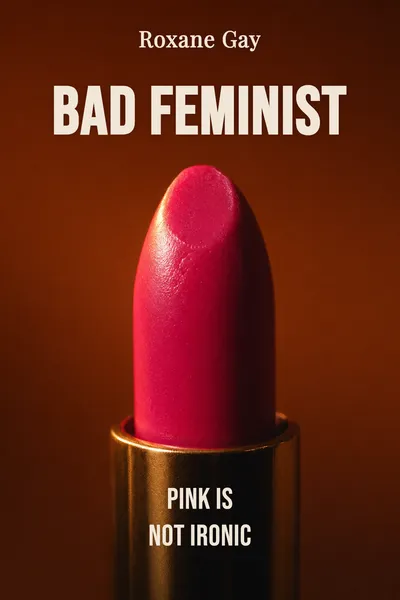
Bad Feminist
Pink is not ironic
Description
Roxane Gay likes pink. Not as a wink, not as a knowing reclamation of something girly, not filtered through three layers of theory. She just likes it — all shades of it — and she reads Vogue the way other people read Vogue, cover to cover, once even live-tweeting the September issue. For years she told people her favorite color was black, because black was cooler, because black didn't need explaining. But the pink was always there. When she published Bad Feminist in 2014, this small confession sat inside a much larger one: that she is a feminist and a deeply imperfect one, and that she had spent a long time worried the two facts couldn't sit together.
The book is a collection of essays, and the title is a phrase Gay coined for herself half in defense, half in surrender. She listens to rap songs that call women names she would never accept anywhere else. She fakes knowing more than she does about cars and sports. She wants to be independent and also wants to be taken care of. By the standards of a certain idea of what a proper feminist looks like — consistent, righteous, above the culture rather than swimming in it — she keeps failing. So she stopped trying to pass the test and started asking why the test existed at all.
What emerges across the essays is less a manifesto than a portrait of a person thinking out loud, in public, about race and gender and the movies and books and songs we absorb without noticing. Gay isn't trying to be the model of anything. She's trying to be honest about the distance between her politics and her pleasures, and to suggest that the distance might not be a disqualification.
The question we’re asking : Can you hold a serious political commitment while remaining a walking contradiction — liking the things you're supposed to critique, failing the standards you believe in?What we’ll see : How Gay turned her own imperfections into a case for a feminism roomy enough to include the people who actually practice it.
Table of contents
01Chapter 1 — Pink is not ironic
The confession about pink is the smallest thing in Bad Feminist and one of the most revealing. Gay spends a page or two admitting that her favorite color is pink, that she used to lie and say black because black read as serious, and that she reads women's magazines with genuine appetite. None of this is performed as camp. She isn't enjoying Vogue at a safe ironic distance, the way an educated reader might claim to enjoy a trashy reality show. She actually wants to know what's in the September issue.
This matters because a certain strain of cultural feminism had made pleasures like these suspect. If you took gender seriously, you were supposed to have transcended the beauty industry, the fashion glossies, the pop songs that reduce women to bodies. Liking those things sincerely marked you as unserious, or worse, complicit. So people learned to perform distance — to consume the girly and the frivolous only with air quotes, only as critique. Gay noticed she'd been doing a version of this her whole life, hedging her real tastes to protect her credibility.

02Chapter 2 — The trap of the essential feminist
Gay's central worry is what she calls the essential feminist — an imaginary figure who does feminism correctly, without lapses, without guilty pleasures, without the messy human wanting that everyone actually carries around. This figure exists mostly as a standard people fear failing. She is angry in the approved ways, pure in her consumption, consistent between what she believes and what she enjoys. And because no real person clears that bar, the standard functions to make women feel like frauds for calling themselves feminists at all.
Gay lays out her own disqualifications with something close to relief. She listens to rap that degrades women and sings along. She wants a man to hold the door and pay for dinner. She's been known to fake interest in stereotypically male things to fit in, and to fake knowledge she doesn't have. She is not above the culture she critiques; she's soaking in it like everyone else. By the essential standard, she is a bad feminist, and for a while that phrase felt like an accusation she'd been trying to outrun.
03Chapter 3 — Culture, watched closely
Most of Bad Feminist is Gay looking hard at the culture she can't stop consuming. She writes about the movies, the novels, the reality television, the music that shapes how a society imagines women and race, and she refuses the two easy exits: pretending the culture doesn't matter, or condemning it wholesale and walking away. She stays in the theater, in the book, in the song, and describes exactly what it does and how it makes her feel.
Her essays on race run alongside her essays on gender, and she doesn't let either simplify the other. She writes about the way Black women are represented and misrepresented, about films that win prizes for depicting Black suffering, about the narrow scripts available to characters who look like her. She writes about The Help and about films built around slavery and racial trauma, uneasy about stories that let audiences feel enlightened while flattening the people at their center. She's a professor and a reader, so the analysis is sharp, but the voice stays conversational, personal, willing to admit when something both offended and entertained her.
04Chapter 4 — The permission to be a mess
Step back from the specific confessions and Bad Feminist is making a broader argument about how anyone holds a conviction. Gay's real target is the demand for purity — the belief that a commitment is only legitimate if it's total and consistent, that any gap between what you believe and how you live invalidates the belief. She thinks this demand is not only impossible but corrosive, because it turns political life into a performance of flawlessness and drives out everyone who can't perform it.
Her counter-position is that contradiction is the ordinary condition of a thinking person, not a failure to be ashamed of. You can want equality and want to be taken care of. You can critique an industry and buy its products. You can hold a principle and fall short of it daily, and the shortfall doesn't cancel the principle — it just means you're a person and not a slogan. What she asks for is the permission to be a mess and still count, to bring the whole inconsistent self to a politics rather than an edited version.
05Conclusion
So the pink was never ironic. That's the thread running under the whole book: Roxane Gay stops apologizing for the person she actually is and asks whether a feminism that requires the apology is worth wanting. She reads Vogue sincerely, listens to songs she'd object to on paper, wants contradictory things, and calls herself a feminist anyway — a bad one, by her own cheerful admission, which is exactly the term she reclaims. The confession about a color turns out to carry the argument of the entire collection.