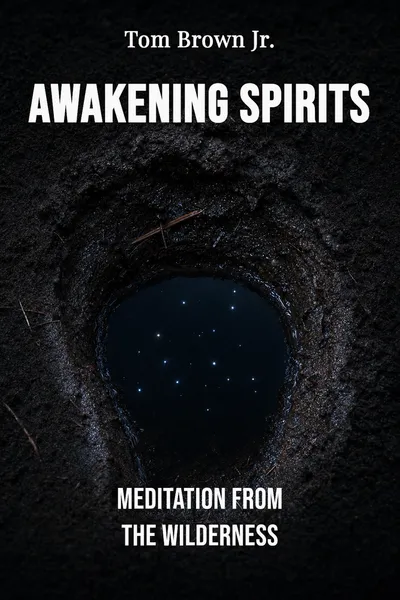
Awakening Spirits
Meditation from the wilderness
Description
There is a particular kind of stillness that comes over a person sitting alone in the woods after dark, when the eyes stop trying to see and the ears take over. Tom Brown Jr. has spent most of his life inside that stillness. As a boy in the New Jersey Pine Barrens, he was taken under the wing of an Apache elder his students would come to know only as Grandfather — a man who wandered the Americas for decades and eventually settled into teaching two boys how to read the earth. What Grandfather passed on was not survival in the narrow sense of shelter and fire. It was a way of belonging to a place so completely that the line between the watcher and the watched began to dissolve.
Brown became famous for the tracking. He can, by most accounts, read a footprint the way the rest of us read a sentence, and for years he ran a school in the Pine Barrens teaching people to do the same. But the tracking was always the visible half of something larger. Underneath the skills of the trail there was a discipline of attention, a set of exercises Grandfather used to quiet the noise inside a person until the land could be heard. For a long time Brown kept those exercises inside the classroom. In Awakening Spirits he wrote them down.
The book is unusual because it takes meditation — a practice most of us picture happening on a cushion, indoors, with the eyes closed — and moves it outside, into the mud and the cold and the dark. It insists that the wilderness is not a scenic backdrop to inner work but its actual teacher. That claim quietly reverses how a lot of us have been taught to think about peace and where it is found.
The question we’re asking : What does it mean to meditate not away from the world but straight into it — with the wilderness itself as the teacher?What we’ll see : How one elder's lessons became a practice that treats the living land as the ground of the spiritual, not its backdrop.
Table of contents
01 Chapter 1 — The old man who taught by silence
Grandfather, in Brown's telling, was already old when the two boys met him — a Lipan Apache who had spent roughly sixty years walking the wilder edges of the continent, learning from anyone who would teach and from the land when no one would. He did not lecture. He asked questions, set problems, and then went quiet, leaving the boys to work out the answer in their own bodies and their own time. Much of what he passed on arrived not as instruction but as a kind of patient withholding, the sense that the woods would tell you what you needed if you stopped demanding it.
This mattered because the exercises in Awakening Spirits are not really techniques in the way a breathing method is a technique. They are ways of being talked into a different relationship with the world, and Grandfather understood that you cannot argue someone into that relationship. He could only arrange the conditions. He would send a boy to sit at a single spot until it became familiar, then until it became boring, then until the boredom broke and something else came through. The impatience had to burn off first.

02 Chapter 2 — Meditation with your eyes open
The most striking thing about the practices Brown describes is how many of them happen with the eyes open and the body outdoors, alert rather than withdrawn. There is a foundational exercise he calls wide-angle vision, borrowed from the way predators and prey actually watch the world — a softening of the gaze that stops fixing on any single point and instead takes in the whole visual field at once. Movement leaps out. The mind, denied a single object to fasten onto, goes quiet almost by accident.
This inverts the usual image of meditation. Where a lot of contemplative practice asks us to close down the senses and turn inward, Brown's exercises open the senses as wide as they will go. The stillness comes not from shutting out the world but from receiving so much of it, so evenly, that the chattering inner voice has nothing left to grab. You are not escaping the woods; you are drowning the noise in them.
03 Chapter 3 — The sacred silence, and what it costs
At the center of the book sits an experience Brown returns to again and again, one Grandfather called by different names but which the book renders as the sacred silence. It is the state the exercises are all pointing toward — a moment when the inner voice finally stops, the boundary between the self and the surrounding land thins out, and a person feels, rather than believes, that they belong to the living whole around them. Brown describes it plainly, without the vocabulary of ecstasy, because for Grandfather it was not a peak experience but a natural condition we have simply forgotten how to enter.
What keeps us out of it, in the book's account, is noise — not the noise of the world but the ceaseless internal commentary we carry into the woods with us. We arrive still narrating, still planning, still ranking the day. The wilderness does not respond to a mind like that; it waits. The exercises are a slow argument with our own restlessness, a way of tiring out the narrator until it falls silent and the older, quieter attention underneath it can surface.
04 Chapter 4 — Nature as the only classroom
Step back from the individual exercises and Brown is making a larger claim about where spiritual practice actually belongs. Most contemplative traditions available to us have been built for interiors — the monastery, the meditation hall, the quiet room set apart from the world. The setting is deliberately neutral, stripped of stimulation, so that nothing outside competes with the work happening inside. Awakening Spirits rejects that architecture entirely. It insists that the land is not a distraction to be screened out but the teacher itself, and that removing it removes the point.
This is the through-line that connects Grandfather to the fox walk to the sacred silence. For Brown there is no version of the spiritual that can be had indoors, in the abstract, cut off from wind and cold and the smell of wet earth. The wilderness does something a bare room cannot: it is alive, indifferent, and endlessly detailed, and that combination forces a kind of attention no amount of willpower can fake. You cannot pretend your way into reading a track or hearing a distant animal. The land checks your work.
05 Conclusion
Awakening Spirits began as a set of exercises Tom Brown Jr. taught only inside his Tracker classes, techniques he had carried for decades from an old Apache man who preferred silence to speech. Putting them into a book was a way of handing on what Grandfather handed to him: not a philosophy to agree with but a practice to do, outdoors, in the discomfort where it actually works. The wide-angle gaze, the impossibly slow walk, the long sit in a single spot — they are all just doors into the same room, the quiet that arrives when the inner narrator finally runs out of things to say.
Related books