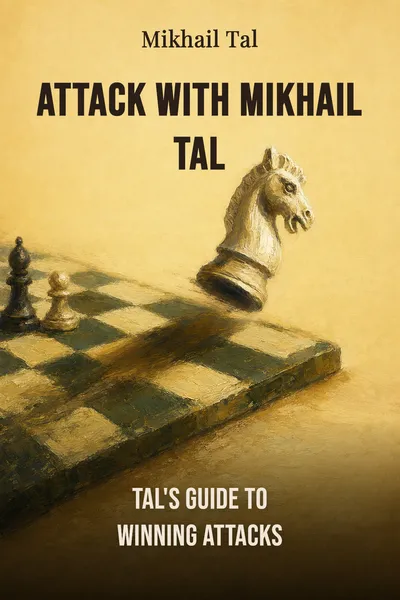
Attack with Mikhail Tal
Tal's guide to winning attacks
Description
In 1960, a twenty-three-year-old from Riga named Mikhail Tal took the world chess title from Mikhail Botvinnik, the most rigorous positional player alive. Tal did it by doing the thing you are not supposed to do: he gave pieces away. Knights, bishops, sometimes a rook, offered up on squares no engine of the era could vindicate, in positions where the compensation was murky at best. Botvinnik, a man who treated chess like an engineering discipline, spent the match trying to refute sacrifices that often could not be cleanly refuted. Tal won, and a legend calcified around him — the magician, the pirate, the player who conjured wins out of thin air.
Years later, together with the writer Iakov Damsky, Tal set out to explain how the magic actually worked, in a book built almost entirely from his own annotated attacking games. It is not a manual of openings or a catalogue of tactical motifs. It is closer to a confession: a champion walking us through the moments where he stopped calculating and started gambling, and telling us, with disarming honesty, when the gamble was sound and when it simply worked.
What makes the book unusual is that Tal refuses to pretend the attacks were provable. He owns the guesswork. He shows us the fork in the road where two moves looked equal and he chose the one that would frighten the man opposite him. Somewhere in that choice lives a whole theory of how attacks are won — one that has less to do with the board than we assume.
The question we’re asking : How does a player actually win an attack when the calculation cannot promise a win?What we’ll see : Tal walks us through his own boldest games to reveal what the sacrifice is really trying to do.
Table of contents
01Chapter 1 — The Riga alchemist and the price of a piece
The reputation arrived early. As a teenager in Riga, Tal was already dismantling stronger players with combinations that looked reckless and turned out to be lethal. By the time he became the youngest world champion in history in 1960, the chess world had settled on a story: Tal saw further than everyone else, so his sacrifices were really just deep calculation dressed up as daring. His book quietly dismantles that flattery. He did not always see to the end. Often he could not.
What Tal offers instead is a different accounting of what a piece is worth. In the classical view, material is close to sacred — you give up a knight only when you can show, move by move, that you get it back with interest. Tal treats material as one currency among several. Time, open lines, an exposed king, the initiative, the sheer momentum of an attack — these can be bought, and pieces are what you spend. The question is never simply 'is this sound?' but 'what does this purchase, and is the purchase worth more than the piece?'

02Chapter 2 — When the calculation runs out
The most honest chapter in Tal's thinking is the one about the limits of calculation. Every attacking player reaches a point in a complicated position where the variations branch faster than the mind can follow. Three plausible captures, each leading to three plausible replies, each leading to three more — the tree explodes, and no human walks it to the leaves. Tal describes reaching that wall constantly. What separates him is not that he saw past it, but what he did when he hit it.
He tells a famous story on himself. In one tangled position he found himself trying to calculate a knight sacrifice through a thicket of lines, and his mind kept wandering — at one point, absurdly, to a children's rhyme about a hippopotamus stuck in a swamp. He never did calculate the sacrifice to a clean conclusion. He simply decided the position deserved it, played the knight, and it worked. The anecdote is not a boast. It is a description of the real texture of decision-making at the board, where at some depth intuition takes the wheel from arithmetic.
03Chapter 3 — The move that makes the opponent doubt
Buried in the analysis is Tal's real secret, and it is not really about chess pieces at all. An attack, in his telling, is aimed at a person. The board is only the medium. Two moves might be objectively equal, but if one of them forces the opponent into a long, nervous, error-prone defense while the other lets him relax into a clear path, they are not equal at all — not against a human being with a clock ticking and a fear of losing.
Tal chose the frightening move. Again and again in the annotations, he explains a decision not by proving it was the strongest but by noting how uncomfortable it made the defense. The defender had to find a narrow sequence of only moves, under pressure, with the sense that one slip meant collapse. Tal understood that defending a difficult position is psychologically harder than attacking one, because the attacker chooses the questions and the defender must answer every one correctly. He weaponized that asymmetry.
04Chapter 4 — What the sacrifice really buys
Step back from the individual games and a larger claim emerges from Tal's book. A winning attack is not a proof — it is a wager. The sacrifice does not guarantee the win; it buys a situation in which the win becomes probable, because the defender is now more likely to err than you are. Tal's whole method is a way of shifting probabilities in your favor when certainty is unavailable, which is to say, almost always.
This reframes boldness itself. We tend to imagine daring and calculation as opposites — the reckless attacker versus the careful accountant. Tal's book argues they are the same thing seen from different angles. His boldness was calculation extended to the point where numbers stop and human factors begin. He counted the defender's difficulty, the clock, the fear, the exhaustion, and folded all of it into the decision. That is not the absence of rigor. It is rigor applied to the full situation, including the part of it that lives inside the opponent's head.
05Conclusion
Tal died in 1992, still playing lightning chess in the small hours, still sacrificing when a quieter move was available. The book he left behind is not the grimoire the 'magician' nickname promised. It is something better: a clear-eyed account of how a great attacker actually thinks, guesswork and all. He shows us the fork in the road, admits he could not always see past it, and explains why he chose the dangerous path anyway — because the danger was doing work that safety could not.
Related books