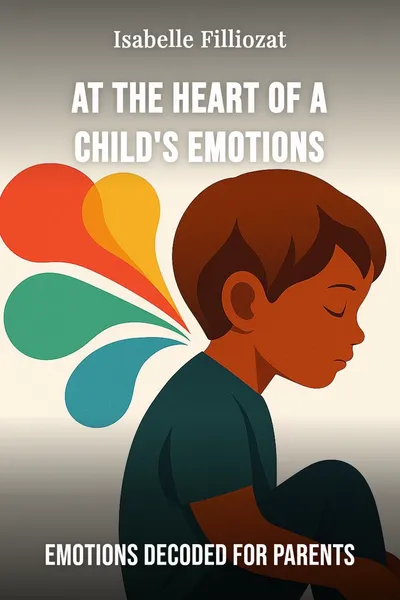
At the Heart of a Child's Emotions
Emotions decoded for parents
Description
A four-year-old drops a cookie on the kitchen floor and comes apart. Not a sniffle — a full collapse, red face, body on the tiles, grief that would seem out of scale if it belonged to anyone older. Most of us have stood over that scene, cookie in hand, baffled. We offer a replacement. The crying gets worse. We explain that it's just a cookie, that there are more in the cupboard, that this is really not a problem. None of it lands. The child isn't negotiating. The child is drowning, and our very reasonable arguments are arriving from a shore they can't reach.
This is the terrain Isabelle Filliozat walks through in At the Heart of a Child's Emotions. A psychotherapist who spent years with families, she noticed that most parenting advice treats feelings as noise to be quieted — behaviors to stop, moods to wait out. Her book flips the order. The crying, the rage, the fear that seems absurd: these aren't obstacles to good parenting. They're the thing itself. A child's emotional storms, she argues, follow a logic, and once we can read that logic, a great deal of the daily struggle softens.
What makes the book unusual is that it refuses to turn into a technique manual. Filliozat is less interested in making the crying stop than in understanding what the crying is for. And the hardest part of her argument, it turns out, isn't about the child at all.
The question we’re asking : Why do a child's emotional reactions seem so wildly out of proportion — and what are they actually asking of us?What we’ll see : How Filliozat reads the storms of childhood, and the order she insists we get right between a feeling and a rule.
Table of contents
01 Chapter 1 — The child who cries over a broken cookie
Filliozat starts with the mismatch we all notice: the intensity of a small child's reaction rarely matches the size of the event. A broken cookie, a sock seam in the wrong place, the wrong colour of cup — these set off grief or fury that looks, to an adult, completely disproportionate. Her first move is to argue that the proportion is wrong only from the outside. For the child, the cookie is not the point. The cookie is where a much larger wave happens to break.
A young brain, she explains, is not yet equipped to regulate what it feels. The regions that let an adult pause, name a feeling, and decide what to do with it are still years from maturity. So when emotion arrives, it arrives whole, with nothing between the child and the full force of it. What looks like an overreaction is simply a reaction without a brake. The child isn't choosing to escalate; the child genuinely has no mechanism yet for turning the volume down.

02 Chapter 2 — What a tantrum is actually doing
If the feeling is real, the next question is what the expression of it accomplishes. Here Filliozat makes a claim that unsettles the standard view: crying and raging are not malfunctions to be stopped. They are the body doing its work. Tears, trembling, shouting — these discharge the physical tension that a strong emotion loads into a small body. A child who is allowed to cry something out often emerges calm, loose, almost relieved, as if a weight has genuinely left them. Because it has.
This is why the instinct to shut the crying down can backfire. When we say stop crying, be a big boy, there's nothing to cry about, we're not teaching regulation. We're interrupting a process mid-way, leaving the tension stuck inside with nowhere to go. Filliozat suggests that the undischarged feeling doesn't vanish; it waits, and tends to leak out later as a new outburst over something equally small, or as sleep trouble, clinginess, aggression. The storm we blocked today becomes the mystery we puzzle over tomorrow.
03 Chapter 3 — The parent's own storm
Here the book turns, and turns toward us. Filliozat argues that the single greatest obstacle to accompanying a child through emotion is not the child's emotion. It's the parent's. A screaming toddler reliably triggers something in the adult standing over them — a surge of anger, helplessness, shame, the hot certainty that everyone in the supermarket is judging us. And we react from that place, not from the calm we'd prefer.
Why, she asks, does a child's crying get so deeply under our skin? Often because it touches an old wire. Many of us were raised to suppress exactly these feelings — told not to cry, sent away until we calmed down, met with irritation when we were sad. Those lessons left grooves. When our own child feels freely what we were forbidden to feel, something in us rebels, usually without our noticing. The anger we aim at the tantrum is partly aimed at a much younger version of ourselves.
04 Chapter 4 — Feeling first, fixing later
Step back from the cookie and the supermarket, and Filliozat's whole book resolves into a single reordering. We tend to lead with correction — stop that, it's fine, there's no reason to cry — and treat the feeling as something to get past so the lesson can begin. She reverses the sequence. The feeling comes first. Only once a child feels genuinely understood is there any room for a rule to land. Validation before correction isn't softness; it's the condition under which correction actually works.
This changes what we think raising a child even is. The dominant model is managerial: a parent shapes behavior from the outside, rewarding and discouraging until conduct falls into line. Filliozat's model is closer to accompaniment. A child is not a behavior to be managed but an inner life still learning to regulate itself, and the parent's job is to walk alongside that learning — to lend, for years, the calm the child can't yet produce alone. The behavior improves as a consequence of the inner life being tended, not as a substitute for it.
05 Conclusion
Return to the kitchen, the cookie in pieces, the child on the floor. Nothing Filliozat offers makes that scene disappear — children will still fall apart over small catastrophes, because at four that is simply how feeling works. What changes is the adult standing over it. Instead of a problem to be solved with a replacement cookie and a reasonable argument, there's a child briefly overwhelmed, and a parent who can read it as such. The crying still runs its course. But it runs it inside a relationship that treats the feeling as real.
Related books