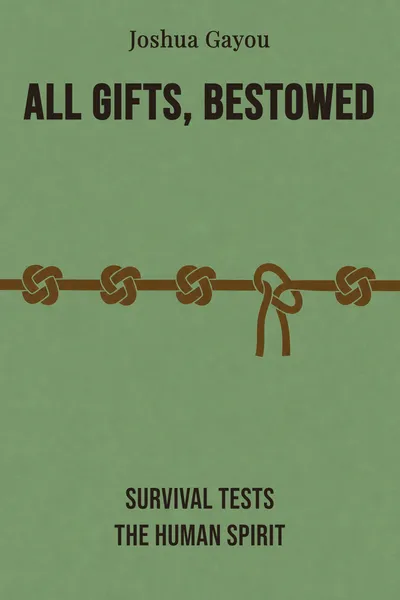
All Gifts, Bestowed
Survival tests the human spirit
Description
Somewhere in a depopulated American West, a handful of people are still counting rounds, rationing fuel, and taking turns on watch. The world they knew ended some time ago — the grid, the supply chains, the state, all gone — and what's left is a small group trying to make it through another season without losing anyone, or losing themselves. This is the ground Joshua Gayou builds on in All Gifts, Bestowed, the third book in his Commune series, a post-apocalyptic saga that has earned a following for refusing the easy thrills of the genre in favor of something slower, colder, and more human.
Gayou's collapse isn't populated by zombies or mutants. The threat is other people — desperate ones, organized ones, sometimes people who look a lot like the protagonists but made a different choice somewhere back down the road. The books read like a long meditation on what a group of ordinary survivors owes one another when the rules that used to hold everyone in place have evaporated. Fights break out, deals go bad, someone new shows up at the perimeter and everyone has to decide, fast, whether that's a gift or a threat.
That decision — who counts as one of us — is the engine of the whole thing. Gayou is less interested in how his characters find food than in what they become while finding it. All Gifts, Bestowed pushes that question harder than the earlier volumes, testing a fragile community against scarcity, arrivals, and the slow erosion that comes from being afraid for too long. It's survival fiction, but the survival at stake is moral as much as physical.
The question we’re asking : When the world falls apart, what actually keeps a group of people human — and what does Gayou's story suggest is the first thing to go?What we’ll see : How a grounded post-apocalyptic saga turns the mechanics of survival into a long argument about trust, loyalty, and the cost of staying decent.
Table of contents
01Chapter 1 — A world stripped down to who you trust
Gayou's saga begins from a premise the genre has worn thin — civilization collapses, a few people live — but he treats it with a patience most apocalypse stories skip. There are no easy villains and no plucky montage where the survivors master their new life. The Commune books, of which All Gifts, Bestowed is the third, unfold across a landscape emptied of institutions, where the characters spend as much time arguing about decisions as executing them. The tension isn't whether the world ended. It's what people do in the long, grinding aftermath, once the initial shock has passed and the real problem becomes the next winter.
What sets the series apart is how literal it is about consequences. Ammunition runs out. Vehicles need fuel that no one is refining anymore. A wound that would have been routine before is now a slow negotiation with death. Gayou writes these constraints with a technician's attention, and the effect is to make every choice feel weighted. When a character decides to spend a resource or take a risk, we understand exactly what it costs, because we've watched the group count what it has. Scarcity isn't a backdrop here; it's the thing that shapes every conversation.

02Chapter 2 — The stranger who walks into camp
The recurring hinge of Gayou's storytelling is the arrival. Someone new appears at the edge of the group's world — lost, wounded, hungry, or simply passing through — and the community has to decide what to do with them. It's an old device in survival fiction, but Gayou refuses to let it resolve cleanly. A stranger might be exactly who they claim to be. They might be scouting for a larger, more dangerous group. They might be honest today and desperate tomorrow. The narrative sits inside that uncertainty rather than resolving it quickly, and the discomfort is the point.
These moments are where the series does its sharpest thinking. Taking someone in is an act of generosity that could get everyone killed. Turning them away is an act of self-preservation that costs the group a piece of its own humanity. Gayou stages the debate honestly, giving weight to both sides, so that the reader feels the pull of caution and the pull of decency at the same time. There's no character positioned as obviously right. The book trusts us to sit in the difficulty, which is rarer in the genre than it should be.
03Chapter 3 — Loyalty is the only currency left
Strip away money, law, and the safety net of a functioning society, and what's left to hold people together is loyalty — the willingness to put the group's survival ahead of your own, and to trust that others will do the same for you. Gayou builds his community on exactly this, and All Gifts, Bestowed spends much of its energy testing how far that loyalty stretches before it snaps. The bonds among the survivors are the reason they're still alive, but they're also the pressure points an enemy can exploit and the source of the group's deepest conflicts.
The saga is honest about how loyalty frays. Fear does it slowly, wearing people down until self-preservation starts to override the ties that bind them. Scarcity does it faster, forcing choices about who eats, who gets protected, who gets left behind. Gayou doesn't let his characters off the hook. People behave badly under strain, betray one another in small ways, rationalize decisions they'd have been ashamed of before the collapse. And yet the books aren't cynical. The same pressure that corrodes loyalty also forges it, and the moments where someone chooses the group at real cost to themselves land with genuine force precisely because we've seen how easy it would be to choose otherwise.
04Chapter 4 — When the fittest aren't the strongest
Step back from the plot and Gayou's series makes an argument about what survival actually requires — one that cuts against the genre's usual instincts. The apocalypse, in most fiction, is a proving ground for the tough: the best-armed, the most ruthless, the willing to do what others won't. Gayou's books quietly dispute this. His most durable survivors aren't the deadliest fighters. They're the ones who can hold a group together, who can be trusted, who understand that a person alone in a collapsed world is a person already most of the way dead.
This is the real subject beneath the ammunition counts and the perimeter watches: that human survival has always been a collective enterprise, and that the thing being tested in a catastrophe isn't individual strength but the capacity to cooperate under conditions designed to make cooperation impossible. Gayou dramatizes what social scientists and historians of disaster have long observed — that when systems fail, the groups that endure are the ones that manage trust well, not the ones that hoard the most guns. The gritty realism isn't just texture. It's the vehicle for that claim.
05Conclusion
By the close of All Gifts, Bestowed, the small community Gayou has been building across the series stands where it began — counting rounds, taking turns on watch, deciding again and again who to let in and who to trust. Nothing about their situation is resolved, because the collapse Gayou imagines doesn't resolve; it continues, demanding the same choices on a loop. What has deepened is the reader's sense of what those choices cost, and of how much of the group's survival depends on bonds that could give way at any moment. The gifts of the title turn out to be double-edged: everything offered creates an obligation, and every obligation is a risk.
Related books