
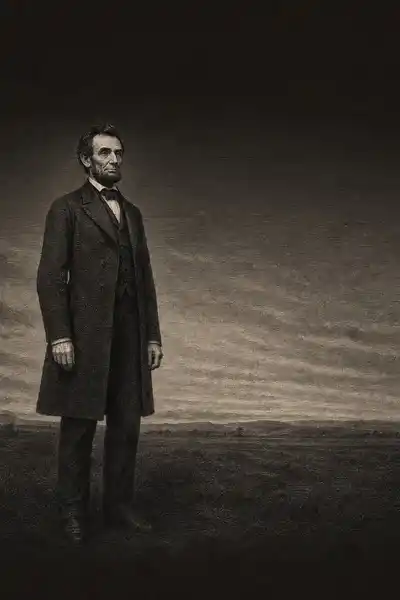
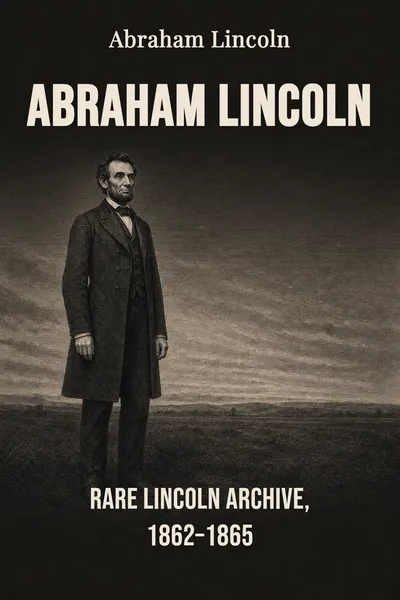
Abraham Lincoln
Rare Lincoln archive, 1862–1865
Description
On March 27, 1924, someone inscribed a presentation plate into a set of maroon-bound books and gave them to the Garfield School Library. The books were volumes eight through twelve of the Gettysburg Edition de Luxe of Lincoln's complete works — set number 274 of a run of exactly 700 numbered and registered sets, copyrighted in 1905 by the publisher Francis D. Tandy and signed by him. Gilded top edges, gold lettering on the spine. Five volumes covering the years 1862 to 1865: the war at its worst, and the presidency at its most consequential.
What survives in these five books is not a biography of Lincoln. It is Lincoln himself, or as close as an editor could get — the letters, the telegrams fired off from the War Department cable office, the notes scrawled in the margins of other men's requests, the orders, the messages to Congress, the proclamations. Woven through them are steel and wood engravings, a rare photograph of Lincoln at Antietam in October 1862, and facsimiles reproduced from the originals: his letter to Postmaster-General Blair, his reply to a Methodist delegation, the celebrated Bixby letter. The final volume drops the chronology and turns him into an anthology of sayings.
An edition like this makes a quiet claim. It says: here is the man, complete, in his own words, arranged so you can follow the years as they happened. But every arrangement is a choice, and the choosing was done by others — editors, publishers, an editor named John G. Nicolay who had been Lincoln's own secretary and knew which letter showed him at his best. What we hold, when we hold set 274, is the war filtered through the hands that decided which pieces of it deserved to last.
The question we’re asking : What does a five-volume run of a man's wartime papers actually preserve — and what did the arranging leave out?What we’ll see : How the working documents of a presidency became a numbered relic, and what the editing did to the voice inside.
Table of contents
01Chapter 1 — Five volumes of a set of seven hundred
The object comes first, because the object tells you what kind of reading was intended. The Gettysburg Edition de Luxe was a limited printing — 700 sets, each numbered and registered, each signed by Francis D. Tandy, who held the 1905 copyright. Set 274 is not a book you were meant to skim. Maroon boards, a gilded top edge that catches light when the volume is shelved, gold lettering running down the spine. This is furniture as much as text, an edition built to be owned, displayed, and handed down.
And handed down it was. Each of the five surviving volumes carries a presentation plate to the Garfield School Library, dated March 27, 1924 — nineteen years after publication, roughly six decades after the events the books describe. Someone decided that a public school should have Lincoln in this form: not a single readable Life, but the primary record, volume by volume, the raw material of the presidency laid out for students who would mostly never open volume nine.

02Chapter 2 — The war years, in his own hand
Open volume eight, covering 1862 into 1863, and the war is already at full pitch. Seven photographs from steel and wood engravings sit among the documents, and one photograph stands apart: Lincoln at Antietam, taken during his October 1862 visit to the army after the bloodiest single day in American history. The volume also carries a copy of the third version of the Gettysburg Address — the address exists in several manuscript versions, and which one an edition prints is itself an editorial decision. Around these anchors: letters, telegrams, notes, and memorandums, the ordinary traffic of running a war by wire.
Volume nine, 1863 into 1864, is where the collected-works form shows its texture. It includes Lincoln's opinion on the draft — the conscription that produced riots in New York and forced the president to argue, in writing, why the government could compel men to serve. It carries seven more images from engravings and photographs. And it holds a facsimile of a letter to Postmaster-General Montgomery Blair, chosen by John G. Nicolay — Lincoln's private secretary through the war — as representing Lincoln at his best. That a former secretary was still, decades later, curating which letter showed the man most fully tells you how much shaping went into the raw record.
03Chapter 3 — The words that got selected out
Volume eleven is 1865 — the last year, and the volume where the editing hand is most visible, because it is where the most famous single object lives. It carries a facsimile of the celebrated Bixby letter, the short condolence note to a Boston widow said to have lost five sons in the war. The letter is one of the most quoted things Lincoln ever wrote, and it is also genuinely uncertain: the original manuscript has never been found, some scholars have long argued that Nicolay's colleague John Hay may have drafted it, and the facts about the Bixby sons themselves turned out to be partly wrong. An edition that reproduces it as a facsimile is reproducing an object whose very status is contested — and mostly not saying so.
The rest of volume eleven is government at the end: telegrams, letters, messages to the Senate, messages to Congress. It includes a section on the proclamation offering pardon to deserters who returned and served out the terms of their enlistment — a small, practical mercy aimed at refilling the ranks, the kind of document that never makes the anthologies but shows the president as manager. And it closes with the Lincoln bibliography compiled by Daniel Fish, an early and serious attempt to catalog everything written by and about the man, folded into the collected works as if to say: this is not the last word, here is the map of all the other words.
04Chapter 4 — A voice edited into an oracle
Step back from set 274 and what you are looking at is a machine for turning a man into a national possession. Every physical decision points the same way. The run is limited to 700 numbered sets — scarcity, the language of relics. Each volume is signed by the publisher, gilded, bound in maroon, made to be displayed rather than consumed. The facsimiles reproduce Lincoln's actual handwriting, so that even in mechanical reproduction you get the aura of the original. This is not how you package information. It is how you package a saint's relics.
The presentation plate to the Garfield School Library, dated 1924, completes the gesture. By the 1920s Lincoln was no longer a contested wartime politician who had suspended habeas corpus and been hated by half the country he governed. He was civic scripture, and putting his collected works in a school was an act of instruction in what an American should revere. The edition does not merely preserve Lincoln; it teaches a way of holding him — as settled, monumental, above argument.
05Conclusion
The five volumes still carry their 1924 plate, still open to the telegrams and the pardon proclamations and the facsimile of a condolence letter nobody can quite prove he wrote. They cover the years he did his hardest work and ran out of time — 1862 to 1865, Antietam to the second inaugural to the silence after April. What they hold is genuine: the daily paper of a presidency conducted by wire, arranged so the documents can speak for themselves.