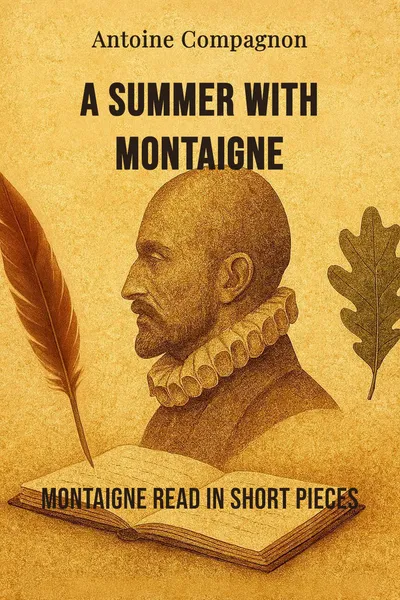
A Summer with Montaigne
Montaigne read in short pieces
Description
In the summer of 2012, French radio station France Inter handed a literature professor named Antoine Compagnon a strange assignment: fill a few morning minutes, every weekday, with Montaigne. Not a lecture on Montaigne, not a syllabus — just short daily pieces, each built around a sentence or two lifted from the Essais, the sprawling book Michel de Montaigne kept adding to from 1572 until his death in 1592. The segments ran a handful of minutes each. They became a small publishing phenomenon, and then a book: A Summer with Montaigne, forty tiny chapters that treat one of the densest works in the Western canon as something you could carry to the beach.
The gamble is almost provocative. The Essais run to more than a thousand pages in most editions, digressive and layered, written and rewritten in three overlapping strata that scholars still track with letters. Generations of readers have opened the book, admired a few famous lines, and quietly closed it again. Compagnon's wager is that Montaigne, of all the great intimidating authors, is the one who actually rewards being read in fragments — because that is roughly how he wrote, and roughly how he wanted to be read.
There is something almost mischievous in using the shortest possible form to smuggle a reader into the longest possible book. And there is a real question underneath it: whether the essayist who invented a genre by refusing to conclude might be, four centuries later, the most companionable writer we have.
The question we’re asking : Can the least summarizable book in the canon be opened, without betraying it, through a handful of very short readings?What we’ll see : How a professor turned radio fragments into a door onto Montaigne — and why the man who never finished a thought still feels like our contemporary.
Table of contents
01Chapter 1 — Forty radio minutes for a thousand pages
Compagnon's method is deceptively light. Each chapter takes a short passage — sometimes a single sentence — and turns it over the way you might handle a stone picked up on a walk. He gives just enough context to place it, a little biography, a little sixteenth-century history, and then lets the sentence do its work. No thesis is imposed, no grand architecture is claimed. It reads like a well-read friend reading over your shoulder and saying, look at this one, isn't it strange that he wrote that.
This turns out to fit Montaigne exactly. The Essais were never a treatise with a plan. Montaigne started around 1572, after retiring to the tower of his estate near Bordeaux, and simply kept writing — adding sentences, whole paragraphs, and cross-references in the margins of his own printed editions for the next twenty years. Scholars label the three layers A, B and C, because a single page can hold thoughts written a decade apart, sometimes contradicting each other. The book grew the way a garden grows, not the way a building goes up.

02Chapter 2 — A self worth writing down
At the front of the Essais, Montaigne warns the reader with a kind of shrug: this book has no aim but a private, domestic one, and its subject is himself. He tells you not to waste your time. It is one of the oddest openings in literature, and Compagnon lingers on it, because the modesty is doing something radical underneath. Before Montaigne, the self was hardly considered a fit subject for serious prose. You wrote about God, about virtue, about the deeds of great men. You did not write about the fact that you preferred white wine, disliked doctors, and forgot names.
Montaigne wrote about all of that, and insisted it mattered. Not because he thought himself important, but because he thought himself ordinary — and reasoned that a faithful portrait of one ordinary man would show something true about the human condition generally. Each man, he wrote, bears the entire form of the human estate. It is a startling democratic intuition dressed as autobiography: study yourself honestly enough and you study everyone.
03Chapter 3 — The body has its reasons
Compagnon keeps returning to a Montaigne that surprises first-time readers: the one obsessed with the body. This is not a philosopher who floats above the flesh. He writes about his digestion, his kidney stones, his sleep, his sexual habits, the way his memory fails him. He notes that we are neither pure spirit nor pure animal but an awkward composite, and that any wisdom which ignores the body is lying. When he confronts death, it is not as an abstraction but as the concrete decay he watches in himself and in the people around him.
This bodily frankness serves a philosophy. Montaigne is suspicious of grand systems precisely because he trusts what he can feel more than what he can prove. His famous line — that even seated on the highest throne in the world, we are still sitting on our own backside — is a joke, but a serious one. It punctures every pretension. No title, no learning, no power exempts a person from the plain facts of being a creature who eats, tires and dies.
04Chapter 4 — Doubt as a way of staying alive
Step back from the forty fragments and one word gathers them: doubt. Montaigne's motto, engraved in his tower, was a question — Que sais-je? What do I know? He meant it. He distrusted certainty the way other people distrust danger, because he had watched certainty, in the religious wars around him, turn ordinary men into killers. His famous essay on the cannibals of Brazil turns the mirror on Europe: the so-called savages, he suggests, are less barbaric than the Christians torturing each other at home. The doubt is not a party trick. It is a discipline for not becoming a monster.
This is where Compagnon's little book quietly makes its case for Montaigne's modernity. Montaigne's skepticism is not the nihilism it is sometimes mistaken for. He does not conclude that nothing is true and therefore nothing matters. He concludes that we should hold our beliefs more loosely, test them against experience, stay ready to change our minds. His is a supple, provisional relationship to truth — a willingness to live inside uncertainty rather than paper over it with a system. In an age drowning in confident opinions, that posture feels less like an antique and more like a rare skill.
05Conclusion
The radio project that became A Summer with Montaigne ran on the simplest premise imaginable: a few minutes, one passage, no conclusion demanded. Compagnon never tries to hand us the whole thousand pages. He hands us doors, forty of them, and trusts that a reader who steps through one will want to find the rest. The bet pays off because it matches the book's own grain — a work assembled from attempts, revised for twenty years, and content never to finish.
Related books