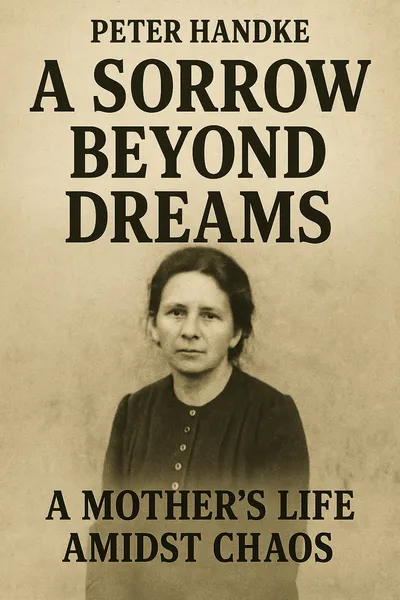
A Sorrow Beyond Dreams
A mother's life amidst chaos
Description
Peter Handke's 'A Sorrow Beyond Dreams' emerges from the intersection of personal trauma and historical testimony, positioned within the broader context of postwar German-language literature grappling with questions of complicity, memory, and individual agency. Written following his mother's suicide, this work transcends mere memoir to become a sociological meditation on the systemic forces that shape and ultimately destroy individual lives. Handke's expertise in psychological realism and linguistic experimentation converges here with historical analysis, producing a text that functions simultaneously as intimate portrait and social critique of twentieth-century Austrian society.
The central research question driving the work asks: How do historical circumstances and social structures determine individual fate, particularly for women constrained by patriarchal expectations and economic dependency? The thesis defended throughout is that personal tragedy cannot be separated from historical context; the mother's death represents the logical conclusion of systemic oppression masked as individual failure. The main stake is to demonstrate that biographical narrative must account for the broader social forces that render certain lives expendable while appearing to celebrate individual choice.
Handke's achievement lies in demonstrating how biographical narrative can function as social criticism without sacrificing analytical rigor or emotional authenticity. The work reveals personal tragedy as historically specific rather than universal, showing how individual suffering reflects broader patterns of structural violence that remain largely invisible within dominant cultural frameworks. By refusing to separate psychological analysis from social critique, Handke produces a form of writing that challenges both therapeutic individualism and abstract sociology. The mother's death becomes legible not as personal failure but as logical outcome of social relations that systematically foreclose possibilities for authentic human development while maintaining ideological commitment to individual responsibility and choice.
Table of contents
01Historical Determinism and Individual Agency
Handke constructs his analysis through a dialectical examination of structure versus agency, revealing how historical circumstances functionally eliminate meaningful choice for his subject. The mother's life trajectory—from rural poverty through Nazi-era socialization to postwar disillusionment—illustrates the manner in which macro-historical forces penetrate intimate experience. Rather than presenting a simple deterministic argument, Handke demonstrates how ideological formations create the illusion of personal responsibility while systematically constraining available options.

02Gender and Systemic Oppression
The text's most powerful analytical dimension emerges through its examination of gendered experience within patriarchal structures that promise fulfillment through subordination. Handke reveals how his mother's socialization prepared her for roles—wife, mother, domestic laborer—that systematically denied autonomous development while presenting these limitations as natural feminine destiny. The postwar period's supposed liberation reveals itself as merely a reconfiguration of constraint, offering consumer culture and domestic modernization as substitutes for genuine self-determination.
03Language, Memory, and Social Reproduction
Handke's investigation extends to examine how dominant cultural forms—religious doctrine, popular media, social expectations—provide vocabularies that obscure rather than illuminate lived experience. The mother's inability to articulate her condition reflects broader patterns of symbolic violence that render certain forms of suffering literally unspeakable within available discourses. This creates a double bind wherein personal distress cannot be legitimately expressed because the cultural frameworks for understanding individual experience systematically exclude structural critique.
04Ethical Implications and Social Responsibility
The work's final analytical dimension addresses questions of collective responsibility for individual tragedy, challenging liberal assumptions about personal autonomy and social obligation. Handke refuses both sentimentalization and abstract sociological analysis, instead insisting on the specific historical content that rendered his mother's life ultimately unlivable. This approach raises uncomfortable questions about complicity—not only direct participation in oppressive systems but the broader social indifference that allows systematic suffering to appear as private misfortune.
05Critical Assessment and Contemporary Relevance
Despite its analytical sophistication, the work remains limited by its focus on a single case study, potentially overgeneralizing from specific Austrian circumstances to broader patterns of gender oppression. Handke's emphasis on structural determination may underestimate forms of resistance and agency that remain available even within constrained circumstances. Additionally, the text's implicit theoretical framework requires more explicit engagement with feminist and materialist analysis to fully develop its critical insights.
Related books